
JAK Inhibitors: What You Need to Know About These New Oral Immune Drugs and Their Monitoring Requirements
 Feb, 10 2026
When you hear about treatments for autoimmune diseases like rheumatoid arthritis, psoriasis, or alopecia areata, you might think of injections, infusions, or bulky biologics. But in recent years, a new kind of pill has quietly changed the game: JAK inhibitors. These aren’t your typical pills. They work inside your cells to calm down an overactive immune system - and they’re taken orally, every day, like a vitamin. For many patients, that’s a game-changer. But they come with serious risks, and not everyone can take them. If you’re considering one - or already are - here’s what you really need to know.
How JAK Inhibitors Actually Work
JAK inhibitors, sometimes called jakinibs, block specific enzymes inside your immune cells called Janus kinases (JAKs). These enzymes are like switches that turn on inflammation. When your immune system goes haywire - as it does in autoimmune diseases - these switches get stuck in the "on" position. JAKs help pass signals from cytokines (inflammatory messengers) into the cell, telling it to attack. JAK inhibitors sit in the enzyme’s active site, blocking that signal before it starts.
There are four types of JAK enzymes: JAK1, JAK2, JAK3, and TYK2. Different drugs target them differently. For example, upadacitinib (Rinvoq) is highly selective for JAK1, which helps control inflammation without messing up as many other functions. Abrocitinib (Cibinqo) targets JAK1 and JAK2, making it strong against skin conditions like atopic dermatitis. Ritlecitinib (Litfulo) works differently - it binds permanently to JAK3, shutting it down for good. This kind of precision matters. The more selective the drug, the fewer side effects you’re likely to get.
Before JAK inhibitors, patients with severe autoimmune conditions often had to try multiple biologics - expensive injections that block just one cytokine at a time. Now, a single pill can block multiple pathways. That’s why doctors call them "broad-spectrum" immunomodulators. They don’t just calm one part of the immune system; they dampen several at once.
Why They’re a Big Deal - and Who Benefits Most
For many patients, the biggest win is convenience. No more weekly injections. No more clinic visits for infusions. Just a daily pill. A 2023 survey of over 1,200 patients on MyRheumatism found that 92% preferred oral JAK inhibitors over injectable biologics. And speed? That’s another advantage. While biologics can take 8 to 12 weeks to show results, many patients notice improvement in just 2 to 4 weeks. One patient on Reddit described abrocitinib clearing her eczema in 10 days. That’s not uncommon.
They’re also helping people who didn’t respond to anything else. In clinical trials, upadacitinib showed a 71% response rate (ACR20) in rheumatoid arthritis patients after 12 weeks - more than double the placebo rate. For patients with alopecia areata, deuruxolitinib (approved in June 2024) helped over 40% regain significant hair growth within six months. These aren’t minor improvements. They’re life-changing.
But here’s the catch: they’re not for everyone. The FDA added black box warnings in January 2022 - the strongest possible warning - for serious infections, cancer, heart attacks, strokes, and blood clots. These aren’t rare. In the ORAL Surveillance study, patients on tofacitinib had a 31% higher risk of major heart events and a 49% higher risk of cancer compared to those on TNF inhibitors. The risk jumps even higher in people over 50 with a history of smoking, heart disease, or prior cancer.
The Monitoring Checklist: What Your Doctor Needs to Track
If you’re prescribed a JAK inhibitor, your care doesn’t end at the prescription. Monitoring isn’t optional - it’s essential. The American College of Rheumatology (ACR) and European guidelines agree: you need regular blood tests, and you need them often.
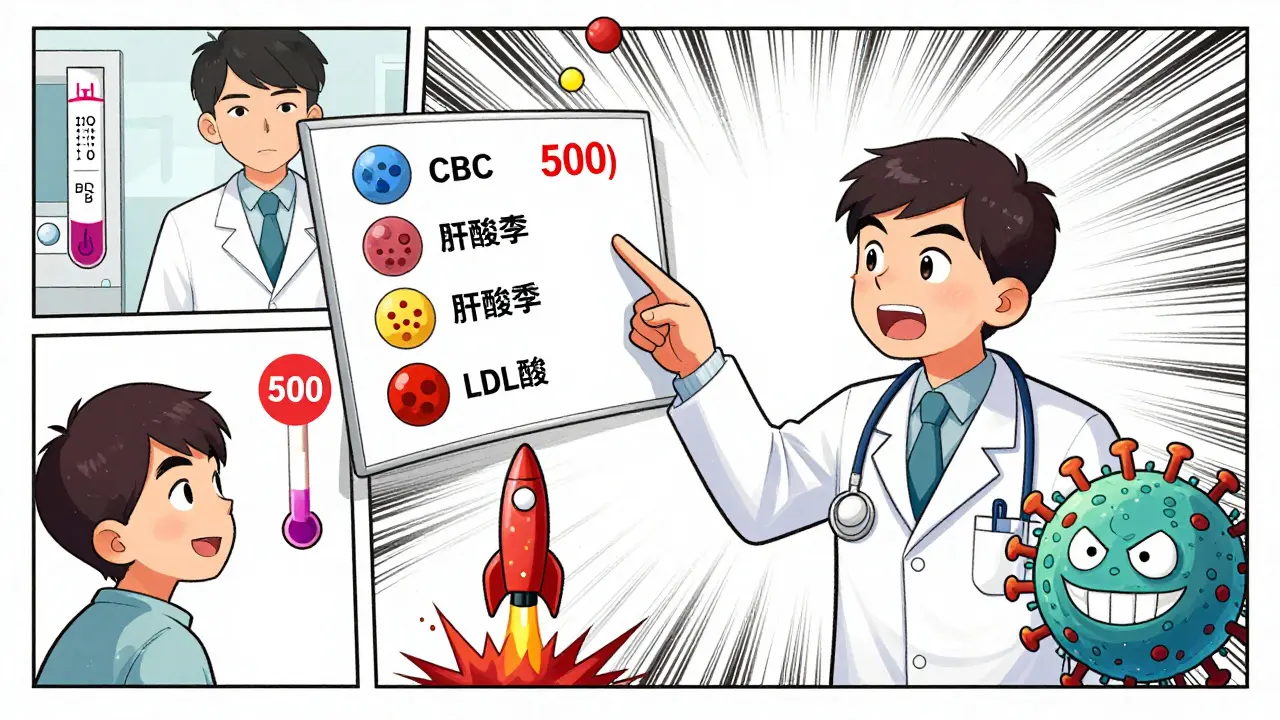
- Before starting: Complete blood count (CBC), liver enzymes (ALT, AST), lipid panel (cholesterol), tuberculosis screening, and hepatitis B/C testing. You should also be up to date on vaccines - especially shingles (varicella-zoster). The European Medicines Agency recommends getting vaccinated at least 4 weeks before starting treatment.
- First year: Blood tests every 3 months. This includes checking your lymphocyte count (if it drops below 500 cells/μL, you may need to stop), hemoglobin (if it falls below 8 g/dL), liver enzymes (if they rise above 3x the normal limit), and LDL cholesterol (if it hits 190 mg/dL or higher, you’ll likely need a statin).
- After the first year: Every 6 months, unless something changes.
One of the most common issues? High cholesterol. In a Reddit community of JAK inhibitor users, 41% reported LDL levels jumping by an average of 28 mg/dL. That’s enough to push many into high-risk territory. It’s not just about numbers - it’s about long-term heart health. Some patients end up on statins, which adds another layer to their medication routine.
Shingles is another big concern. Studies show 23% of patients on JAK inhibitors get herpes zoster - compared to just 3% on biologics. That’s why many doctors now prescribe antiviral prophylaxis (like valacyclovir) for patients with a history of shingles or who are over 50. One patient on HealthUnlocked wrote: "I got shingles twice. Now I take an antiviral every day. It’s annoying, but worth it."
Who Should Avoid JAK Inhibitors?
Not everyone is a candidate. The 2024 ACR/EULAR guidelines are clear: avoid JAK inhibitors if you have:
- A history of heart attack, stroke, or blood clots
- Active or past cancer (especially lymphoma or lung cancer)
- Chronic lung disease or smoking history
- Age over 65 with cardiovascular risk factors
- Low white blood cell or platelet counts
Even if you’re young and healthy, your doctor will likely weigh your options carefully. In Europe, only 18% of rheumatologists prescribe JAK inhibitors as first-line after methotrexate - compared to 32% in the U.S. Why? Because European regulators are stricter about safety. In the U.S., the pressure to find fast-acting treatments is higher, especially for patients who’ve tried multiple biologics without success.
What’s Coming Next?
The field is evolving fast. Newer JAK inhibitors are being designed to be more selective. Brepocitinib, a TYK2 inhibitor currently in phase 3 trials, targets a more specific part of the immune pathway. Early results suggest it may have fewer side effects - especially around cholesterol and infection risk. Ritlecitinib’s covalent binding mechanism (permanent attachment to JAK3) is also being studied for other conditions like vitiligo and hidradenitis suppurativa.
Meanwhile, off-label use is growing. A 2023 survey found that 43% of dermatologists now use JAK inhibitors for vitiligo, and 18% for hidradenitis suppurativa. These aren’t approved uses yet - but real-world data is mounting.
But the shadow of long-term risk looms. The 2024 follow-up to the ORAL Surveillance study showed that the increased cancer risk with tofacitinib persisted even after 8.5 years. That’s not going away. Experts are now asking: are we trading short-term convenience for long-term danger?

Real Talk: The Patient Experience
There are two sides to every story. On one hand, patients like the one on HealthUnlocked who said, "Baricitinib reduced my swollen joint count from 18 to 2 in 6 weeks - life-changing," are thriving. For them, these pills mean walking without pain, sleeping through the night, and not missing work.
On the other hand, patients like u/RhuemWarrior on Reddit are living with the trade-offs: "Abrocitinib cleared my eczema in 10 days but gave me shingles twice - now I’m on prophylactic antivirals but worried about future risks."
The truth? JAK inhibitors are powerful. They’re not magic bullets. They’re tools - tools that come with serious responsibilities. For the right patient, they can restore quality of life. For others, the risks outweigh the benefits. The decision isn’t just medical - it’s personal. And it needs careful thought, clear communication, and ongoing monitoring.
Are JAK inhibitors better than biologics?
It depends. JAK inhibitors work faster and are taken as pills - a big plus for patients who hate injections. But biologics have a longer safety track record. JAK inhibitors carry higher risks for heart problems, cancer, and blood clots, especially in older patients or those with risk factors. For patients who’ve tried multiple biologics without success, JAK inhibitors often work. But for someone new to treatment, biologics are still often the safer first choice.
Can I drink alcohol while taking a JAK inhibitor?
Moderate alcohol is usually okay, but heavy drinking increases liver damage risk. JAK inhibitors can raise liver enzymes, and alcohol does too. If your liver tests are normal and you drink occasionally (1 drink per day), it’s generally safe. But if you drink heavily or have existing liver disease, talk to your doctor. Some may advise complete avoidance.
Do JAK inhibitors cause weight gain?
Weight gain isn’t a direct side effect listed in clinical trials. But some patients report it. Why? Possibly because inflammation causes weight loss in autoimmune diseases - when inflammation drops, appetite and metabolism normalize. Also, improved energy and mobility may lead to more eating or less activity. It’s not the drug itself, but the body’s response to feeling better.
What happens if I stop taking a JAK inhibitor?
Symptoms often return within weeks. Unlike biologics, which may have a lingering effect, JAK inhibitors clear from your system quickly. Stopping suddenly doesn’t cause withdrawal, but your autoimmune condition can flare back - sometimes worse than before. If you need to stop, your doctor will likely guide you toward a replacement therapy to avoid a rebound flare.
Are JAK inhibitors covered by insurance?
Yes - but it’s complicated. Most insurance plans cover them, but they often require prior authorization. Many are classified as specialty drugs, meaning you’ll need to get them through a specialty pharmacy. Co-pays can range from $10 to $150 depending on your plan. Some manufacturers offer patient assistance programs that reduce costs significantly - especially if you’re underinsured.
Final Thoughts: A Powerful Tool, Not a Quick Fix
JAK inhibitors are one of the biggest advances in autoimmune treatment in decades. They’re convenient, fast-acting, and effective for conditions that once had few options. But they’re not without danger. The black box warnings exist for a reason. The monitoring isn’t bureaucratic - it’s life-saving. If you’re considering one, ask your doctor: "What’s my risk? What are we watching for? What’s the plan if something goes wrong?" Don’t just accept the prescription. Understand the trade-offs. Your future self will thank you.
Ernie Simsek
February 10, 2026 AT 18:38Joanne Tan
February 11, 2026 AT 16:11Gloria Ricky
February 13, 2026 AT 06:54Sonja Stoces
February 13, 2026 AT 11:22Reggie McIntyre
February 13, 2026 AT 17:50Jason Pascoe
February 15, 2026 AT 01:47Annie Joyce
February 15, 2026 AT 18:12Neha Motiwala
February 16, 2026 AT 20:34Jack Havard
February 17, 2026 AT 12:31Rob Turner
February 19, 2026 AT 03:48Jim Johnson
February 20, 2026 AT 16:57Stacie Willhite
February 22, 2026 AT 12:01athmaja biju
February 24, 2026 AT 02:05Vamsi Krishna
February 24, 2026 AT 21:52