
Melanoma: Early Detection and Immunotherapy Treatment
 Jan, 17 2026
When it comes to skin cancer, melanoma is the one you can’t afford to ignore. It’s not the most common type, but it’s the most dangerous. A single untreated mole can spread to lymph nodes and organs within months. Yet, if caught early, the chance of surviving five years or more is over 99%. That’s the gap between panic and peace of mind-and it all comes down to detection and treatment.
How Melanoma Starts and Why Timing Matters
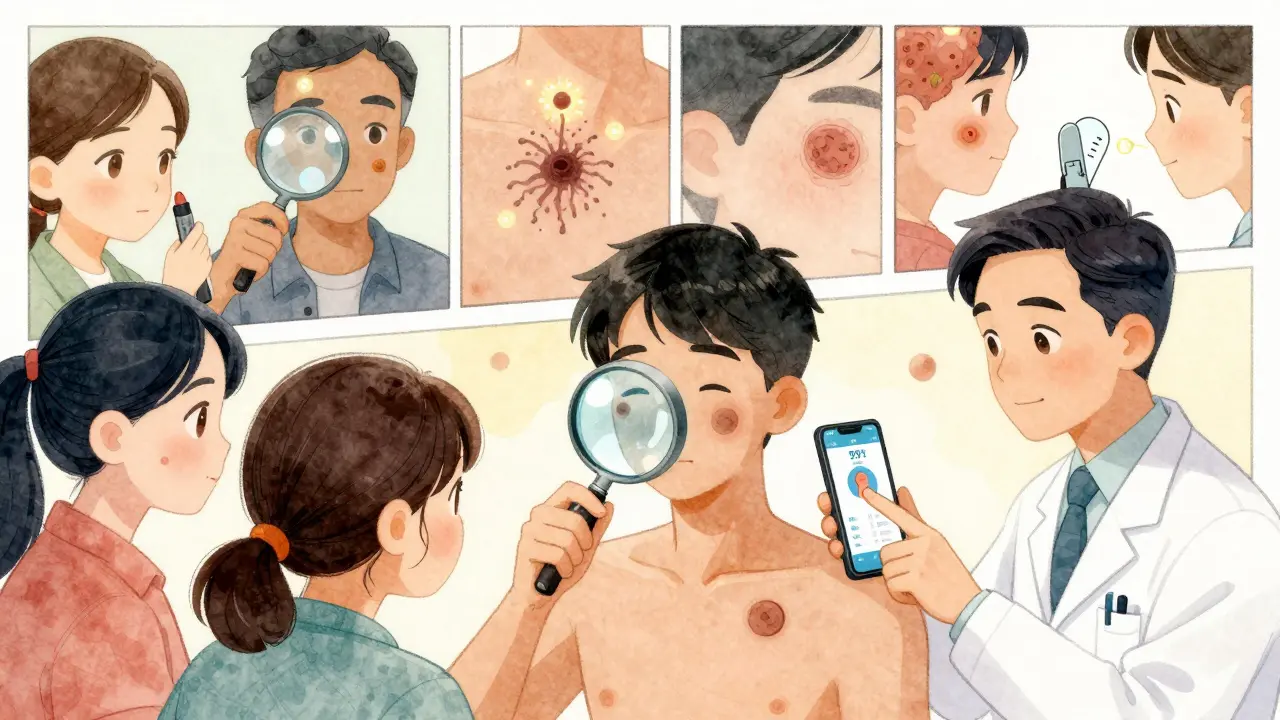
Melanoma begins in melanocytes, the cells that give your skin its color. These cells can turn cancerous after too much UV exposure, genetic risk, or a mix of both. Unlike basal or squamous cell cancers, melanoma doesn’t stay put. It moves fast. Once it spreads beyond the skin, survival rates drop sharply-from 99% for localized cases to just 32% when it reaches distant organs, according to the American Cancer Society’s 2025 data.That’s why the first sign isn’t always a big, ugly mole. Sometimes it’s a spot that changes slowly: growing wider, darkening unevenly, or bleeding without being scratched. The ABCDE rule still holds up-Asymmetry, Border irregularity, Color variation, Diameter larger than 6mm, Evolving over time. But many melanomas don’t fit the classic mold. Some are flat, some are red, and some look like scars. That’s why visual checks alone aren’t enough anymore.
What Early Detection Looks Like Today
For decades, the only tool doctors had was the naked eye and a dermatoscope-a handheld magnifier with polarized light. Primary care providers caught about 60-70% of melanomas this way. That’s better than nothing, but it leaves nearly 4 out of 10 cases missed.Now, new tools are changing the game. One of the most promising is AI-powered image analysis. Systems like Northeastern University’s SegFusion use two models working together: one cuts out the suspicious spot from the photo, and the other decides if it’s cancer. It hits 99% accuracy on test images and correctly identifies 95% of melanomas. That’s higher than most human dermatologists in routine practice.
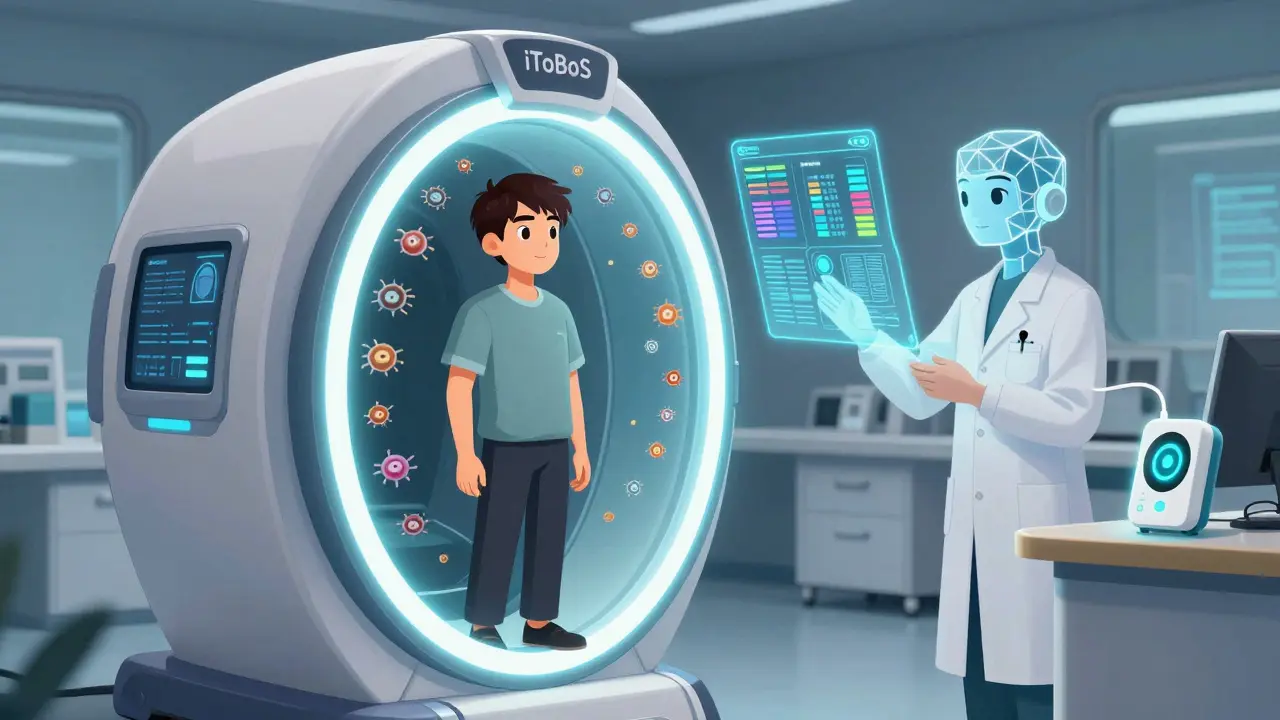
Then there’s the iToBoS full-body scanner, used in clinics across Europe. It takes six minutes to scan your whole body, spots every mole, and flags the risky ones with an AI that explains its reasoning. Doctors don’t just get a yes/no answer-they see why the system flagged a spot, which builds trust. In pilot tests, dermatologists rated it 78% effective, even though it flagged 35% of moles as false positives. That’s still better than missing a real one.
At the same time, small devices like DermaSensor are making their way into family doctors’ offices. Approved by the FDA in early 2024, it shines near-infrared light on a mole and measures how the light bounces back. Cancerous tissue scatters light differently. The device gives a score, and with just a few hours of training, primary care staff can use it reliably. Sensitivity is high-85-95%-but specificity is low, around 26-40%. That means it often says “maybe” when it’s not cancer. That leads to more biopsies, more anxiety, and more cost.
And then there’s the wearable patch from Wake Forest University. It’s battery-free, sticks to your skin like a Band-Aid, and measures electrical differences between healthy and cancerous tissue. In a small trial with 10 people, it showed clear differences in lesions. It’s not ready for mass use yet, but the idea is powerful: imagine checking your moles at home, every week, without ever stepping into a clinic.
Where These Tools Fall Short
No technology is perfect. Even the best AI struggles with real-world conditions. A mole photographed under bright sunlight looks different than one taken in a dim exam room. Darker skin tones are still underrepresented in training data. A 2025 JAMA Dermatology study found AI tools perform 12-15% worse on Black and Brown skin. That’s not just a technical flaw-it’s a health equity issue.Another problem? Overdiagnosis. Just because you detect something early doesn’t mean it would’ve killed you. Some melanomas grow so slowly they’d never become dangerous. But once you see it, you remove it. And that means thousands of people every year get surgery for lesions that didn’t need it. A 2025 paper in Taylor & Francis warned this could lead to more harm than good if we’re not careful.
Integration is another hurdle. A dermatology clinic might have an AI tool, but if it doesn’t plug into their electronic health records, staff spend extra time typing results by hand. Training takes time too. Some systems need 40+ hours of learning. Others, like DermaSensor, take under 3 hours. The gap between innovation and implementation is still wide.
Immunotherapy: Turning the Body Into a Weapon
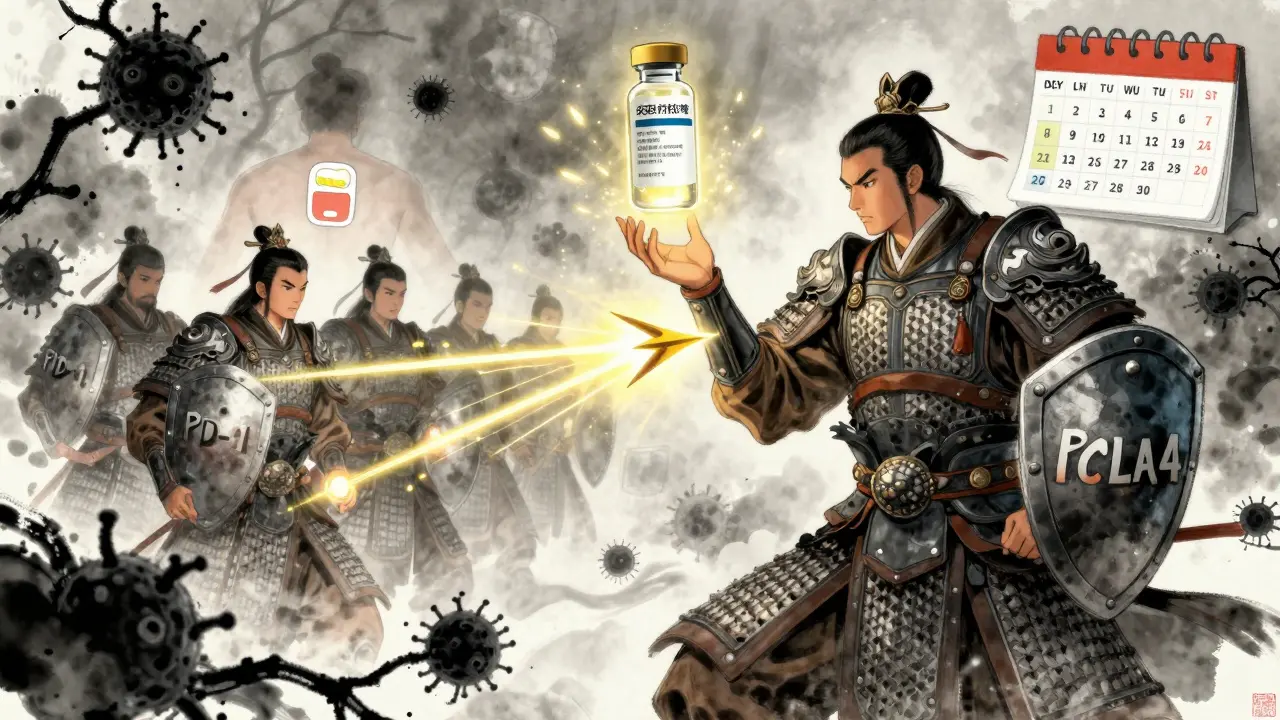
If melanoma spreads, surgery and radiation aren’t enough. That’s where immunotherapy comes in. Before 2011, metastatic melanoma meant a death sentence within months. Now, many patients live for years.These drugs don’t attack cancer directly. They remove the brakes on your immune system. Cancer cells hide by tricking T-cells into thinking they’re normal. Immunotherapy drugs like pembrolizumab (Keytruda) and nivolumab (Opdivo) block a signal called PD-1, letting T-cells see the cancer again. Another drug, ipilimumab (Yervoy), targets CTLA-4, another brake. Used together, they’re even more powerful.
The results are dramatic. In clinical trials, combination immunotherapy leads to long-term survival in nearly half of patients with advanced melanoma. Some stay in remission for over a decade. That’s unheard of in the past.
Newer drugs are on the horizon. Regeneron’s fianlimab, paired with a PD-1 blocker, showed strong early results in Phase 2 trials. IMA203 PRAME cell therapy, now in Phase 3 trials, is a personalized treatment that trains immune cells to hunt down melanoma cells with a specific marker. In early tests, 56% of patients had a complete response-meaning no detectable cancer left.
But immunotherapy isn’t magic. Side effects can be severe: fatigue, rashes, colitis, even autoimmune damage to the thyroid or liver. Not everyone responds. Some tumors have ways to resist the drugs. That’s why researchers are now combining immunotherapy with targeted therapy, radiation, and even vaccines.
What’s Next for Melanoma Care
The future isn’t just better tools-it’s smarter integration. Imagine a system that combines:- A wearable patch tracking electrical changes in your skin daily
- An AI app analyzing photos you take with your phone
- A blood test checking for tumor DNA fragments
- A full-body scanner at your annual checkup
That’s not science fiction. The iToBoS project and others are already building these links. The goal is a personalized risk score-not just “this mole looks bad,” but “your genetic profile, past sun exposure, and recent mole changes suggest a 12% risk of melanoma in the next year.”
Reimbursement remains a bottleneck. Google Health pulled its AI tool from the market in late 2024 because insurers wouldn’t pay for it. But hospitals like Mayo Clinic and Cleveland Clinic are proving it’s worth it. Cleveland Clinic cut unnecessary biopsies by 28% after using DermaSensor. That saves money and reduces patient stress.
By 2030, experts predict AI-assisted detection will be standard. Immunotherapy will become more targeted, less toxic, and available to more people. The real win? Reducing melanoma deaths by 40-50% over the next decade, according to WHO projections.
What You Can Do Right Now
You don’t need a scanner or a patch to protect yourself. Start here:- Check your skin monthly. Use a mirror. Look at your back, scalp, between toes, under nails.
- Know your ABCDEs. But also watch for anything new, changing, or unusual-even if it doesn’t look like a classic mole.
- See a dermatologist if you’re unsure. Don’t wait for it to bleed or hurt.
- Wear sunscreen daily. UV damage adds up, even on cloudy days.
- Ask your doctor about screening tools if you have a history of sunburns, many moles, or family melanoma.
Early detection isn’t glamorous. It’s not a breakthrough drug or a miracle cure. It’s showing up for your skin. And that one habit could save your life.
Can melanoma be cured if caught early?
Yes. When melanoma is found before it spreads beyond the top layer of skin, the five-year survival rate is over 99%. Surgery to remove the mole is usually all that’s needed. The key is catching it before it grows deeper or spreads to lymph nodes.
How accurate are AI tools for detecting melanoma?
Top AI systems like SegFusion and DenseNet-201 achieve 94-99% accuracy on standardized images. But real-world accuracy drops when lighting, skin tone, or image quality varies. The best systems combine multiple data points-image analysis, patient history, and clinical judgment-to reduce errors.
Is immunotherapy better than chemotherapy for melanoma?
For advanced melanoma, yes. Chemotherapy rarely works well against melanoma. Immunotherapy, by contrast, trains your immune system to recognize and destroy cancer cells long-term. Many patients on immunotherapy live for years, sometimes with no signs of cancer. Chemotherapy offers shorter, less durable responses with more side effects.
Do I need a full-body scan to detect melanoma?
No. Most people don’t need one. Full-body scanners like iToBoS are used in research and specialty clinics. For most, regular self-checks and annual skin exams by a dermatologist are enough. These scanners are best for people with many moles, a strong family history, or previous melanoma.
Can dark-skinned people get melanoma?
Yes. While less common, melanoma in darker skin often appears on palms, soles, under nails, or in the mouth. It’s also more likely to be missed or diagnosed late because people don’t expect it. AI tools trained mostly on light skin can miss these cases. That’s why self-checks and dermatologist visits are critical for everyone, regardless of skin tone.
Are home skin scanners worth buying?
Not yet. Most consumer apps and handheld devices lack clinical validation. They can give false reassurance or cause unnecessary panic. Stick to FDA-cleared tools used in clinics, like DermaSensor, and always follow up with a professional if you’re unsure. No app replaces a trained doctor.
Jake Moore
January 19, 2026 AT 04:17Just got back from my dermatologist and they used that DermaSensor thing. Honestly? It felt like a sci-fi gadget. Gave me a 7/10 on a mole I thought was just a freckle. Turned out it was benign, but the anxiety? Real. Still, better than waiting for it to bleed.
Worth the $200 copay? Maybe. Worth the peace of mind? Absolutely.
Praseetha Pn
January 20, 2026 AT 17:08AI detecting melanoma? LOL. They’re training it on photos taken by rich white people with perfect lighting. Meanwhile, my cousin in Kerala had a melanoma under his toenail for 3 years because no doctor even looked there. They don’t test on brown skin because ‘it’s rare’-until it kills you. This isn’t innovation, it’s colonial medicine with a fancy app.
And don’t get me started on the wearable patch. Next they’ll sell us a $500 sticker to monitor our ‘risk’ while Big Pharma sells us chemo. Wake up, sheeple.
Dayanara Villafuerte
January 21, 2026 AT 02:16Okay but can we talk about how wild it is that we’re now using AI to read moles like they’re QR codes? 🤯
I took a selfie of my weird spot, uploaded it to some app, and it said ‘probably fine.’ Then I went to the doc and they said ‘definitely fine.’ So… I paid $120 to have a robot validate my anxiety? Worth it? Maybe. Do I feel like a cyborg now? Absolutely. 😎
christian Espinola
January 22, 2026 AT 15:0799% survival rate? Sure. If you’re white, middle-class, have health insurance, and live within 40 miles of a dermatologist. For the rest of us? It’s a lottery where the house always wins.
And don’t pretend AI is neutral. The training data is built on photos from Harvard Medical, not rural Mississippi. You think your ‘advanced’ scanner sees the melanoma under your grandma’s toenail? Nah. It sees a ‘normal’ mole and moves on.
This isn’t progress. It’s a luxury good wrapped in jargon.
Chuck Dickson
January 24, 2026 AT 06:54Hey everyone-just wanted to say this post gave me chills. Seriously. I used to ignore my moles until my buddy lost his sister to late-stage melanoma. Now I check my skin every Sunday after coffee. No fancy gadgets. Just a mirror, a notebook, and a little courage.
You don’t need AI to save your life. You just need to care enough to look. And that? That’s the real breakthrough.
Keep checking. Keep living. You’ve got this.
Max Sinclair
January 25, 2026 AT 10:13I appreciate the depth here. The stats are staggering, and the tech is exciting-but I think the most important takeaway is the human element. No algorithm replaces a dermatologist who takes the time to listen, who asks, ‘Has this changed?’
Let’s not trade empathy for efficiency. We need both.
Nishant Sonuley
January 25, 2026 AT 15:51Let’s be real-immunotherapy sounds like magic until you’re the one throwing up for three weeks straight because your immune system decided your colon is the enemy. I’ve seen friends go from ‘I’m gonna beat this’ to ‘I just want to sleep without pain’ in six months.
Yes, some people live a decade. But many more just get a few extra months of hell. And the cost? $150,000 a year. Insurance won’t cover it unless you’re ‘exceptionally lucky’ or have a lawyer on retainer.
So yeah, it’s progress. But it’s progress for the privileged. The rest of us? We just pray the mole doesn’t change.
Emma #########
January 26, 2026 AT 18:25My mom had melanoma in 2018. She’s been in remission since. She doesn’t use any of the fancy scanners. Just checks herself every week and refuses to skip her dermatologist appointments. She says, ‘If it’s gonna kill me, I’m not gonna let it sneak up.’
I just wanted to say-thank you for writing this. It made me cry. In a good way.
Andrew McLarren
January 26, 2026 AT 23:01It is imperative to underscore that the integration of AI-based diagnostic modalities into dermatological practice must be subject to rigorous regulatory oversight, particularly with regard to algorithmic bias and equitable access. The current disparity in performance across skin phototypes constitutes a significant ethical concern that demands immediate remediation by both developers and policymakers.
Andrew Short
January 28, 2026 AT 22:4599% survival? That’s what they want you to believe. But how many of those ‘survivors’ are now on lifelong immunosuppressants because their immune system turned on their liver? How many are bankrupt from ‘curative’ treatments that barely worked?
This whole ‘early detection’ push? It’s a money machine. Biopsies cost $500. Scanners cost $10k. Drugs cost $100k. And you? You’re the customer.
They don’t want you cured. They want you hooked.
Danny Gray
January 30, 2026 AT 05:34What if melanoma isn’t a disease at all? What if it’s your body’s way of saying, ‘I’ve absorbed too much poison-from sunscreen chemicals, from plastic microbeads, from corporate lies about UV safety?’
They call it cancer. I call it a symptom of a broken world.
And the ‘cure’? More chemicals. More scans. More profit.
Maybe the real treatment is stepping outside, barefoot, and letting your skin breathe without SPF 50… and maybe, just maybe, your body knows how to heal itself-if we’d stop trying to control it.
Tyler Myers
January 30, 2026 AT 23:46AI detecting skin cancer? Yeah right. They’re using this to track your biometrics, sell ads, and feed data to the government. Next thing you know, your insurance company flags you as ‘high risk’ because your phone app detected a ‘suspicious mole’ you didn’t even know about.
And don’t get me started on the ‘wearable patch.’ That’s a tracker. Not a healer.
They’re not saving lives. They’re building a surveillance state with a dermatology filter.
rachel bellet
February 1, 2026 AT 11:26Let’s deconstruct the ‘99% survival’ narrative. The data is cherry-picked from Stage Ia lesions. Once you cross the 1mm threshold, survival drops to 89%. By Stage IIB? 65%. But the headlines? ‘Melanoma is curable!’
It’s not misinformation-it’s marketing. And the pharmaceutical-industrial complex is the architect.
Don’t be fooled by the glossy AI demos. The system is designed to monetize fear, not cure disease.
Pat Dean
February 2, 2026 AT 07:32My dad died of melanoma in ’09. Back then, they said ‘get it cut out.’ Now? They’re selling you $200 patches and $100k drugs. Meanwhile, the government cuts public health funding every year.
This isn’t science. It’s capitalism with a stethoscope.
And you? You’re the product.
Andrew Qu
February 2, 2026 AT 12:43For real-don’t wait for an AI to tell you something’s wrong. If you’ve got a mole that’s been there for years and suddenly it’s itchy, bleeding, or growing? Go. Don’t schedule. Don’t wait for ‘convenient hours.’ Just go.
I waited six months. My friend didn’t. She’s alive today. Don’t be the one who says ‘I thought it was nothing.’