
Asian Generic Markets: How India and China Dominate Global Pharma Supply Chains
 Dec, 6 2025
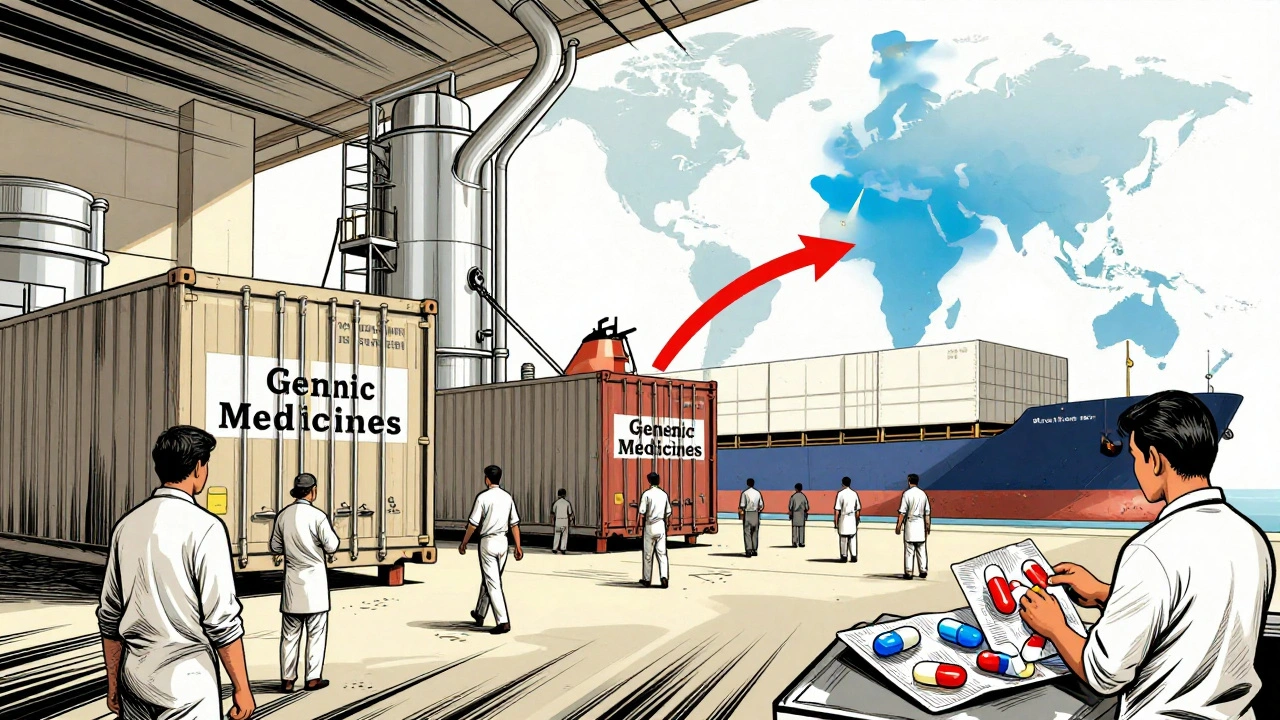
The world’s generic medicines don’t come from Europe or the U.S. They come from Asia-mostly from India and China. If you take a pill for high blood pressure, antibiotics, or diabetes, there’s a better than 60% chance it was made in one of these two countries. Even if you buy it at a pharmacy in London, Toronto, or Sydney, the active ingredient likely came from a factory in Gujarat or Jiangsu. This isn’t just about cost. It’s about scale, strategy, and survival.
India: The Pharmacy of the World, Built on Policy
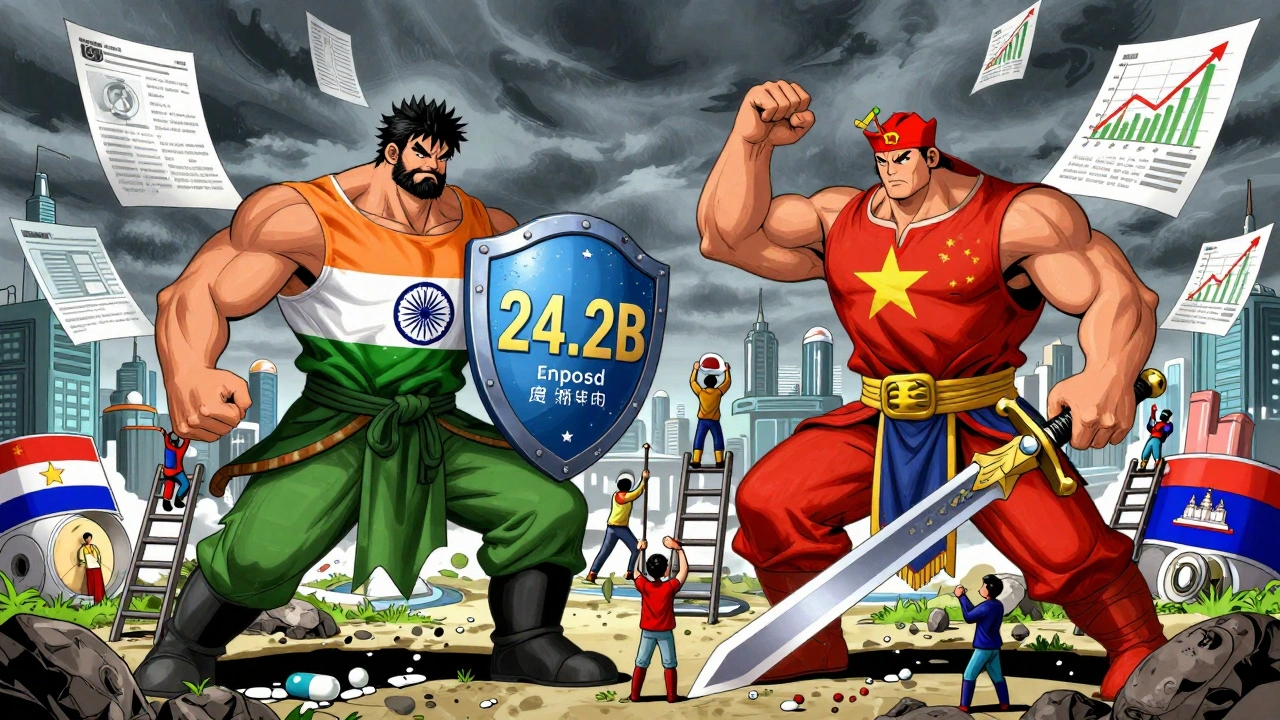
India didn’t become the largest supplier of generic drugs by accident. In the 1970s, the government changed its patent laws to allow companies to copy drug formulas as long as they used a different manufacturing process. That one move turned India into a global manufacturing hub. By 2024, its pharmaceutical market hit $61.36 billion, with 75% of that coming from conventional generics. The country exports 24.2 billion worth of medicines annually, and 87% of those are generics.What makes India unique isn’t just volume-it’s flexibility. Indian manufacturers can adapt quickly. Need a custom tablet formulation? They’ll deliver it in 14 days. Need a small batch for a clinical trial? They’ll do it without minimum order requirements. That’s why U.S. pharmacy chains report a 60% drop in operational issues when sourcing from India versus China. Customer service is built into the business model.
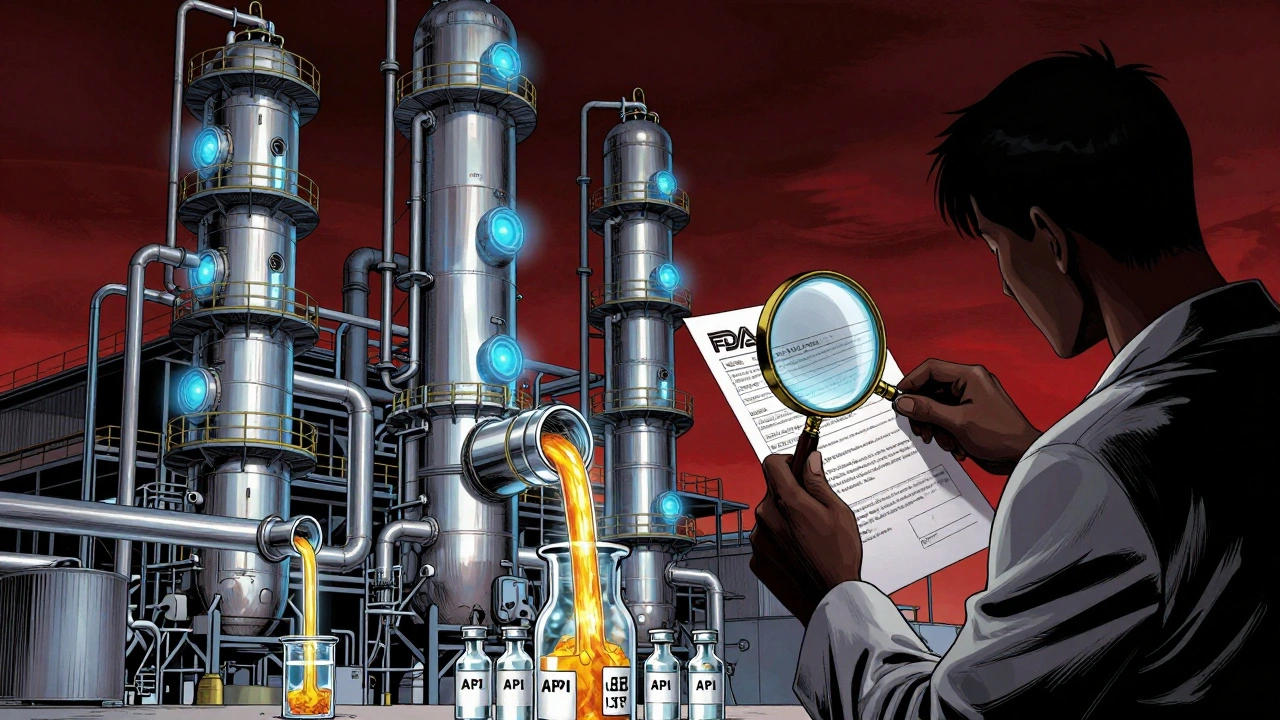
But there’s a catch. India makes almost all its finished drugs, but it doesn’t make most of the raw ingredients. Over 68% of its Active Pharmaceutical Ingredients (APIs) are imported-mostly from China. That’s a vulnerability. When China restricted exports during the pandemic, India’s production lines slowed down. In response, India launched Pharma 2047, a $13.4 billion plan to build 12 new API parks and cut its reliance on Chinese imports from 68% to 30% by 2030.
China: The Hidden Engine Behind Every Pill
While India sells the finished pills, China makes the powder inside them. China controls about 70% of the global API market. That means nearly every generic drug in the world-whether made in India, Brazil, or South Africa-depends on Chinese chemicals. In 2024, China’s pharmaceutical exports reached $48.7 billion, with 63% being generics. But the real growth is in biologics and high-value drugs.China’s market is bigger than India’s-$80.4 billion in 2024-and it’s growing faster in dollar terms, even if its percentage growth is slower. Why? Because China is moving up the value chain. In 2024, 45% of new pharmaceutical facilities built in China were for biologics. That’s not just aspirin anymore. That’s cancer treatments, insulin analogs, and monoclonal antibodies. China’s 14th Five-Year Plan poured $150 billion into R&D, with 40% going to biologics. By 2030, it aims for 25% of its pharmaceutical exports to be high-value products, up from just 8% in 2024.
But quality remains a concern. In 2024, the U.S. FDA issued 142 warning letters to Chinese manufacturers-nearly twice as many as India’s 87. Many of these were for data integrity issues, poor sanitation, or unapproved process changes. Still, China has improved. FDA approval timelines dropped from 24 months in 2018 to just 9 months in 2024. Companies that invest in compliance now get faster approvals and better trust.
Emerging Economies: The New Players on the Block
India and China aren’t the only ones shaping the future. Vietnam and Cambodia are quietly carving out niches. Vietnam’s pharmaceutical exports jumped 24.7% in 2024 to $2.8 billion, thanks to a focus on antibiotic intermediates. It’s not making finished drugs yet, but it’s making the building blocks-and doing it cheaper than China.Cambodia, meanwhile, is becoming a hub for low-cost medical device assembly. Its sector grew 32% last year, thanks to ASEAN trade deals that give it tariff-free access to markets like Australia and Japan. These countries aren’t replacing India or China. They’re filling gaps. Where India is too expensive for simple components, and China is too complex for small orders, Vietnam and Cambodia step in.
Other countries are watching closely. Bangladesh and Indonesia are investing in API production. The Philippines is building its first biologics plant. This isn’t just about competition-it’s about resilience. After years of supply chain shocks, countries want multiple sources for critical medicines.
How Buyers Choose: Cost vs. Control
Pharmaceutical buyers don’t pick suppliers based on country alone. They weigh risk, speed, and reliability. A German healthcare company told G2 in April 2025 that Chinese APIs are 20% cheaper than Indian ones-but the FDA warnings forced them to dual-source. Now they get 40% from India and 35% from China. That split isn’t about preference. It’s about insurance.Indian suppliers score higher on communication. One U.S. pharmacy chain reported that Indian reps answer calls 24/7. Chinese suppliers often have language barriers and longer response times. But Chinese factories deliver lower prices and better consistency in bulk. For a company buying 50 million tablets of metformin, price wins. For a hospital ordering 5,000 doses of a rare antibiotic, speed and support matter more.
Trustpilot data shows Indian suppliers average 4.1/5.0 for customer service, while Chinese suppliers score 3.8/5.0. But on pricing, Chinese suppliers lead 4.5 to 4.0. That’s the trade-off: India gives you flexibility and service. China gives you volume and price.
The Real Challenge: Quality Under Pressure
The World Health Organization reported a 27% increase in inspection failures at Asian pharmaceutical facilities in 2024 compared to 2023. Why? Because demand is outpacing capacity. When the U.S. FDA launched Project BioSecure in late 2024, it required full traceability of every API-from raw material to finished pill. That’s expensive. It adds 18-22% to compliance costs.India’s 3,000+ FDA-approved facilities are spread across 17 different state regulators. That means inconsistent enforcement. One factory in Gujarat might be spotless. Another 50 miles away might be cutting corners. China’s system is more centralized, but it’s also more rigid. Companies that don’t meet standards get shut down fast-but rebuilding takes years.
And then there’s the raw material problem. Both countries are racing to become self-sufficient in APIs. India wants to cut imports from 68% to 30%. China is building more API plants too. But when two giants flood the market with the same chemicals, prices drop. S&P Global Ratings warns of a 15-20% price correction in API markets by 2026-2027. That could mean lower profits, fewer investments in quality, and more pressure to cut corners.
What’s Next? Innovation, Not Just Copies
The old model-copy a drug, sell it cheap-is running out of steam. The global generics market hit $448.6 billion in 2024, but growth is slowing. The real opportunity now is in biosimilars: cheaper versions of expensive biologic drugs like Humira or Enbrel. India has 15 biosimilar products on the market. China has over 30. By 2030, biosimilars could make up 20% of Asia’s pharmaceutical exports.India’s advantage? A young population. 65% of its people are under 35. That means a huge domestic market for chronic disease drugs. It also means more talent entering labs and manufacturing plants. China’s advantage? Capital. It’s spending $22.8 billion on its Healthy China 2030 plan to push into innovation. It doesn’t just want to make pills. It wants to invent them.
The winner won’t be the country that makes the most pills. It’ll be the one that can make the most complex ones-and do it reliably. India might lead in volume. China leads in value. But the future belongs to whoever can combine both.
Oliver Damon
December 7, 2025 AT 19:29The structural asymmetry in API dependency is a textbook case of global supply chain fragility. India's 68% reliance on Chinese inputs isn't just a vulnerability-it's a strategic liability baked into their business model. The Pharma 2047 initiative is a necessary pivot, but scaling domestic API production at that scale requires not just capital, but regulatory harmonization across 17 state-level authorities. That’s a bureaucratic nightmare. Meanwhile, China’s centralized control allows for faster compliance enforcement, even if their FDA warning letters are higher. The real metric isn’t quantity of approvals-it’s consistency of quality over time. And that’s where China’s institutional discipline still holds an edge, despite the noise.
Kurt Russell
December 9, 2025 AT 19:00THIS IS WHY WE NEED TO STOP TREATING PHARMA LIKE A COMMODITY. We outsource the life-saving stuff to two countries and then act surprised when something goes wrong? The FDA’s 142 warning letters to China? That’s not a failure of manufacturing-it’s a failure of oversight. We’re letting foreign governments regulate our medicine supply chain. And now we’re surprised when the pills don’t work? Wake up. We need to bring at least 30% of API production back to the U.S. or EU. National security isn’t about missiles-it’s about the damn pills in your medicine cabinet.
Stacy here
December 11, 2025 AT 06:57EVERYTHING YOU’RE SAYING IS A COVER-UP. The real reason India and China dominate is because they’re poisoning the supply chain with cheap, contaminated APIs-and the FDA is in on it. Why do you think the approval times dropped from 24 to 9 months? Because they’re rushing approvals to keep the profits flowing. The WHO’s 27% spike in inspection failures? That’s not ‘demand outpacing capacity’-that’s intentional negligence. Big Pharma and the Chinese government have a deal. They’re feeding us slow-acting toxins under the guise of ‘affordable medicine.’ You think your blood pressure pill is saving you? It’s slowly killing you. And they call it ‘global health equity.’
Kyle Flores
December 12, 2025 AT 17:14Really appreciate this breakdown. I’ve been on the receiving end of both Indian and Chinese suppliers in my work. Indian reps actually call back. Like, genuinely. One guy even sent me a handwritten note after we had a miscommunication about batch numbers. Chinese factories? They reply in 3 days with a translated email that says ‘everything fine.’ But yeah, their prices are insane. We switched to dual-sourcing last year and our inventory errors dropped by 40%. It’s not about patriotism-it’s about not getting sued when a batch goes bad.
Ryan Sullivan
December 13, 2025 AT 06:31Pathetic. You call this ‘strategy’? India’s entire pharmaceutical dominance rests on intellectual property theft disguised as ‘process innovation.’ China’s API monopoly is a state-sponsored cartel. And now we’re supposed to applaud their ‘resilience’? The only resilience here is the resilience of corporate greed. The WHO’s data is a joke-27% more inspection failures? That’s just the tip. The real number is 10x higher because most facilities in Gujarat and Jiangsu are never inspected. This isn’t globalization-it’s exploitation with a compliance checklist.
Wesley Phillips
December 13, 2025 AT 21:16Look I get it. India’s got good customer service. China’s got cheaper stuff. But honestly? We’re all just playing Jenga with global health. One wrong move and the whole tower collapses. I don’t care if it’s 4.1 vs 3.8 on Trustpilot. What happens when the next pandemic hits and China shuts down exports again? We’re gonna be begging for expired insulin from a factory in Cambodia? That’s not innovation. That’s desperation with a PowerPoint.
Desmond Khoo
December 14, 2025 AT 02:47So many people don’t realize this but the real win here is Vietnam and Cambodia. 🤯 They’re not trying to be India or China-they’re just doing the boring, unglamorous stuff right. Making intermediates. Assembling devices. No drama. Just steady work. And guess what? They’re getting paid. The future isn’t about who makes the most pills-it’s about who makes the most reliable parts. 🙌
Kyle Oksten
December 15, 2025 AT 16:35There’s a deeper layer here that nobody’s addressing: the human cost. The workers in those API plants in Gujarat and Jiangsu are breathing in chemical dust for 12-hour shifts. No union. No OSHA. No oversight. The ‘quality’ metrics we obsess over? They’re measured in tablets, not lives. The real innovation won’t come from more biologics or bigger parks-it’ll come when we stop treating human health as a supply chain optimization problem. Until then, we’re just rearranging deck chairs on the Titanic.