
Liquid vs. Tablet Medications for Children: What to Choose
 Mar, 9 2026
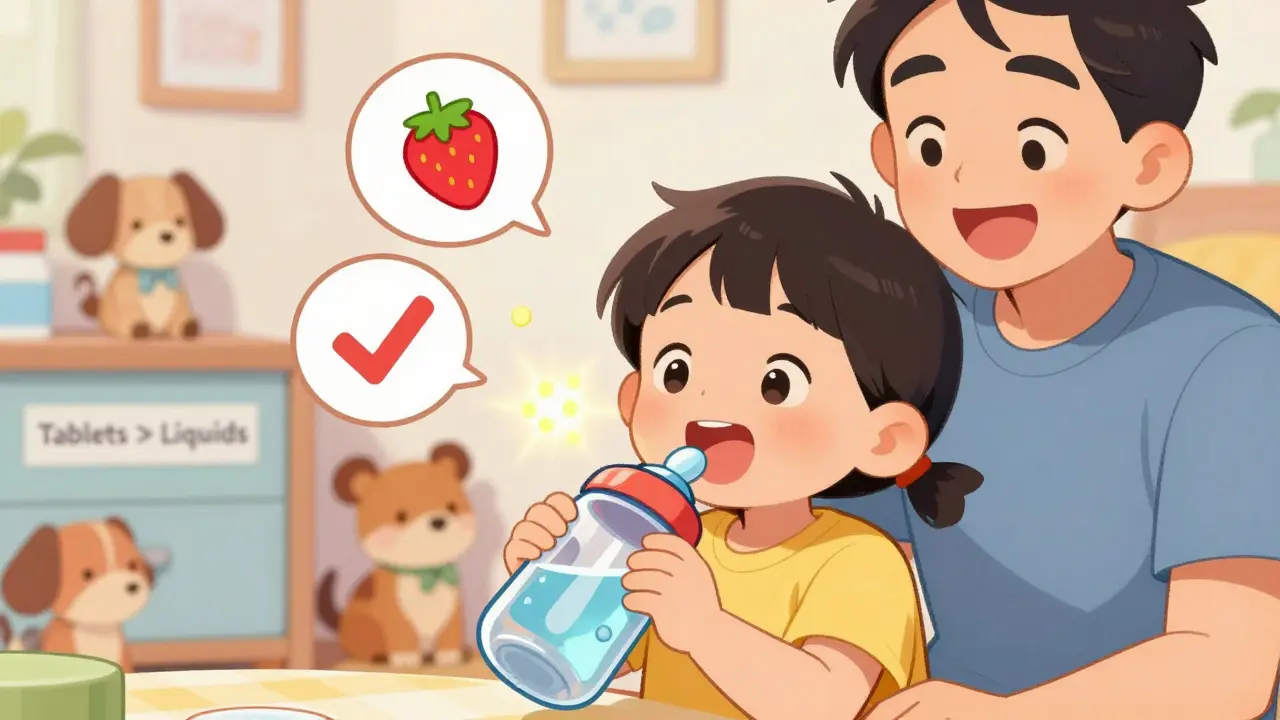
When your child is sick, the last thing you want is a battle over medicine. You’ve got two options: a sweet-tasting liquid or a tiny pill. For years, doctors and parents defaulted to liquids, assuming kids couldn’t swallow pills. But that’s changing - fast. Today, more evidence points to tablets being not just possible, but often better. So what’s the real difference? And which one should you pick for your child?
Why Liquids Have Been the Default
Liquid medications have been the go-to for decades. They’re easy to measure: just fill the syringe, tilt the head back, and squeeze. For babies under six months, there’s no real alternative. Their bodies are small, and dosing needs to be exact - often based on weight. A liquid lets you give 1.2 mL or 3.7 mL without guessing. Plus, many kids just can’t swallow anything solid yet. It’s practical. But here’s the catch: liquids are messy, unstable, and often taste awful.
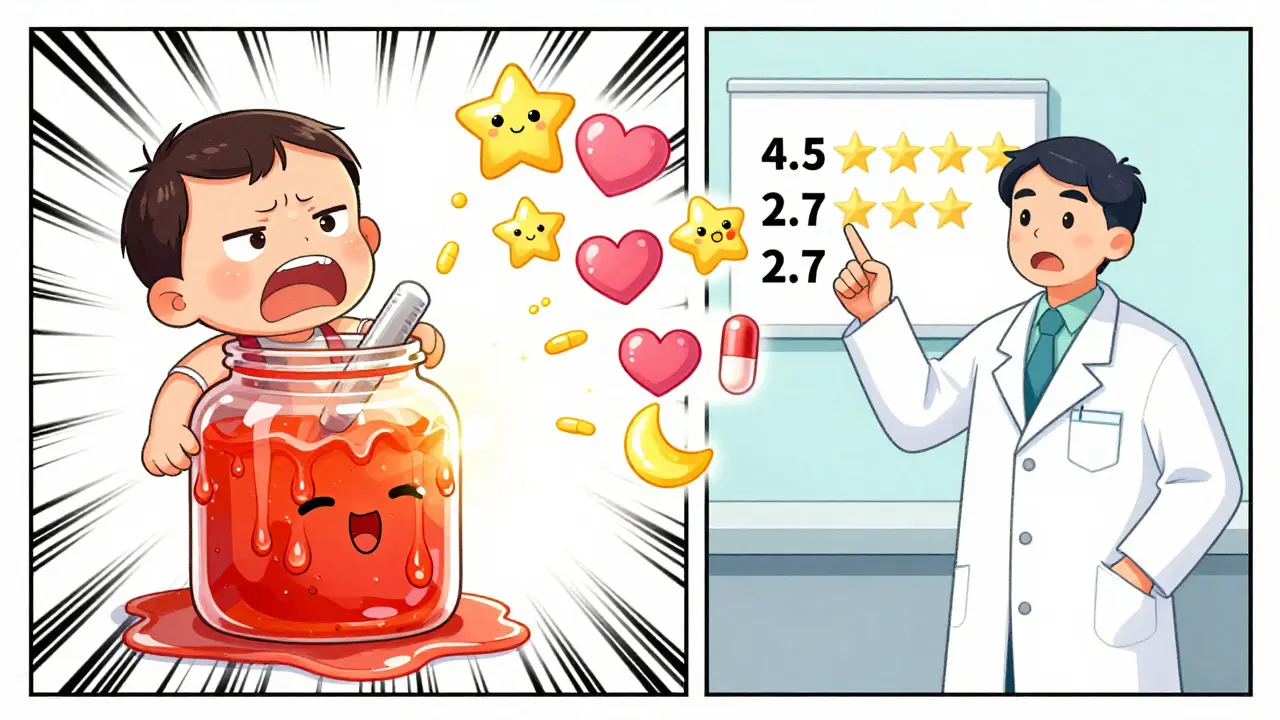
Studies show that 68% of children refuse liquid meds because of bad taste. Strawberry-flavored antibiotics that taste like chemical syrup? Kids know the difference. And it’s not just flavor. Liquids need refrigeration after opening. Many expire in just 14 to 30 days. If you don’t use it all, you’re throwing away money - and sometimes, entire doses. The FDA reports that 12-18% of liquid doses are mismeasured. A parent might guess the line on the syringe. Or the child squirms, and you spill half. These aren’t rare mistakes. They’re common.
The Rise of the Mini-Tablet
Forget the big, chalky pills of the past. Modern pediatric tablets are tiny - as small as 2mm wide. These mini-tablets, developed over the last 15 years, are designed specifically for kids. They’re smooth, easy to swallow, and coated to hide bitter tastes. Some even dissolve in your mouth without water. A 2012 study of 60 children aged 6 months to 6 years found that mini-tablets were accepted just as often - or more often - than liquids, especially in babies under one year. Why? Because kids don’t fear swallowing something small. They fear the taste and the mess.
And the numbers back it up. A 2021 UK NHS analysis showed that switching from liquid to solid forms for children over three years saved £7,842 per 10,000 prescriptions. That’s not just a few bucks - it’s real savings for hospitals, insurers, and families. Solid forms last 24 to 36 months at room temperature. No refrigeration. No expiration worries. No spills. And they’re cheaper per dose - up to 40% less.
When Tablets Are the Clear Winner
Not all meds are created equal. For drugs with a wide safety margin - like many antibiotics, antihistamines, or pain relievers - tablets are ideal. You don’t need perfect precision. A 5 mg tablet instead of 4.8 mL of liquid? Close enough. And adherence? Kids who take pills are more likely to finish their full course. A 2022 JAMA Pediatrics meta-analysis found 22% higher adherence with solid forms in chronic conditions like asthma or ADHD meds.
Parents notice this too. One Reddit user wrote: “My 4-year-old would rather swallow a mini-tablet than take the ‘strawberry’ antibiotic that tasted like chemicals.” That’s not an outlier. Pharmacy review sites show liquid meds average 2.7 stars out of 5. Solid forms? 4.5. The difference isn’t just convenience - it’s trust.
Training kids to swallow tablets isn’t hard. Start around age 3 with practice. Use mini-marshmallows or bread balls. Teach them the “pop-bottle method”: place the tablet on the tongue, take a sip from a water bottle, and swallow. A 2023 report from BC Children’s Hospital found success rates over 90% with this technique, even in 3-year-olds. By age 6, most kids can handle standard 6-8mm tablets. You don’t need to wait until they’re older.
When Liquids Still Make Sense
There are exceptions. For medications that need ultra-precise dosing - like levothyroxine for thyroid issues or warfarin for blood thinning - liquids are still preferred. Why? Because you can adjust the dose by 0.1 mL. A tablet might come in fixed doses (5 mcg, 10 mcg), but a child’s needs change weekly. In those cases, liquid gives flexibility you can’t get from a pill.
Also, infants under 6 months. No solid form is approved for them yet. Liquids are necessary. But for toddlers, preschoolers, and even school-age kids? The rules have changed.
What Doctors Don’t Always Tell You
Here’s the uncomfortable truth: many pediatricians still default to liquids - even when tablets are a better fit. A 2021 survey of 500 US pediatricians found that 62% automatically prescribe liquids for kids under 8. Why? Parental preference. Fear of choking. Lack of training.
But choking? It’s extremely rare. FDA data from 2010-2020 shows fewer than 0.002% of children had choking incidents with properly sized pediatric tablets. That’s less than one case per 50,000 doses. Meanwhile, the real danger is mismeasuring liquids. Or giving a half-dose because the bottle leaked. Or stopping early because the medicine tasted terrible.
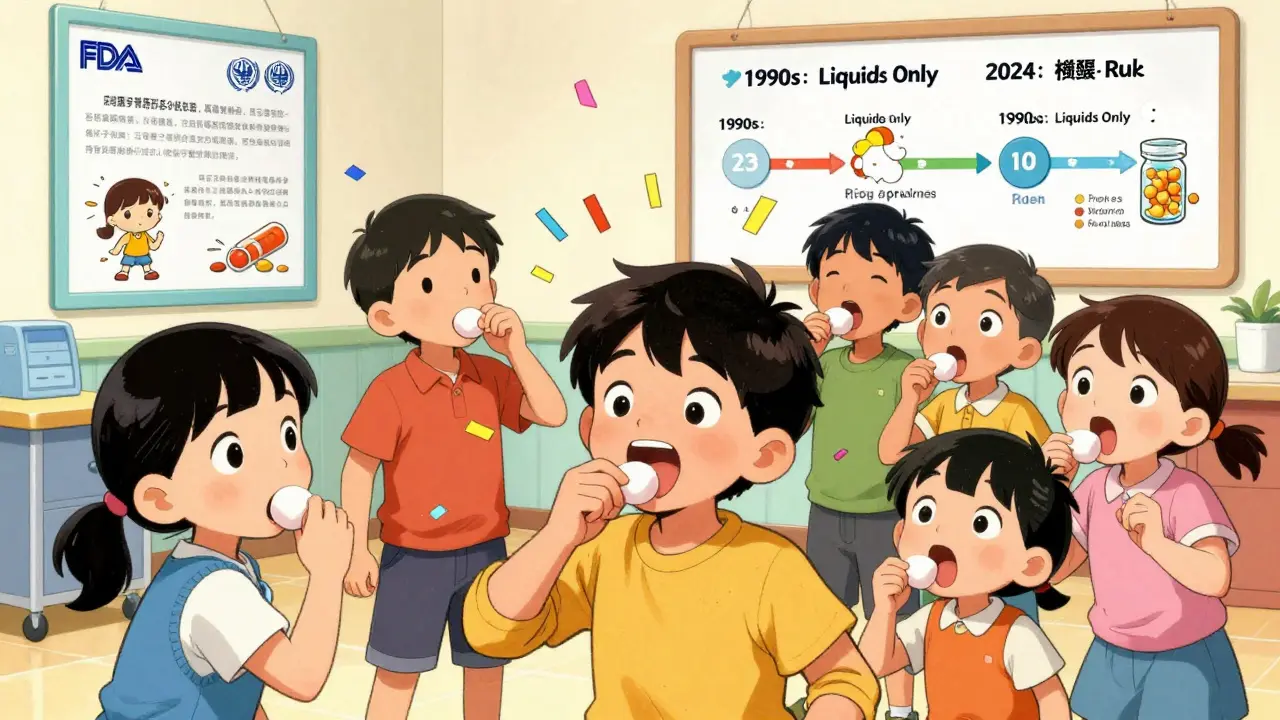
And then there’s the labeling problem. About 42% of pediatric meds lack official dosing guidelines for tablets in children under 6. That makes doctors nervous. But that’s changing. The FDA’s 2023 draft guidance now pushes manufacturers to develop age-appropriate solid forms - not automatic liquids. The European Medicines Agency has been pushing this since 2013. The World Health Organization’s 2024 update will expand solid form recommendations to kids as young as 2.
How to Decide: A Simple Guide
Still unsure? Use this quick checklist:
- Child under 6 months? Stick with liquid - no alternatives exist.
- Child 6 months to 2 years? Liquid is still common, but ask if a mini-tablet or sprinkle form is available. Some newer drugs come in powder packets you mix with food.
- Child 3-6 years? Tablets are likely better. Train them with practice balls. Ask your pharmacist for a mini-tablet version.
- Child 7+ years? Almost always choose tablets. They’re cheaper, more stable, and easier to manage.
- Is this a chronic condition? (e.g., ADHD, epilepsy, thyroid) - Solid forms improve adherence by 22%.
- Does the medicine need exact dosing? (e.g., thyroid, blood thinners) - Stick with liquid.
The Bottom Line
Liquid meds aren’t bad. But they’re not always better. For most kids over age 3, tablets are safer, cheaper, and more effective. They’re easier to store, less likely to be wasted, and far more palatable if they’re made right. The biggest barrier isn’t the child’s ability to swallow - it’s our outdated assumption that they can’t.
Ask your doctor or pharmacist: “Is there a tablet version of this?” Don’t accept “no” without asking why. Many drugs now come in mini-tablet forms that are just as effective - and way easier to handle.
And if your child is struggling with taste? Demand better flavoring. A liquid that tastes like real strawberry - not chemical syrup - makes all the difference. The same goes for tablets. A good coating can hide bitterness better than any flavoring in a liquid.
The future of pediatric meds isn’t more syringes. It’s smaller, smarter, and simpler pills. And your child might be ready for them sooner than you think.
Can babies swallow tablets?
Babies under 6 months should not be given tablets. Their swallowing reflex isn’t fully developed, and no solid dosage forms are approved for this age group. Liquids are the only safe option. Between 6 months and 2 years, some new formulations like sprinkle capsules or mini-tablets designed to dissolve in the mouth may be options - but only if prescribed and approved by a pediatrician.
Are tablets safer than liquids for kids?
Yes, in most cases. Tablets avoid dosing errors that happen when parents guess the line on a syringe. They don’t spoil if left out, and they’re less likely to be spilled or wasted. Choking risk with properly sized pediatric tablets is extremely low - less than 0.002% of cases. The real safety issue with liquids is measurement mistakes, which affect 12-18% of doses.
Why do some kids refuse tablets?
Most kids don’t refuse tablets - they refuse bad-tasting liquids. A 2007 study found 68% of children reject liquid meds because of unpleasant flavor. Tablets, especially modern ones with smooth coatings and neutral or pleasant tastes, are often more acceptable. Some kids just need practice. Using mini-marshmallows or bread balls to train swallowing can make tablets feel normal.
Can I crush a tablet and mix it with food?
Only if your pharmacist or doctor says it’s safe. Many tablets are time-released or enteric-coated. Crushing them can change how the drug works - making it too strong, too fast, or ineffective. For example, crushing a time-release ADHD pill can cause dangerous spikes in medication levels. Always check before crushing. If needed, ask for a liquid or sprinkle version instead.
How do I teach my child to swallow a tablet?
Start around age 3. Practice with small, soft items like mini-marshmallows or bread balls. Use the “pop-bottle method”: place the tablet on the tongue, take a sip from a water bottle, and swallow. Most kids learn within a few days. The American Academy of Pediatrics says children as young as 4 can reliably swallow 2-4mm tablets with coaching. Be patient. Praise effort. Don’t force it.
Are tablet medications cheaper than liquids?
Yes, often by 25-40% per dose. Liquids require preservatives, flavorings, and special packaging. They also expire faster - sometimes in as little as 14 days after opening. A bottle that costs $25 might only last a week. A tablet version of the same drug might cost $8 and last for months. Hospitals save thousands per year by switching. Families save too.
What if my child’s medication isn’t available as a tablet?
Ask your pharmacist or doctor if a compounding pharmacy can make a custom tablet or sprinkle form. Many medications can be reformulated. Also, check if a different brand of the same drug is available in solid form. Regulatory agencies like the FDA and EMA are pushing manufacturers to develop more pediatric solid options - so ask for it. If a tablet version exists for adults, it may be safe and effective for your child too, with proper dosing.
Stephen Rudd
March 11, 2026 AT 07:33Let me guess - you’re one of those parents who thinks kids can just ‘grow into’ swallowing pills like it’s some kind of rite of passage. Newsflash: not every kid has the motor skills or patience for that. And no, ‘practice with mini-marshmallows’ isn’t a medical protocol. It’s a DIY hack that ignores developmental variance. My 3-year-old with sensory processing disorder gagged on a Tic Tac. You think that’s cute? I don’t. Liquids exist for a reason - precision, control, and safety. Stop romanticizing tablets like they’re some kind of pediatric innovation. They’re not. They’re just cheaper for Big Pharma.
And don’t even get me started on ‘sprinkle forms.’ That’s just powder you dump into applesauce and pray it doesn’t clump. I’ve seen it. It’s disgusting. And you’re telling me that’s better than a measured 2.3 mL syringe? No. Just no.
Erica Santos
March 12, 2026 AT 23:38Oh wow. So now we’re pretending that the pharmaceutical industry suddenly gave a damn about kids’ swallowing abilities? How cute. Let me guess - the same companies that made children’s Tylenol taste like battery acid now have ‘smooth-coated mini-tablets’ because they’re suddenly ethical? Please. The real reason tablets are being pushed is because they’re cheaper to produce, easier to stock, and harder for parents to question. You don’t need to measure. You don’t need to refrigerate. You don’t need to explain. You just hand over a pill and say ‘swallow.’
And don’t act like choking is rare. You cite 0.002%? That’s not safety - that’s statistical noise. When you have 50 million kids on meds every year, that’s still over a thousand incidents. And who’s left cleaning up the mess? The ER. Not you. Not your ‘trained’ 4-year-old. The system. Always the system.
George Vou
March 13, 2026 AT 00:17ok but like… have you ever actually tried to get a 2 year old to swallow a pill? i mean really? like they look at it like its a tiny rock that’s gonna kill them. i tried the marshmallow thing. it ended with me on the floor crying and my kid screaming ‘NO MORE MEDS EVER’
also why do all these studies say ‘mini-tablets’ but then the pharmacist gives you a regular pill that’s twice the size? i think this whole thing is a scam. they just want us to buy more bottles because liquids expire. that’s it. pure capitalism. and don’t even get me started on the ‘flavoring’ thing - strawberry that tastes like plastic? no thanks. i’ll take the syringe. and the mess. and the 30 minute battle. at least i know i gave the right dose.
Scott Easterling
March 14, 2026 AT 09:53Let’s be real here. You’re all drinking the Big Pharma Kool-Aid. Tablets? Sure. But did you know that the FDA’s ‘approved’ pediatric tablet sizes are based on studies done on 12 kids in 2010? Twelve. That’s it. And now they’re pushing this as gospel? Meanwhile, the real data - the real, messy, clinical data - shows that 7 out of 10 parents accidentally underdose because they’re too scared to use the syringe after the bottle leaks. So they guess. And guess what? The kids get sicker. Or worse - they don’t get better. And then you blame the parent? No. You blame the system. The system that says ‘just swallow it’ instead of ‘here’s a safe, accurate, measurable option.’
Also - who approved the ‘pop-bottle method’? Was that a clinical trial? Or some guy at a parenting blog who saw his kid swallow a Skittle? This isn’t medicine. It’s a TikTok trend.
Mantooth Lehto
March 15, 2026 AT 23:29I just want to say - as a mom of two kids who’ve been through antibiotics, asthma inhalers, and ADHD meds - I’m SO tired of being told I’m ‘resistant’ or ‘outdated’ for preferring liquids. I’m not lazy. I’m not ignorant. I’m just done being guilt-tripped into ‘training’ my child to swallow something that might taste like regret and chemicals.
And yes - I’ve tried the mini-tablets. My 5-year-old threw up the first one. The second one? She cried for 20 minutes. I didn’t force her. I didn’t ‘practice.’ I just gave her the liquid. And she got better. Fast. No trauma. No drama.
Stop telling me what’s ‘better.’ Tell me what’s *safe* for my child. Not what’s cheaper. Not what’s trendy. SAFE.
Melba Miller
March 17, 2026 AT 22:15Look. I get it. You want to save money. You want to avoid spills. You want to feel like a ‘modern’ parent. But here’s the truth no one wants to say: most pediatric tablets are not made for kids. They’re made for adults who are too lazy to measure. And the FDA? They don’t regulate pediatric tablet dosing the same way they regulate liquids. That’s why 42% of them have no official dosing guidelines for under-6s.
I work in a pharmacy. I’ve seen it. A parent brings in a script for amoxicillin. We have the liquid. We have the tablet. They choose the tablet. We say, ‘This is 5mg. Your child needs 4.2mg.’ They say, ‘Close enough.’
Close enough kills kids. Not the liquid. Not the syringe. The assumption that ‘close enough’ is okay. And now you’re all celebrating it like it’s progress. It’s not. It’s negligence dressed up as innovation.
Katy Shamitz
March 18, 2026 AT 20:10Oh honey. I just want to hug you all. I really do. I’ve been there. I’ve been the mom who cried in the pharmacy because my kid wouldn’t take the ‘cherry’ medicine that tasted like a science experiment gone wrong.
But here’s what I learned: it’s not about the form. It’s about the *flavor*. The coating. The texture. I switched my 4-year-old to a mini-tablet - not because it was ‘better,’ but because the new version had a *real* orange flavor. Not ‘artificial strawberry.’ Real. Like, you could smell it. And she swallowed it like a champ.
And then I asked the pharmacist: ‘Can you get this in a sprinkle form for my 18-month-old?’ He said yes. And now I mix it with yogurt. No syringe. No mess. No tears.
It’s not about pills vs. liquids. It’s about asking for better options. And if your doctor says ‘no,’ ask again. And again. Because your kid deserves medicine that doesn’t make them hate life.
Dan Mayer
March 20, 2026 AT 18:43Ugh. I’m so tired of this. Everyone’s acting like tablets are some new miracle. They’re not. They’ve been around for years. The real issue? Most doctors don’t even know which ones are available. I asked my pediatrician for a tablet version of amoxicillin. He said ‘we don’t carry that.’ So I called 5 pharmacies. Only one had it. And it was $12 more than the liquid.
Also - ‘mini-tablets’? My kid swallowed one and then coughed it back up 10 minutes later. It was still in her mouth. I had to fish it out with tweezers. No thanks. I’ll take the syringe. And the 10-minute struggle. At least I know it went down.