
Manufacturing Changes and Generic Approval: What Triggers FDA Re-Evaluation
 Jan, 3 2026
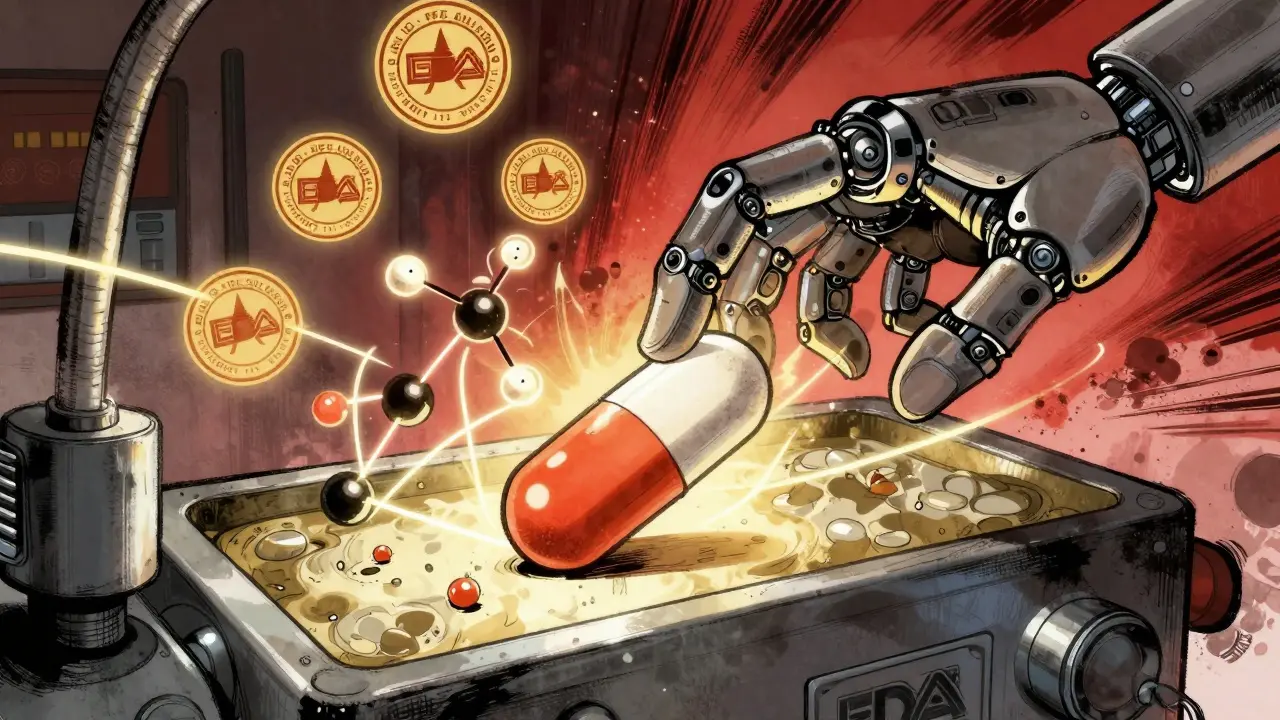
When a generic drug hits the market, it’s not set in stone. Even small tweaks to how it’s made can trigger a full FDA re-evaluation. For manufacturers, this isn’t just paperwork-it’s a race against time, cost, and regulatory uncertainty. The question isn’t whether you’ll need to make a change; it’s when that change will force you back to the FDA for approval.
What Kind of Changes Force a Re-Evaluation?
Not every tweak to a manufacturing process needs FDA approval. But some do-and the line between "minor" and "major" isn’t always clear. The FDA breaks these changes into three buckets: Prior Approval Supplements (PAS), Changes Being Effected (CBE), and Annual Reports (AR). Only PAS changes require the FDA to say "yes" before you can make the switch.PAS triggers include:
- Switching to a new drug substance supplier, especially if the new source uses a different synthetic route
- Changing the manufacturing facility, especially if moving from one country to another
- Scaling up production by more than 20% without prior validation
- Modifying the formulation-adding a new excipient or changing its concentration
- Updating the analytical method used to test purity or potency
- Introducing continuous manufacturing for a product previously made in batches
These aren’t theoretical. Between 2018 and 2022, PAS submissions for manufacturing changes jumped 27.3%. Why? Half of those changes were planned improvements-like adopting better tech or reducing waste. The other half were unplanned: equipment failures, out-of-spec batches, or supply chain breakdowns. Each one sends the manufacturer back to square one with a new application.
Why the FDA Cares So Much
Generic drugs are approved under the Abbreviated New Drug Application (ANDA) pathway. That means manufacturers don’t have to repeat the clinical trials the brand-name drug went through. Instead, they prove their product is bioequivalent-same active ingredient, same dose, same effect.But if you change how the drug is made, you could change how it behaves in the body. A new mixing process might affect how fast the tablet dissolves. A different solvent in the synthesis could leave behind a new impurity. Even a slight variation in particle size can alter absorption. The FDA doesn’t want patients switching from one version of a generic to another and suddenly getting less (or more) of the drug than expected.
That’s why even small changes require data. For peptide-based generics, any new impurity must be under 0.5% and proven not to affect safety. For complex injectables or inhalers, the FDA may require full bioequivalence studies-just like the original approval.
The Cost and Time of Re-Evaluation
A PAS submission isn’t cheap. Industry data from 2023 shows the average cost is $287,500. That’s not just filing fees-it’s the cost of running stability studies, validating new equipment, hiring consultants, and preparing documentation. For a low-margin generic drug selling for pennies per pill, that’s a tough investment to justify.And the timeline? The FDA’s average review for a PAS is 10 months. Complex cases-like facility transfers or new manufacturing tech-can stretch to 14 months or longer. One company spent 18 months getting approval for a simple tablet press upgrade, even though the final product met all quality specs. Why? Because the FDA asked for more data, then more data, then another round of validation.
Small manufacturers suffer the most. Companies with fewer than five ANDAs report review times 43% longer than big players. Why? They lack the in-house regulatory teams to anticipate what the FDA will ask for. One quality manager on Reddit described it as "regulatory paralysis"-avoiding upgrades because the approval process feels like a black box.

How to Avoid the Trap
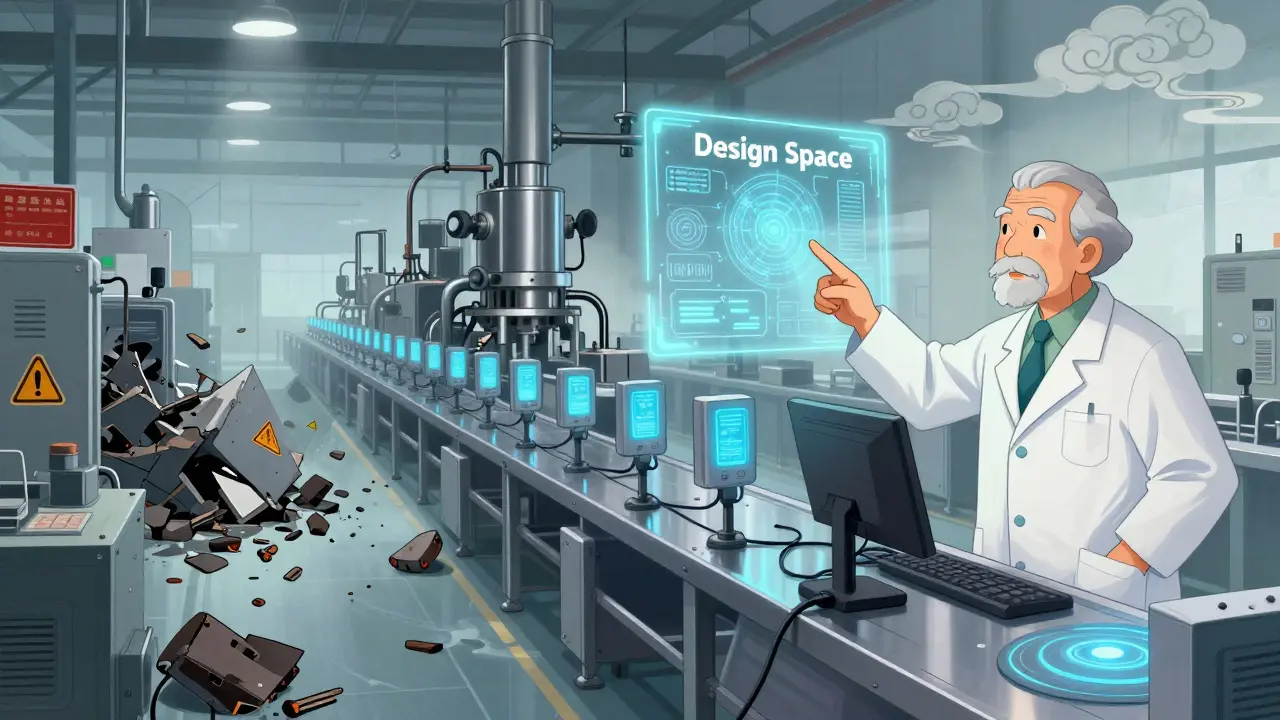
The smartest manufacturers don’t wait for a problem to happen. They build flexibility into the original ANDA. That’s where Quality by Design (QbD) comes in. Instead of locking in one exact process, they define a "design space"-a range of acceptable parameters for temperature, pressure, mixing time, etc. If you stay inside that space later, you might not need a PAS at all.Companies using Process Analytical Technology (PAT)-real-time sensors that monitor production-cut PAS submissions by 32.6% over five years. Why? Because they catch small drifts before they become big problems. One manufacturer of amlodipine switched to continuous manufacturing and got FDA approval in just eight months-not because they rushed, but because they had years of data to back up every change.
Pre-submission meetings with the FDA also help. The agency’s 2022 guidelines recommend 3-5 of these meetings for complex changes. Use them. Ask: "Will this trigger a PAS?" Get it in writing. Don’t assume you know what the FDA wants-ask.
What’s Changing in 2025 and Beyond
The FDA isn’t ignoring the problem. In September 2023, they launched the ANDA Prioritization Pilot Program. If you make your drug-and its active ingredient-in the U.S., your review can drop from 30 months to as little as 8 months. That’s a game-changer for companies willing to invest in domestic manufacturing.In January 2024, the FDA released draft guidance proposing a tiered risk system for complex generics. If approved, it could reduce PAS submissions by up to 35% for minor changes. The PreCheck program, rolled out in February 2024, could cut facility transfer times in half-from 18 months to 9.
And with GDUFA IV negotiations coming in 2025, the industry is pushing for standardized rules. Right now, one FDA division might call a change a PAS, while another says it’s a CBE. That inconsistency is a major pain point. Standardized criteria could save manufacturers millions in wasted time and resources.
What You Should Do Now
If you’re a generic manufacturer:- Map every step of your current process. What’s in your design space? What’s locked in?
- Review your last three changes. Did any of them trigger a PAS? Why?
- Start a pre-submission meeting checklist. What data does the FDA always ask for?
- Consider investing in PAT tools. The ROI isn’t just faster approvals-it’s fewer recalls and fewer out-of-spec batches.
- Don’t wait for a crisis. If you’re thinking about upgrading equipment, talk to the FDA before you buy.
The goal isn’t to avoid change. It’s to control it. The companies that thrive aren’t the ones with the cheapest production-they’re the ones who understand the rules well enough to work within them, not against them.
What Happens If You Change Without Approval?
Making a manufacturing change without submitting the right supplement isn’t just risky-it’s illegal. The FDA can:- Issue a warning letter
- Block shipments of your product
- Require a recall
- Delay approval of other products
- Remove your facility from the approved list
One company in 2021 switched to a new tablet press without filing a PAS. The product was bioequivalent, but the FDA found the change wasn’t properly validated. The result? A 6-month production halt and a $1.2 million fine. The change itself cost $45,000. The fallout cost 27 times more.
What’s the difference between a PAS and a CBE?
A Prior Approval Supplement (PAS) requires FDA approval before you can implement the change. These are for high-risk modifications like new facilities, major process changes, or altered formulations. A Changes Being Effected (CBE) allows you to make the change first, then notify the FDA. CBEs are for lower-risk changes like labeling updates or minor equipment swaps. CBE-30 gives you 30 days to notify the FDA; CBE-0 lets you notify immediately.
Can I change my drug’s packaging without FDA approval?
It depends. If you’re only changing the color or design of the bottle or carton, and it doesn’t affect how the drug is stored or handled, you can usually file an Annual Report. But if you’re switching from glass to plastic, changing the seal type, or altering the child-resistant cap, you may need a CBE or even a PAS-especially if it impacts stability or patient safety.
How long does a PAS review really take?
The FDA’s target is 10 months, but it often takes longer. Complex changes-like facility transfers or new manufacturing tech-can take 14 to 18 months. If the FDA sends a complete response letter asking for more data, the clock resets. Companies with strong pre-submission meetings and thorough documentation typically get through faster.
Does the FDA inspect my facility after I submit a PAS?
Yes, almost always. For PAS submissions involving new facilities, major process changes, or foreign sites, an inspection is standard. Even for smaller changes, the FDA can request one if they have concerns. That’s why it’s critical to keep your facility audit-ready at all times-not just when you’re submitting paperwork.
Why do small manufacturers get longer review times?
Small manufacturers often lack dedicated regulatory teams. Their submissions may be incomplete, poorly organized, or miss key data the FDA expects. Big companies have teams that know exactly what to include-what data to highlight, what to preemptively address. Small firms also get fewer pre-submission meetings and less guidance, making it harder to get it right the first time.
Is the FDA making it easier to make manufacturing changes?
Yes, but only for certain manufacturers. The new ANDA Prioritization Pilot Program and PreCheck program speed up reviews for companies making drugs and active ingredients in the U.S. The draft guidance for complex generics also aims to reduce unnecessary PAS submissions. But these benefits aren’t automatic-you have to qualify. The rules are shifting, but you still need to play by them.
Uzoamaka Nwankpa
January 4, 2026 AT 04:23The FDA’s obsession with control is suffocating. Every tiny tweak becomes a bureaucratic nightmare, and the real cost isn’t the $287K-it’s the innovation that never happens because no one dares to improve anything.
Manufacturers aren’t hiding anything. They’re just trying to make better medicine, not jump through hoops designed by people who’ve never seen a tablet press.
It’s not regulation-it’s performance art with paperwork.
Chris Cantey
January 5, 2026 AT 00:25There’s a deeper philosophical tension here: if a drug is bioequivalent, why does the mechanism of its creation matter? The FDA treats pharmaceuticals like sacred relics, where the ritual of production is as important as the substance itself.
But biology doesn’t care how the molecule was assembled-only whether it binds to the receptor.
Perhaps we’ve confused process with purity, and control with safety.
At what point does regulatory rigor become a form of epistemic arrogance?
Abhishek Mondal
January 5, 2026 AT 15:01Let’s be precise: the FDA’s classification of PAS, CBE, and AR is not merely inconsistent-it’s ontologically incoherent. The criteria for what constitutes a ‘major’ change are neither quantitatively nor qualitatively grounded in pharmacokinetic evidence.
Furthermore, the 20% scaling threshold is arbitrary; it originates from a 1987 guidance document predating modern process analytics.
And let’s not forget: the agency’s own 2021 internal audit admitted that 41% of PAS rejections were due to ‘inadequate documentation,’ not scientific deficiency.
So we’re not talking about safety-we’re talking about administrative compliance theater.
Also, the term ‘design space’ is a misnomer-it’s not a space, it’s a probability distribution over multivariate parameter sets, which the FDA rarely acknowledges in its reviews.
And don’t get me started on PAT-most companies use it as a compliance checkbox, not a real-time control system.
There’s a reason why 78% of PAS delays occur after the first FDA request for additional data: they’re fishing.
It’s not science. It’s interrogation.
Oluwapelumi Yakubu
January 5, 2026 AT 15:48Man, this whole thing is wild-like trying to fix a car engine while the mechanic’s blindfolded and you gotta ask permission before tightening a bolt.
But here’s the thing: the smart folks? They’re not waiting for the FDA to catch up.
I’ve seen startups in Lagos and Pune using AI-driven process monitoring to predict deviations before they happen-no PAS needed because they never break the rules, they just stay inside the lines before the lines even exist.
And guess what? Their products are cleaner, cheaper, and faster to market.
The FDA’s scared of change, but the world ain’t.
They’re building the future while the regulators are still arguing over the rulebook from 2003.
Meanwhile, patients are still waiting for their meds.
It’s not about resisting change-it’s about outsmarting the system before it catches you.
Terri Gladden
January 7, 2026 AT 10:36Okay but like… why does the FDA even exist if they’re just gonna make everyone cry? I swear I read this whole thing and now I’m crying in my coffee. Like… I just want my blood pressure pills to not cost $1200 a month because some bureaucrat didn’t like the color of the new mixer. Why is this so hard? I just want to live.
Also I think the FDA is secretly run by robots from 1998.
Send help. Or at least a hug.
Jennifer Glass
January 7, 2026 AT 14:53It’s fascinating how the system incentivizes stagnation. The more you innovate, the more regulatory risk you take. That’s not just inefficient-it’s anti-innovation by design.
And yet, the companies that thrive are the ones who treat regulatory strategy like R&D.
They don’t see the FDA as an obstacle-they see it as a co-designer.
Pre-submission meetings, QbD frameworks, PAT integration-these aren’t just compliance tools, they’re competitive advantages.
It’s not about playing the game better.
It’s about changing the game before you play it.
Joseph Snow
January 8, 2026 AT 06:52Let’s be honest: this entire regulatory framework is a corporate welfare scheme disguised as public safety.
The FDA doesn’t care about patients-they care about protecting Big Pharma’s market share.
Why? Because small manufacturers can’t afford the $300K PAS fee, so they don’t compete.
That means fewer generics, higher prices, and more profit for the brand-name companies who lobby for these rules.
And don’t tell me about ‘safety’-if a drug is bioequivalent, it’s bioequivalent.
The real reason for the PAS maze is to keep new entrants out.
It’s not regulation.
It’s collusion.
John Ross
January 8, 2026 AT 23:10Let’s unpack the jargon: PAS isn’t about safety-it’s about liability arbitrage.
The FDA shifts the burden of proof onto manufacturers, forcing them to validate every variable under a microscope, while the agency itself operates with zero transparency.
Process Analytical Technology isn’t a tool-it’s a shield.
Companies using PAT aren’t innovating-they’re insulating themselves from regulatory scrutiny.
And the ‘design space’ concept? It’s a legal loophole dressed in Six Sigma packaging.
The real innovation here isn’t in manufacturing-it’s in regulatory evasion.
And the FDA? They’re just playing catch-up with a spreadsheet.
Clint Moser
January 10, 2026 AT 11:32Did you know the FDA has a secret database that tracks which companies get approved faster? It’s called ‘The List’-and it’s only accessible to lobbyists who donate to the right PACs.
And the ‘Prioritization Pilot’? It’s not about domestic manufacturing-it’s about rewarding companies that donate to the FDA’s ‘training fund’.
They’re not speeding up reviews-they’re selling priority access.
And the ‘PreCheck’ program? It’s a front for a backdoor inspection racket.
Every facility that applies gets a ‘voluntary audit’-and guess who gets hired to do it? The same consultants who wrote the guidance.
This isn’t regulation.
It’s a pyramid scheme with lab coats.
Ashley Viñas
January 12, 2026 AT 00:39It’s pathetic. Small manufacturers don’t get longer reviews because they’re unprepared-they get longer reviews because they’re not connected.
The FDA has a whole network of former regulators who now work for big pharma consultancies.
They know exactly what to write, what to emphasize, what to bury.
Meanwhile, the honest ones? The ones trying to do the right thing? They’re left drowning in 300-page submissions that get rejected for using the wrong font.
It’s not about quality.
It’s about who you know.
And if you don’t have the right LinkedIn profile? Too bad.
Patients pay the price for this elitist club.
Brendan F. Cochran
January 12, 2026 AT 11:01America makes the best generics. Why are we letting India and China take over? The FDA’s rules are killing U.S. manufacturing.
Every time a company moves production overseas to avoid PAS hell, it’s a win for China and a loss for American jobs.
And now the FDA wants us to ‘invest in domestic production’? Too late.
We’ve already lost the race.
And now we’re stuck paying more for pills because we were too proud to play by the rules.
It’s not regulation.
It’s economic suicide.
And we’re the ones holding the shovel.
jigisha Patel
January 13, 2026 AT 12:11Statistically, the 27.3% increase in PAS submissions between 2018–2022 correlates almost perfectly with the rise in global supply chain disruptions-but the FDA’s analysis doesn’t acknowledge this.
They treat each submission as an isolated event, ignoring macroeconomic context.
Furthermore, the $287,500 cost figure is misleading-it excludes opportunity cost, which for a small firm can be 3–5x higher.
And the 10-month review timeline? That’s the mean, not the median.
The distribution is heavily right-skewed: 38% of PAS take over 18 months, with 12% exceeding 24 months.
Yet the FDA publishes only the average.
That’s not transparency.
That’s manipulation.
Mandy Kowitz
January 15, 2026 AT 07:48Wow. So the FDA is basically a 14-month-long customer service hold with a $300k fee and a 70% chance they’ll ask for one more thing you can’t possibly provide.
And we wonder why people are dying because they can’t afford their meds.
It’s not a health agency.
It’s a money pit with a badge.
melissa cucic
January 16, 2026 AT 16:57There’s an elegant paradox here: the more rigorously you define your process, the more flexibility you gain downstream.
Quality by Design isn’t a buzzword-it’s a mathematical framework for regulatory resilience.
When you map your design space using statistical process control, you don’t just reduce PAS submissions-you create a living system that adapts to variation without breaking compliance.
The FDA’s resistance isn’t to change-it’s to uncertainty.
And the companies that succeed are the ones who turn uncertainty into quantifiable risk.
It’s not about avoiding the regulator.
It’s about becoming the regulator’s most trusted partner.
That’s the real innovation.