
Sunscreen Science: SPF, UVA/UVB, and Daily Protection
 Jan, 2 2026
Every morning, you wash your face, apply moisturizer, maybe even a serum. But if you’re skipping sunscreen, you’re leaving your skin exposed to damage you can’t see - and it’s adding up. Sunscreen isn’t just for beach days. It’s not optional. It’s the single most effective thing you can do to prevent skin cancer and slow down visible aging. Yet most people don’t use it right - or even understand what they’re putting on their skin.
What SPF Really Means (And Why It’s Not Linear)
SPF stands for Sun Protection Factor. It measures how well a sunscreen blocks UVB rays - the ones that burn your skin. SPF 15 blocks about 93% of UVB rays. SPF 30 blocks 97%. SPF 50 blocks 98%. That’s it. There’s no magic jump from SPF 30 to SPF 50. The difference is just 1% more protection. But here’s the catch: most people apply only a quarter to half the amount they should. When you underapply, SPF 30 drops to the level of SPF 7.5. That’s why dermatologists recommend SPF 30 or higher - it gives you a buffer for sloppy application.
The FDA says SPF values above 50 don’t offer meaningful extra protection. In fact, they can trick you into thinking you’re invincible. You might stay out longer, reapply less, and end up getting more damage. That’s why the FDA proposed capping SPF labels at 60+. It’s not about marketing. It’s about keeping people safe.
UVA vs. UVB: The Silent vs. The Burn
Not all sun damage is the same. UVB rays are the short, intense ones that cause sunburns. They’re strongest between 10 a.m. and 4 p.m. and mostly affect the top layer of skin. That’s why you get red, peeling skin after a long day outside.
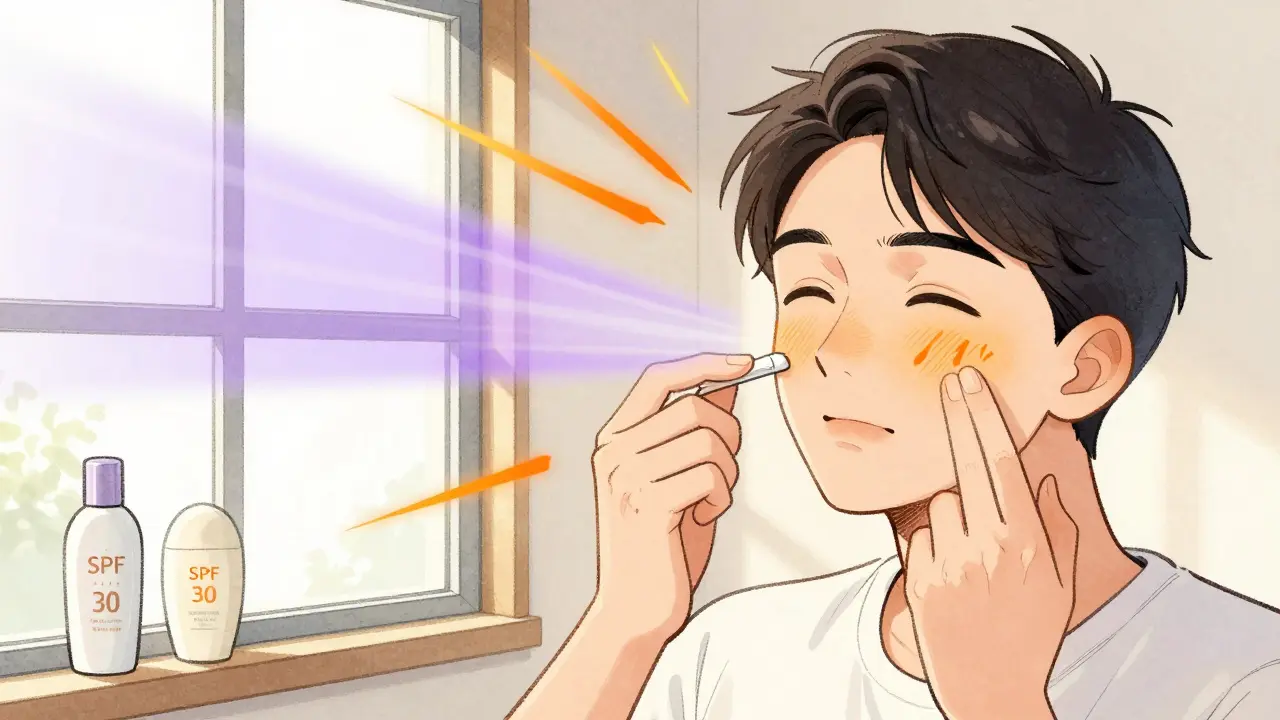
UVA rays are the quiet killers. They’re longer wavelengths that penetrate deeper - past the epidermis, into the dermis where collagen and elastin live. They don’t burn. They don’t even make you feel like you’re being damaged. But they break down your skin’s structure over time. That’s what causes wrinkles, sagging, and dark spots. UVA rays are present all day, every day, even through clouds and windows. You’re getting hit by them while driving, working near a window, or walking to your car.
That’s why broad-spectrum matters. A sunscreen labeled just “SPF 30” without “broad spectrum” might block UVB well but do almost nothing against UVA. The FDA requires sunscreens to pass a critical wavelength test (at least 370 nm) to be called broad spectrum. And now, the Skin Cancer Foundation requires UVA protection to match SPF levels - meaning SPF 50 must deliver UVA protection that’s at least one-third of that value, or higher. That’s new. That’s important.
Mineral vs. Chemical: What’s Actually in Your Sunscreen?
There are two main types of sunscreens: mineral (physical) and chemical.
Mineral sunscreens use zinc oxide and titanium dioxide. These sit on top of your skin and reflect UV rays like tiny mirrors. They start working immediately. They’re less likely to irritate sensitive skin - which is why so many people with acne or rosacea swear by them. But they can leave a white cast, especially on darker skin tones. Newer formulas use micronized particles and tinted bases to reduce this. Brands like Suntribe and CeraVe have made big strides here.
Chemical sunscreens use ingredients like avobenzone, octinoxate, octocrylene, and oxybenzone. These absorb UV rays and convert them into harmless heat. They tend to be lighter, more invisible, and easier to layer under makeup. But some ingredients - especially oxybenzone - can trigger breakouts or stinging around the eyes. A 2023 Reddit survey of over 1,200 users found 78% had fewer reactions switching to mineral sunscreens. But 63% complained about the white cast.
Here’s the truth: neither is universally better. It depends on your skin. If you break out easily, try mineral. If you hate the white cast, look for chemical formulas labeled “invisible” or “no white cast.” La Roche-Posay Anthelios, for example, has 4.4 stars on Amazon from nearly 9,000 reviews - mostly because it blends well and doesn’t irritate.

Water Resistance, Reapplication, and the 1/4 Teaspoon Rule
Water resistance isn’t waterproof. No sunscreen is. The FDA allows two labels: “water resistant (40 minutes)” or “water resistant (80 minutes).” That means the SPF stays effective for that long while swimming or sweating. After that, you need to reapply - even if you didn’t get wet.
And here’s the biggest mistake people make: they don’t use enough. Dermatologists say you need 2 milligrams of sunscreen per square centimeter of skin. For your face and neck, that’s about 1/4 teaspoon. For your whole body, it’s a shot glass full. Most people use a third of that. That’s why SPF 30 becomes SPF 10 in real life.
Reapply every two hours - no exceptions. If you’re sweating, swimming, or wiping your face, reapply right away. Even if the bottle says “all-day protection.” That’s marketing. Not science.
Daily Use Isn’t Optional - Even on Cloudy Days
Dr. Leslie Baumann says it plainly: UVA rays are just as strong in winter as in summer. They cut through clouds. They pass through glass. You’re getting exposed while sitting by a window, commuting, or walking the dog.
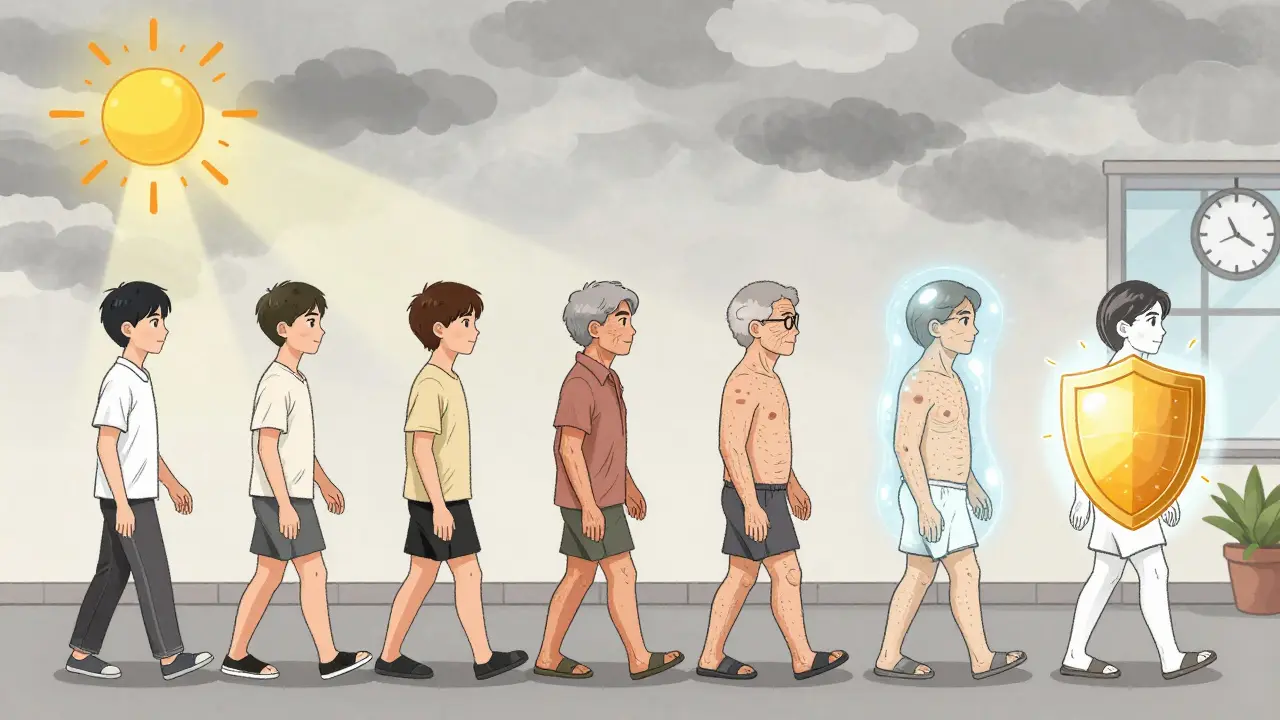
That’s why the American Academy of Dermatology and the Skin Cancer Foundation now recommend daily sunscreen use - not just when you’re outside. UV damage is cumulative. Every little exposure adds up. That’s why people in their 40s and 50s are showing signs of sun damage even if they never got sunburned.
Start your morning routine with sunscreen. Apply it after moisturizer, before makeup. Let it sit for 15 minutes before adding anything else. If it pills under foundation, you’re either using too much or applying it too soon. Wait. Let it absorb. Then go.
What’s Changing in 2025?
The FDA is cracking down. By December 2025, any sunscreen sold in the U.S. that doesn’t clearly label “broad spectrum” will be pulled from shelves. That’s a big deal. It means brands can’t hide weak UVA protection behind a high SPF number anymore.
Also, the Skin Cancer Foundation raised its standards. To earn their Seal of Recommendation, Daily Use sunscreens now need SPF 30+ (up from 15). Active sunscreens need SPF 50+ (up from 30). And they now require UVA protection scores of at least 20 for SPF 50+ products - meaning real, measurable UVA defense, not just a label.
And yes, the industry is looking ahead. Dermatologists predict that in five years, sunscreens will also protect against blue light from screens and infrared radiation from heat. Some already do. But that’s the next frontier.
What to Look For - and What to Avoid
Here’s a simple checklist:
- SPF 30 or higher - no exceptions for daily use
- Broad spectrum - non-negotiable
- Mineral (zinc oxide/titanium dioxide) - if you have sensitive, acne-prone, or reactive skin
- Chemical (avobenzone, octocrylene) - if you want something lightweight and invisible
- Water resistant (40 or 80 min) - if you sweat or swim
- No oxybenzone or octinoxate - if you’re worried about coral reefs or skin irritation
Avoid anything labeled “sunblock” - that term is banned by the FDA. Don’t trust “SPF 100” claims - they’re misleading. And never rely on makeup with SPF alone. You’d need to apply 7 times the normal amount of foundation to get the protection listed.
Bottom Line: Sunscreen Is Your Skin’s Best Friend
You don’t need the most expensive product. You don’t need to wear it in the winter. You just need to use it - every day - the right way. SPF 30+, broad spectrum, 1/4 teaspoon for your face, reapplied every two hours. That’s it.
The science is clear. The data is solid. The risks are real. Skin cancer is the most common cancer in the U.S. - and most of it is preventable. Wrinkles and dark spots? Also preventable.
Start today. Pick one sunscreen that works for your skin. Stick with it. Apply it like your skin depends on it - because it does.
Is SPF 50 really better than SPF 30?
SPF 50 blocks 98% of UVB rays. SPF 30 blocks 97%. That’s just a 1% difference. But most people apply too little sunscreen, so SPF 50 gives you a safety buffer. If you’re applying the full amount, SPF 30 is enough. If you’re not - and most people aren’t - SPF 50 helps make up for it.
Do I need sunscreen on cloudy days or indoors?
Yes. Up to 80% of UV rays penetrate clouds. UVA rays - the ones that age your skin - pass through windows. You’re getting exposure every day, even if you’re not outside. Daily sunscreen is the only way to stop cumulative damage.
Why does my mineral sunscreen leave a white cast?
Zinc oxide and titanium dioxide are naturally white. Older formulas used larger particles that sat on top of the skin. Newer versions use micronized or tinted versions that blend better. Look for brands labeled “sheer,” “tinted,” or “for dark skin tones.” Letting it sit for 15 minutes before makeup also helps it blend.
Can I use last year’s sunscreen?
Check the expiration date. Most sunscreens last 3 years unopened. Once opened, they lose effectiveness after 12 months. If it smells weird, changed color, or separated, toss it. Expired sunscreen won’t protect you - even if it still looks fine.
Are chemical sunscreens safe?
The FDA has approved the ingredients in chemical sunscreens for use. But some, like oxybenzone, can irritate sensitive skin or cause breakouts. If you have acne or rosacea, mineral sunscreens are often better. Also, oxybenzone and octinoxate are banned in some places because they harm coral reefs. If you’re swimming in oceans, choose reef-safe formulas.
Should I wear sunscreen under makeup?
Yes - and make it the last step of your skincare routine. Apply sunscreen after moisturizer and before makeup. Wait 15 minutes for it to absorb. If your makeup pills, you applied too soon or too much. Some foundations have SPF, but you’d need to apply 7 times the normal amount to get the protection listed. Don’t rely on them alone.
Next time you reach for your moisturizer, grab your sunscreen first. It’s not extra. It’s essential. Your skin won’t thank you today. But it will thank you in five, ten, twenty years.
Angela Fisher
January 3, 2026 AT 21:26SPF 50 is a scam. The FDA knows it. Big Pharma knows it. They just want you to buy more. You think they care about your skin? Nah. They care about profit. And don’t get me started on mineral sunscreens - zinc oxide is literally just white paint with a science label. They’re putting nanoparticles in there and calling it ‘safe.’ But what about the long-term effects? No one’s studying that. I’ve seen videos - these particles get into your bloodstream. Your blood. And they’re still selling it like it’s holy water. 😡
Neela Sharma
January 4, 2026 AT 14:00sunscreen is not a product
it is a promise
to your future self
who will still have skin
when the world forgets to care
apply it like prayer
not like a chore
Sarah Little
January 6, 2026 AT 05:50Based on the 2023 Reddit survey cited, there’s a significant correlation between mineral sunscreen usage and reduced cutaneous reactivity (p < 0.01). However, the sample size is self-selected and non-representative of the general dermatological population. Additionally, the white cast phenomenon is empirically linked to particle size distribution and refractive index variance - not formulation quality. The FDA’s 2025 labeling mandate may induce unintended compliance drift in consumer behavior due to perceptual anchoring on SPF values.
JUNE OHM
January 6, 2026 AT 07:28SPF 30? That’s what they want you to use. But if you’re American, you deserve better. We invented sunscreen. We built the science. And now some hippie brand from India is telling us to use ‘reef-safe’ crap? No way. SPF 100 is real. And if you don’t use it, you’re letting the world win. 🇺🇸☀️💥
Philip Leth
January 7, 2026 AT 14:02My abuela in Mexico used olive oil and a hat. No sunscreen. Lived to 92. Walked barefoot in the fields till she was 85. Maybe we’re overcomplicating this. Sun’s not the enemy. Fear is.
Angela Goree
January 7, 2026 AT 18:47Wait-so you’re telling me I’ve been wasting money on SPF 50? And I’ve been applying it wrong? And now I have to wait 15 minutes? And I can’t trust makeup with SPF? And I have to use a shot glass? And the FDA is changing rules AGAIN? WHAT IS THIS, A LIE? I’M JUST TRYING TO NOT GET OLD!!!
Shanahan Crowell
January 9, 2026 AT 00:45You’re not alone. I used to skip sunscreen until I saw my first mole biopsy result. Now I treat it like brushing my teeth. Doesn’t matter if it’s raining, snowing, or I’m inside. It’s non-negotiable. Start small. Just do your face. Then your neck. Then your hands. You’ll feel better. I promise.
Kerry Howarth
January 10, 2026 AT 22:22SPF 30 applied correctly is sufficient. Most people underapply. Reapply every two hours. Use broad spectrum. Avoid oxybenzone if sensitive. That’s the science. No hype needed.
Tiffany Channell
January 12, 2026 AT 11:11Let’s be honest. You think you’re protecting your skin? You’re just buying into a $12 billion industry built on fear. You’re not preventing cancer. You’re preventing a feeling of vulnerability. Meanwhile, your skin is suffocating under layers of chemical sludge. You’re not being protected. You’re being manipulated.
Joy F
January 14, 2026 AT 10:25It’s not about sunscreen. It’s about control. We live in a world that tells us to fear the sun, fear our own bodies, fear the natural. We’re told to cover up, to block, to chemically armor ourselves - all while corporations profit from our anxiety. Mineral or chemical? It’s a false binary. The real question is: Who benefits from your fear? And why does your skin feel like it’s screaming every time you apply it?
Haley Parizo
January 15, 2026 AT 17:36I’ve been using zinc oxide for 10 years. I’m 47. No wrinkles. No spots. No melanoma. I don’t care about the white cast - I care about living. If you’re still using chemical sunscreen because you don’t want to look like a ghost, you’re choosing vanity over survival. Wake up.
Ian Detrick
January 17, 2026 AT 14:21My dad used to say, ‘The sun gives life. Don’t fight it. Respect it.’ He was right. I wear a hat. I seek shade. I use sunscreen - but I don’t obsess. I live. I don’t hide. And I’m 52. Still tan. Still healthy. Maybe the answer isn’t more product. Maybe it’s more wisdom.
Shruti Badhwar
January 18, 2026 AT 14:47While the scientific consensus supports daily broad-spectrum sunscreen use, cultural norms in South Asia have historically emphasized physical barriers - umbrellas, scarves, and hats - as primary protection. These methods, when combined with minimal topical application, yield comparable photoprotection with fewer chemical exposures. The Western obsession with SPF numbers may overlook holistic, low-tech alternatives that are equally effective and culturally embedded.
Angela Fisher
January 19, 2026 AT 14:25And don’t even get me started on the ‘tinted’ mineral sunscreens. They’re just foundation with a sunscreen label. They’re using iron oxides - which are fine - but then they add mica and titanium dioxide to make it ‘glow.’ That’s not skincare. That’s makeup with a fake medical stamp. You’re not protecting your skin. You’re painting it. And then you wonder why you break out. 😒