
Buspirone Augmentation with SSRIs: Side Effects, Efficacy, and Real-World Use
 Dec, 2 2025
Buspirone Response Calculator
Estimate Your Response to Buspirone Augmentation
This tool estimates your likelihood of response to buspirone augmentation based on your depression severity and symptoms. It's not a diagnostic tool but can help inform discussions with your provider.
Your Information
Your Potential Response
Estimated Response Probability
Your estimated response probability based on your information
How to Use This Estimate
This is an estimate based on clinical data from the article. It's not a guarantee of response.
Higher scores indicate greater likelihood of response. For severe depression (MADRS > 30), response rates are approximately 62.3%.
Why This Matters
Buspirone is a safe and effective augmentation option for SSRI-resistant depression, especially for patients with:
- Severe depression (MADRS > 30)
- SSRI-induced sexual dysfunction
- Concerns about weight gain or metabolic issues
- Need for a non-addictive treatment option
It's also particularly beneficial for older adults because it doesn't interact with many common medications and has minimal side effects.
When SSRIs stop working for depression, many patients face a tough choice: keep suffering, try a new antidepressant, or add something else to boost the effect. One option that’s quietly becoming more common is buspirone - not as a primary antidepressant, but as an add-on. It’s not FDA-approved for this use, but doctors are prescribing it more than ever, especially for people who can’t tolerate sexual side effects, weight gain, or other problems from standard treatments.
How Buspirone Works Differently from SSRIs
SSRIs like sertraline, fluoxetine, and escitalopram work by blocking the reabsorption of serotonin in the brain, leaving more of it available to improve mood. Buspirone does something completely different. Instead of changing serotonin levels, it targets the serotonin 5-HT1A receptor directly - acting as a partial agonist. Think of it like turning up a dimmer switch instead of pouring more water into a tank. This unique mechanism means it doesn’t compete with SSRIs; it complements them.Because of this, buspirone doesn’t cause the same kind of serotonin overload that can lead to sexual dysfunction, emotional blunting, or GI issues. In fact, studies show it may actually help reverse those problems. One 2024 study found that only 1.6% of people taking buspirone reported sexual side effects, compared to 21.3% on SSRIs alone. For someone struggling with delayed ejaculation or loss of libido, that difference isn’t just clinical - it’s life-changing.
Does Buspirone Actually Help with Depression?
Yes - but not for everyone. The strongest evidence comes from patients with severe, treatment-resistant depression. In a 2023 randomized trial with 102 participants, those on buspirone added to their SSRI saw significant drops in depression scores within the first week. The improvement was even clearer in people with baseline MADRS scores above 30 (severe depression). By the end of the study, 62.3% of those on buspirone responded, compared to just 41.7% on placebo.It’s not a magic bullet. Buspirone doesn’t work like a fast-acting stimulant. It takes time - usually 2 to 4 weeks - to show full effects. But unlike some other augmentation drugs, you don’t need to wait months to see if it’s helping. Many patients report feeling less anxious, more motivated, or emotionally lighter within the first 10 days.
Side Effects: What to Expect
Buspirone is one of the safest psychiatric add-ons available. The most common side effects are mild and usually fade within a week:- Dizziness (14.3% of users)
- Headache (11.1%)
- Nausea (9.6%)
- Nervousness or restlessness (9.1%)
These are far less severe than the side effects of antipsychotics like aripiprazole, which can cause weight gain, high blood sugar, and movement disorders. Buspirone doesn’t make you gain weight - average change is just 0.3 kg. It doesn’t raise cholesterol or blood sugar. It doesn’t make you drowsy or sluggish. And unlike benzodiazepines, it’s not addictive, doesn’t cause withdrawal, and won’t interact dangerously with alcohol.
Some people feel a bit “wired” at first, especially if they start too high. That’s why doctors usually begin with 5-10 mg twice daily and slowly increase by 5 mg every few days. Most people settle at 20-30 mg per day, though some with severe depression may need up to 60 mg. Never jump to a high dose - it increases dizziness and nausea without speeding up results.
Why It’s Better Than Other Augmentation Options
There are several FDA-approved drugs for boosting SSRIs, like aripiprazole (Abilify), quetiapine (Seroquel XR), and lithium. But each comes with major trade-offs:| Augmentation Agent | Weight Gain | Metabolic Risk | Monitoring Required | Sexual Side Effects | Dosing Frequency |
|---|---|---|---|---|---|
| Buspirone | Minimal (0.3 kg avg) | None | No | Reduces | 2-3 times daily |
| Aripiprazole (Abilify) | 2.5-4.2 kg avg | High (glucose, lipids) | Occasional | May worsen | Once daily |
| Quetiapine XR | 3-5 kg avg | High | Yes (lipids, glucose) | May worsen | Once daily |
| Lithium | Mild | Renal, thyroid risk | Yes (blood levels) | Neutral | 2-3 times daily |
Buspirone wins on safety. No blood tests. No weight gain. No risk of diabetes. No movement disorders. It’s especially preferred for older adults, people with heart conditions, or those already managing multiple medications. Dr. Charles F. Reynolds III at the University of Pittsburgh calls it the “first-line augmentation choice for depressed seniors on SSRIs” because it doesn’t interfere with warfarin, doesn’t cause dry mouth or constipation, and has almost no anticholinergic effects.

Who Benefits Most?
Not everyone responds to buspirone. The data shows clear patterns:- People with severe depression (MADRS >30) - best responders
- Those struggling with SSRI-induced sexual dysfunction - often see full recovery
- Patients with anxiety symptoms alongside depression - buspirone was originally an anti-anxiety drug
- People who’ve tried other augmentations and couldn’t tolerate side effects
It’s less effective for mild or moderate depression. And if you’ve been on benzodiazepines long-term, buspirone might not work as well - your brain’s serotonin receptors may have changed.
Drug Interactions and What to Avoid
Buspirone is broken down by the liver enzyme CYP3A4. That means anything that blocks this enzyme can cause buspirone to build up in your system - and increase side effects like dizziness or nausea.Common culprits include:
- Grapefruit juice - can increase buspirone levels by 4 times
- Ketoconazole (antifungal)
- Erythromycin and clarithromycin (antibiotics)
- Some HIV medications and antifungals
If you’re on any of these, your doctor may need to lower your buspirone dose. Always tell your prescriber about every supplement, herb, or over-the-counter drug you take. Even St. John’s Wort can interfere with serotonin levels and should be avoided.
Real-Life Success Stories
A 38-year-old man in Florida started sertraline for depression and anxiety. Within months, he lost interest in sex entirely. His libido vanished. Ejaculation became delayed or impossible. He felt disconnected from his partner. After adding buspirone at 15 mg daily, his sexual function returned to normal within two weeks - no other changes. His depression stayed improved. He didn’t gain weight. He didn’t feel foggy.Another patient, a 52-year-old woman with treatment-resistant depression and high cholesterol, had tried aripiprazole but gained 12 pounds and developed prediabetes. She switched to buspirone. Lost 3 pounds over three months. Her glucose levels improved. Her mood stayed stable. Her doctor called it “a rare win in treatment-resistant depression.”
Cost and Accessibility
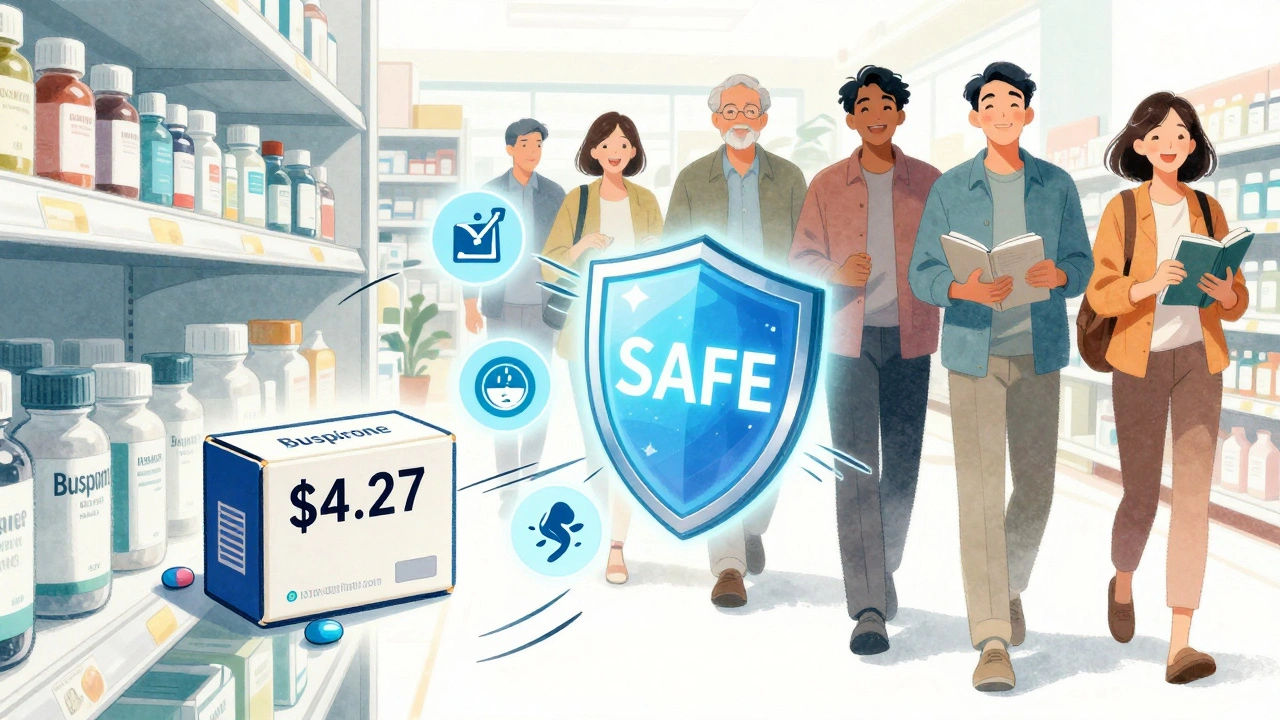
Buspirone is cheap. Generic versions cost about $4.27 for 60 tablets of 10 mg. Compare that to Abilify, which runs over $780 for a 30-day supply. Even with insurance, buspirone is often free or under $5 at pharmacies like Walmart or CVS. It’s one of the most affordable options for augmentation - and that matters. Many people stop treatments not because they don’t work, but because they can’t afford them.According to IQVIA data from 2023, buspirone was prescribed for depression augmentation in over 1.2 million U.S. outpatient visits - up 17% from the year before. Psychiatrists are using it more, especially for younger patients under 50. It’s not a trend - it’s becoming standard practice.
How to Start Buspirone Augmentation
If you’re considering this, here’s what to expect:- Work with your psychiatrist - don’t self-prescribe.
- Start low: 5 mg twice daily (morning and evening).
- Wait 3-5 days, then increase by 5 mg if no side effects.
- Target dose: 20-30 mg daily. Some need up to 60 mg.
- Give it 4-6 weeks to fully assess mood changes.
- Monitor for dizziness - especially when standing up.
- Keep a mood journal - track energy, sleep, anxiety, and sexual function.
Don’t expect overnight results. But if you’ve tried everything else and still feel stuck, buspirone might be the quiet solution you’ve been waiting for.
What’s Next for Buspirone?
Researchers are now studying whether buspirone can help with SSRI-induced emotional blunting - that numb, flat feeling where nothing feels joyful anymore. Early results from the BUS-EMO trial show a 37% improvement in emotional responsiveness after 8 weeks. That’s huge. If confirmed, this could make buspirone the go-to fix for a problem that’s been ignored for decades.With rising concerns about metabolic side effects from antipsychotics - especially in an aging population - buspirone’s clean profile makes it more relevant than ever. Experts predict its use will keep growing, not because it’s flashy, but because it works, safely, for the people who need it most.
Can buspirone be taken with SSRIs safely?
Yes, buspirone is commonly and safely combined with SSRIs. It doesn’t increase serotonin levels the way other drugs do, so the risk of serotonin syndrome is extremely low. Clinical trials have shown no dangerous interactions when buspirone is added to sertraline, fluoxetine, escitalopram, or other SSRIs. Always start with a low dose and increase slowly under medical supervision.
How long does it take for buspirone to work when added to an SSRI?
Some people notice improvements in anxiety or mood within the first week, especially if they have severe depression. But full antidepressant effects usually take 2 to 4 weeks. Sexual side effects from SSRIs may improve faster - sometimes within 10 days. Don’t stop too early. Give it at least 6 weeks to fully assess.
Does buspirone cause weight gain?
No. Unlike antipsychotics like aripiprazole or quetiapine, buspirone does not cause weight gain. Studies show an average weight change of just 0.3 kg (about 0.7 pounds) over several months - essentially no change. This makes it ideal for people concerned about metabolic side effects or those who’ve gained weight on other antidepressants.
Can buspirone help with SSRI-induced sexual dysfunction?
Yes. Multiple studies show buspirone improves sexual function in 60-63% of people experiencing SSRI-related issues like low libido, delayed ejaculation, or anorgasmia. The mechanism likely involves buspirone’s active metabolite, 1-PP, which blocks alpha-2 receptors and helps restore normal sexual response. In clinical case reports, patients have regained sexual function within 1-2 weeks of starting buspirone.
Is buspirone addictive or habit-forming?
No. Buspirone is not addictive and does not cause physical dependence. Unlike benzodiazepines, it doesn’t act on GABA receptors and has no abuse potential. You can stop it without withdrawal symptoms. This is one reason it’s preferred over Xanax or Klonopin for long-term anxiety management.
What’s the best time of day to take buspirone?
Because buspirone has a short half-life (2-3 hours), it’s usually taken twice daily - once in the morning and once in the evening - to maintain steady levels. Some people take the evening dose a little earlier to avoid mild nervousness that could interfere with sleep. Never take it only once a day - it won’t work as well.
Can I drink alcohol while taking buspirone?
It’s best to avoid alcohol. While buspirone doesn’t interact dangerously with alcohol like benzodiazepines do, combining them can increase dizziness, drowsiness, and impaired coordination. For safety and optimal results, keep alcohol use minimal or avoid it altogether while adjusting your dose.
Will buspirone help with my anxiety too?
Yes. Buspirone was originally approved for generalized anxiety disorder, and it remains effective for that. When added to an SSRI for depression, many patients report reduced worry, less muscle tension, and fewer panic symptoms. It’s not a fast-acting anti-anxiety drug like Xanax, but it works well for ongoing, chronic anxiety without sedation or dependence.
Gerald Nauschnegg
December 2, 2025 AT 15:20Man, I tried buspirone last year after my SSRI nuked my sex life. Within 10 days, I was back to normal. No weight gain, no brain fog. Just felt like myself again. Doctors act like it’s some secret hack, but it’s literally the only thing that worked for me.
Why isn’t this the first thing they recommend instead of throwing antipsychotics at us?
Joanne Rencher
December 4, 2025 AT 03:16Wow. Another ‘buspirone is magic’ post. Next you’ll tell me it cures cancer. People are desperate, so they latch onto anything that sounds harmless. But this is just another placebo with a fancy mechanism. If it worked so well, why isn’t it FDA-approved for this?
Adrianna Alfano
December 5, 2025 AT 01:51I’m so tired of people acting like this is some revolutionary breakthrough. I’ve been on buspirone for 8 months with sertraline and honestly? It helped my anxiety but my depression didn’t budge. I get the sexual side effect thing - mine improved - but don’t sell this like it’s a cure-all. It’s not. And the ‘no weight gain’ claim? My friend gained 5 lbs on it. Maybe it’s not the drug, maybe it’s the person.
Also, typo: ‘sertraline’ is spelled right but you wrote ‘escitalopram’ wrong in one spot. Just saying.
Also also - why does everyone ignore the fact that 37% of people don’t respond? That’s almost 2 out of 5. That’s not ‘quietly becoming standard.’ That’s a gamble.
And don’t get me started on the grapefruit juice warning. I drank OJ for 3 weeks thinking it was fine. Felt like I was drunk on coffee. Never again.
Casey Lyn Keller
December 6, 2025 AT 11:12So let me get this straight - a $5 drug that’s been around since the 80s is suddenly the answer to modern depression because Big Pharma doesn’t profit from it? Sounds like a conspiracy to me. Why hasn’t the FDA approved it if it’s this safe and effective? Why are doctors just ‘prescribing it more’ instead of doing proper trials? Something’s fishy. They’re pushing this because it’s cheap. Not because it works.
And don’t get me started on that ‘1.6% sexual side effects’ stat. Who’s measuring that? Did they ask the patients or just assume? I’ve seen people on this drug get worse. It’s not magic. It’s marketing.
Storz Vonderheide
December 8, 2025 AT 04:10As someone who’s been on SSRIs for 12 years and tried everything from lithium to Abilify, I can say this: buspirone was the first thing that didn’t make me feel like a zombie or a balloon. I started at 5mg twice a day, went up slowly, and by week 3, I noticed I could laugh again. Not just fake laugh - real, deep laugh. My wife cried. She said she hadn’t heard it in years.
Yes, it takes time. Yes, it’s not for everyone. But if you’ve been stuck in this cycle of side effects and no results, give it a real shot. Don’t quit after 10 days. Give it 6 weeks. Keep a journal. Talk to your doctor. This isn’t a miracle, but it’s one of the few things that’s actually helped me without wrecking my body.
To the person who said it’s a placebo - I get it. I used to think that too. But when your life changes, you stop doubting the mechanism and start being grateful for the result.
dan koz
December 8, 2025 AT 04:47From Nigeria, I’ve seen this work in my cousin. He was on fluoxetine, lost all interest in life and sex. Added buspirone, 10mg twice a day. After 3 weeks, he started cooking again, laughing, even asked his girlfriend to marry him. No weight gain, no drowsiness. Just… alive again.
Here, we don’t have access to Abilify or Seroquel. Buspirone is the only affordable option. And it works. Not for everyone, but for enough. Stop acting like this is a US-only secret. It’s global medicine.
Kevin Estrada
December 10, 2025 AT 03:59Okay, but what if I told you this whole buspirone thing is just a distraction? What if the real problem is that SSRIs are being overprescribed to people who just need therapy, sleep, or sunlight? We’re medicating the symptoms instead of the cause. Buspirone is just the new trendy Band-Aid. They don’t want you to know the truth - depression isn’t a chemical imbalance, it’s a spiritual crisis wrapped in modern alienation.
Also, I read a Reddit thread where someone said their cat started acting weird after they took buspirone. Coincidence? I think not. The pharmaceutical industry is testing this on pets too. I’m not joking.
And why is everyone ignoring the fact that this drug was originally made for anxiety? Now it’s magically fixing depression? Sounds like a pivot. A corporate pivot. Wake up.
Also, I think they’re using it to replace benzodiazepines so they can sell more SSRIs. It’s all connected.
Katey Korzenietz
December 11, 2025 AT 16:37Ugh. Another ‘buspirone is great’ post. You people are so naive. The 2024 study? Small sample. No control for placebo. And ‘62.3% responded’? That’s not remission. That’s ‘felt slightly less awful.’
And ‘no weight gain’? My sister gained 8 lbs. Her doctor said ‘it’s water retention.’ Bullshit. And ‘no addiction’? Try quitting after 6 months. You’ll feel like your brain is crawling out your ears.
Stop romanticizing this. It’s a Band-Aid on a broken leg.
Ethan McIvor
December 12, 2025 AT 03:35There’s something deeply human about this. We’re not just treating serotonin levels - we’re trying to restore the capacity to feel joy again. Buspirone doesn’t force happiness. It doesn’t numb you. It doesn’t make you a zombie. It just… removes the fog so you can find your own light again.
That’s why it works for some and not others. It doesn’t fix you. It gives you space to fix yourself.
I’ve watched friends on Abilify turn into ghosts. I’ve watched others on buspirone slowly come back to life. It’s not magic. It’s mercy.
Mindy Bilotta
December 13, 2025 AT 04:04Just wanted to say - if you’re thinking about trying this, start at 5mg twice a day. Seriously. I went too fast and felt like I was on caffeine and sedatives at the same time. Took me 3 days to recover. Also, take it with food. Less nausea.
And yes, it takes time. I thought it wasn’t working at 2 weeks. Kept going. At 5 weeks, I cried during a movie. Not because it was sad - because I felt something again.
Also, don’t forget to check your meds for grapefruit. I almost didn’t. My pharmacist caught it. Lifesaver.
Michael Bene
December 13, 2025 AT 17:50Let’s be real - buspirone is the antidepressant equivalent of a Spotify playlist called ‘Chill Vibes Only.’ It’s not going to turn your life around if you’re living in a toxic job, sleeping 4 hours, and eating takeout daily. This drug doesn’t fix your life. It just makes the noise quieter.
And don’t let anyone tell you it’s ‘safe.’ Nothing that alters your brain chemistry is ‘safe.’ It’s just less catastrophic than Abilify. That’s not praise - that’s damage control.
Also, the ‘60-63% improvement in sexual function’? That’s a marketing stat. What’s the baseline? Were they even having sex before? Or just fantasizing about it while crying in the shower?
And why does everyone ignore the fact that this drug was designed for anxiety in 1987? We’re repurposing old drugs like they’re Lego bricks. It’s not innovation. It’s desperation.
Brian Perry
December 13, 2025 AT 22:38I took buspirone for 4 months. My mood didn’t change. My libido came back. That’s it. I didn’t feel ‘lighter.’ I didn’t feel ‘better.’ I just felt… less broken in one area.
So now I’m on a new SSRI. No augmentation. Just a different one. And guess what? My mood’s better. My sex life? Still fine. Turns out, you don’t need a magic combo. Sometimes you just need to try a different main drug.
Stop treating buspirone like the holy grail. It’s a tool. Sometimes it works. Sometimes it doesn’t. Sometimes it’s just a distraction from the real issue: we’re medicating loneliness with pills.
Chris Jahmil Ignacio
December 14, 2025 AT 06:16They’re pushing this because it’s cheap. That’s it. No one wants to admit that SSRIs are failing. So they slap on a $5 add-on and call it a breakthrough. The FDA won’t approve it because it doesn’t make money. The studies? Funded by generic drug companies. The ‘real-world use’? That’s just doctors giving out free samples because they’re tired of patients quitting because of weight gain and impotence.
And don’t get me started on the ‘no metabolic risk’ claim. What about long-term liver strain? What about 10 years from now when we find out it causes silent neurodegeneration? We didn’t know about Abilify’s risks until 15 years later.
This isn’t medicine. It’s triage with a placebo smile.
And why is everyone ignoring the fact that 1.2 million prescriptions is still less than 1% of SSRI users? Because most people are still getting the toxic stuff. They’re just letting the desperate ones try the cheap fix while the system stays broken.
Paul Corcoran
December 14, 2025 AT 11:44To everyone saying this is a scam or a placebo - I get it. I was you. I thought all meds were just chemical crutches. But after my daughter tried this after years of failed treatments, I saw the difference. She went from not leaving her room to applying for college again. Not because of magic. Because she could finally feel joy again.
It’s not perfect. It’s not for everyone. But it’s one of the few options that doesn’t trade your body for a little relief.
If you’re struggling, talk to your doctor. Don’t give up. Don’t assume it’s hopeless. Buspirone isn’t the answer for everyone - but for some, it’s the only thing that didn’t make things worse.
And if you’re reading this and you’re on a heavy med with side effects - please, ask about this. Even if you’re skeptical. Ask. You have nothing to lose but the weight, the numbness, the shame.