
Diabetes Foot Care: Ulcer Prevention and Daily Inspection Checklist
 Dec, 3 2025
Every year, over 82,000 people in the U.S. lose a foot or leg to diabetes-related amputation. Most of these cases are preventable. The truth is, diabetic foot ulcers don’t appear out of nowhere. They start as a tiny cut, a blister, or a red spot you didn’t notice. By the time you feel pain, it’s often too late. But with a simple daily routine and the right knowledge, you can stop it before it begins.
Why Foot Care Matters More Than You Think
Diabetes doesn’t just affect blood sugar. Over time, high glucose levels damage nerves and reduce blood flow-especially in your feet. This is called peripheral neuropathy and peripheral artery disease. You might not feel a pebble in your shoe. You might not notice a blister forming. Your foot could be getting injured every day, and you won’t know until it’s infected. The International Working Group on the Diabetic Foot (IWGDF) says 15% to 25% of people with diabetes will develop a foot ulcer in their lifetime. Of those, 20% end up needing an amputation. The good news? The same group found that up to 85% of these amputations can be prevented with proper foot care. It’s not about being perfect. It’s about being consistent. A daily 5-minute check can save your foot-and your life.The 7-Step Daily Foot Inspection Checklist
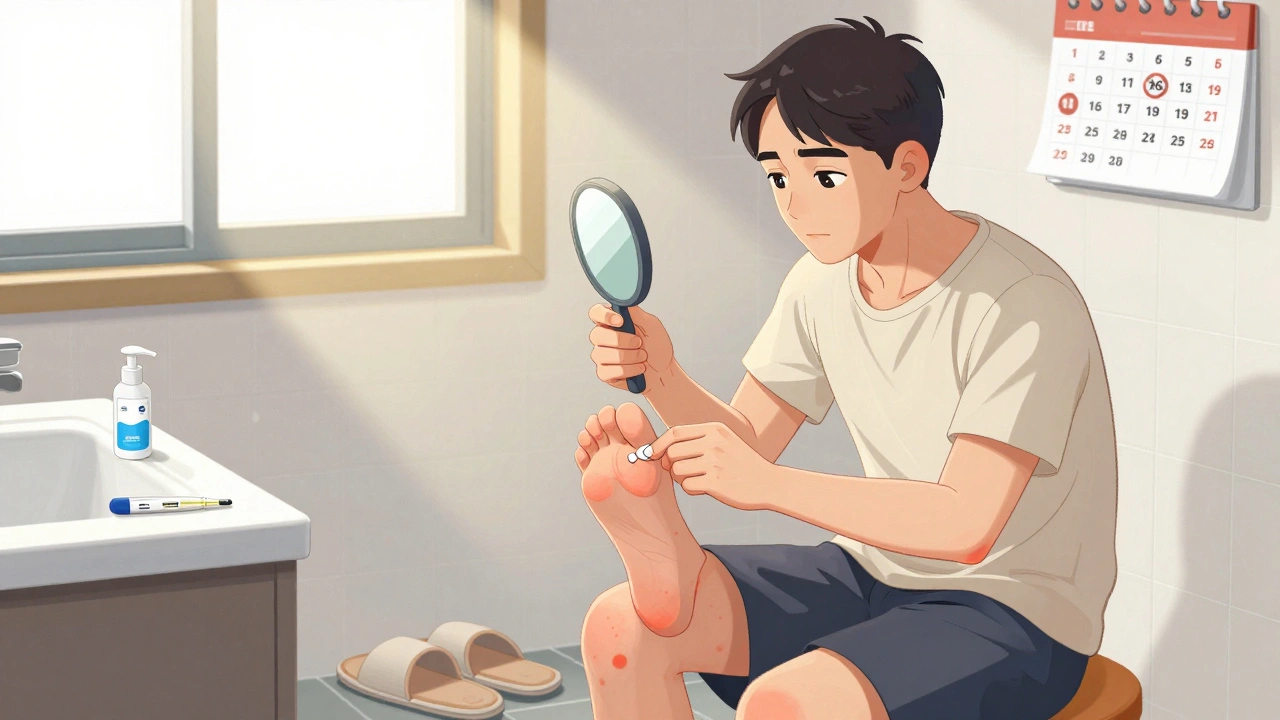
This isn’t a suggestion. It’s a medical protocol backed by research from NYU Langone, the CDC, and the IWGDF. Do this every single day, no exceptions.- Wash your feet in lukewarm water-between 90°F and 95°F. Never use hot water. Test it with your elbow or a thermometer. Nerve damage means you can’t trust your feet to tell you if the water’s too hot.
- Dry thoroughly, especially between your toes. Moisture there invites fungal infections, which can turn into open sores.
- Inspect every surface. Use a mirror or ask someone to help. Look at the soles, heels, sides, and between toes. Don’t skip the top of your feet. Ulcers can form anywhere.
- Look for warning signs: blisters larger than 3mm, cuts deeper than 1mm, redness bigger than 1cm, swelling that makes your foot feel tight, or skin that’s noticeably warmer than the other foot.
- Apply moisturizer to dry skin-but never between your toes. Dry skin cracks. Cracks become entry points for bacteria.
- Trim nails straight across. Cut them just short enough so they don’t press into the skin. Don’t round the corners. Ingrown toenails are a leading cause of foot infections in diabetics.
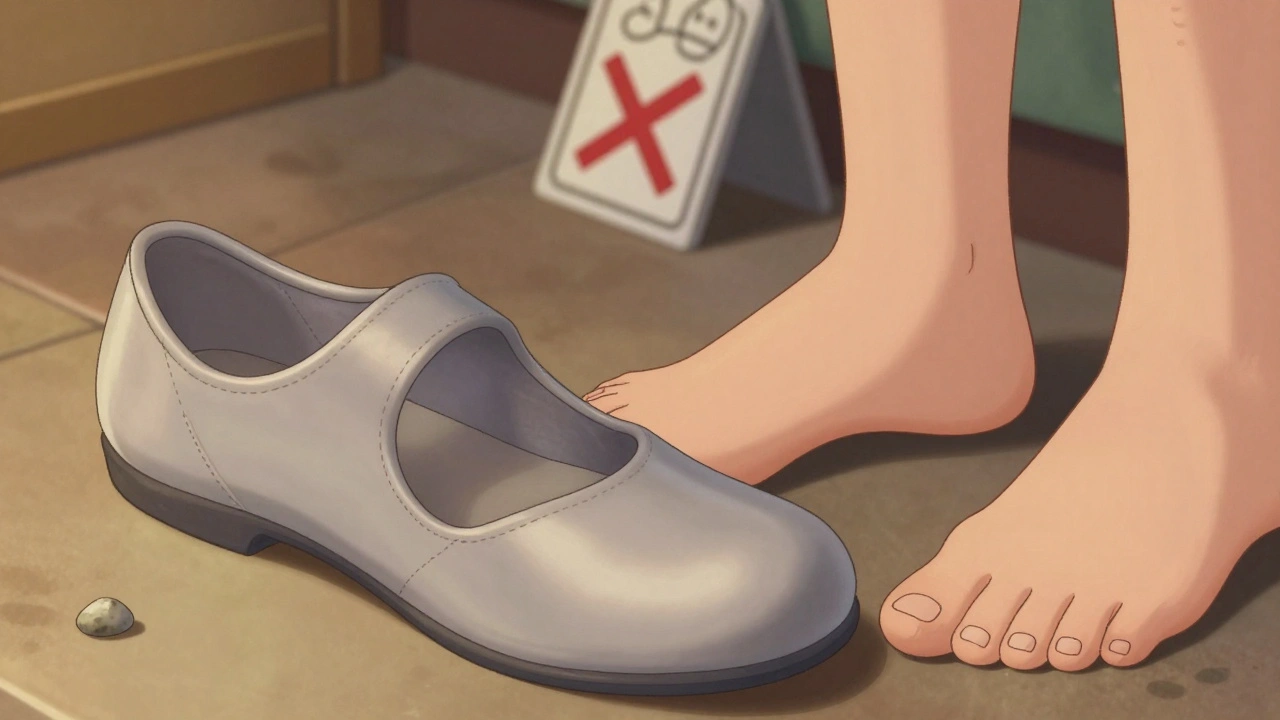
- Check your shoes before putting them on. Shake them out. Feel the inside. Remove pebbles, socks with seams, or torn linings. Even a small fold in your sock can cause a pressure sore.
The CDC found that 68% of ulcers start from minor injuries that went unnoticed because inspections were inconsistent. If you skip even one day, you’re rolling the dice.
What to Do If You Find Something Wrong
If you see any of these, don’t wait:- A cut, blister, or sore that doesn’t start healing in 24 hours
- Redness or warmth spreading beyond the injury
- Drainage, pus, or a bad smell
- Any change in foot shape or color
Call your doctor or podiatrist immediately. Don’t try to treat it yourself. Over-the-counter creams, hydrogen peroxide, or soaking in Epsom salts can make things worse. You need professional wound care.
Remember: no antibiotic will heal an ulcer if the pressure and trauma aren’t removed. The goal isn’t just to kill bacteria-it’s to stop the injury from happening again.
Footwear: Your First Line of Defense
Shoes are not optional. They’re medical equipment. The IWGDF says 87% of forefoot ulcers in neuropathic patients come from ill-fitting shoes. That means your sneakers, flip-flops, or even new boots could be causing damage without you realizing it. Here’s what to look for:- Space: At least 0.5 inches (12.7mm) between your longest toe and the end of the shoe.
- Width: Your toes should have room to splay naturally-about 15mm of extra space across the ball of your foot.
- Heel support: The back of the shoe should be firm, not collapse when you press it.
- No seams: Inside the shoe should be smooth. No stitching or bumps.
Therapeutic shoes aren’t just for people with ulcers. If you have neuropathy, deformities like bunions or hammertoes, or a past ulcer, you need them. Insurance often covers them under Medicare Part B or private plans.
And never walk barefoot-not even in your house. The CDC found that walking barefoot for just 5 minutes a day increases your ulcer risk by more than 11 times.
Who Needs More Than Daily Checks?
Not everyone has the same risk. The IWGDF classifies risk into four levels:- Risk 0: No nerve damage, no history of ulcers. Get checked once a year.
- Risk 1: Nerve damage but no deformity or past ulcers. Get checked every 6 months.
- Risk 2: Nerve damage with foot deformities. Get checked every 3 months.
- Risk 3: History of ulcer or amputation. Get checked monthly-or more often if your doctor says so.
If you’re Risk 2 or 3, you also need:
- An ankle-brachial index (ABI) test at least once a year to check blood flow. If your ABI is below 0.9, you need a vascular specialist.
- A referral to a podiatrist for custom orthotics or therapeutic footwear.
- Education sessions with a diabetes educator. Most people don’t know how to inspect properly-or they forget.
And here’s something you won’t hear from every doctor: don’t do unsupervised ankle exercises. A 2022 study found that people who did random foot exercises without gait analysis had a 22% higher chance of developing ulcers. Movement is good-but only if it’s safe.
What Doesn’t Work (And What’s Dangerous)
There’s a lot of misinformation out there.- Antibiotics for uninfected sores? No. The IDSA says they don’t help and increase antibiotic resistance. Don’t take them unless an infection is confirmed.
- Nerve decompression surgery? The 2023 IWGDF guidelines say it doesn’t prevent ulcers. Skip it.
- Soaking feet in vinegar or tea tree oil? No. These can dry out skin and cause cracks. Stick to water and mild soap.
- Using sharp tools to remove calluses? Never. Use a pumice stone gently after washing. Let a professional handle it.
Even well-meaning family members can make things worse. If someone tries to cut your toenails or “clean” a sore with a knife, stop them. This isn’t a DIY project.
Barriers to Care-and How to Overcome Them
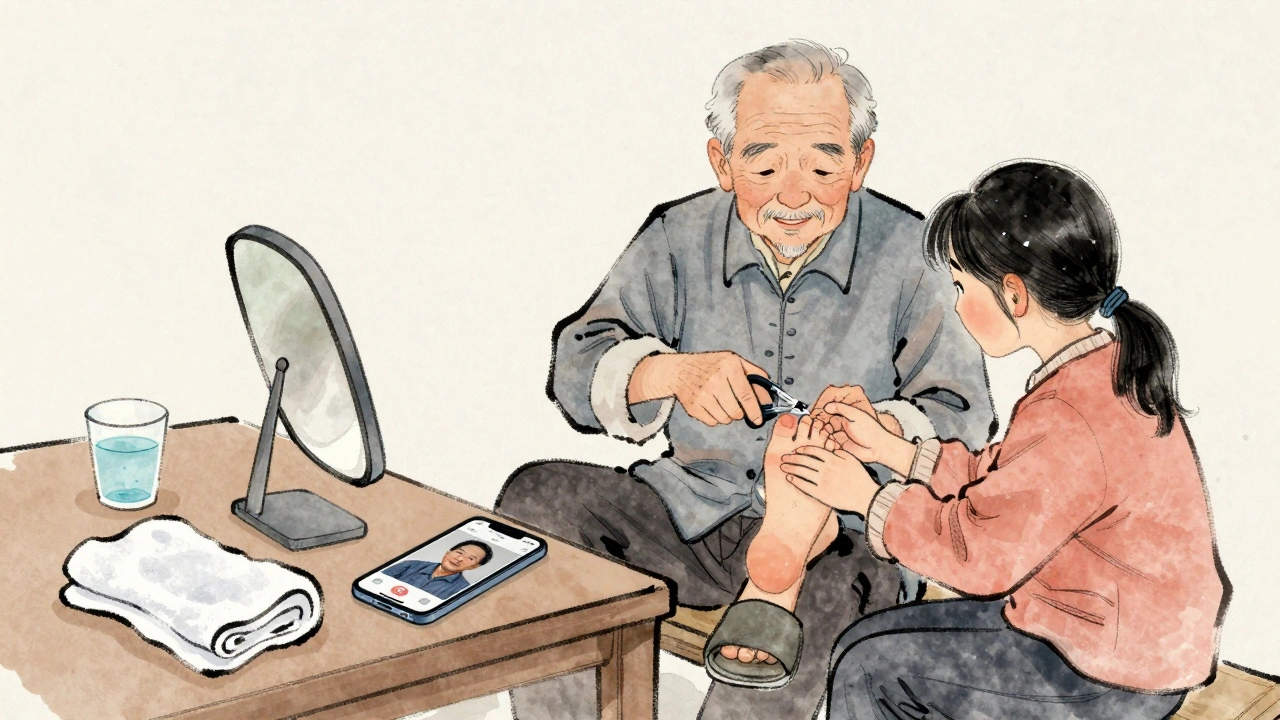
Many people want to do the right thing. But life gets in the way.- Can’t see your feet? Use a handheld mirror or a smartphone camera. Prop it up on a table. Take a picture every morning.
- Arthritis or mobility issues? Ask a family member or caregiver to help. Make it part of your daily routine-like brushing your teeth.
- Cost of shoes or sensors? Medicare and many private insurers cover therapeutic footwear. Call your provider. Some nonprofits offer free or low-cost shoes. Avoid sandals-even in summer. They increase ulcer risk 4.3 times.
- Forgot to check? Set a daily alarm on your phone. Label it: “Feet Check.”
One study found that Medicaid patients are nearly 30% less likely to follow foot care routines. That’s not about laziness-it’s about access, education, and support. If you’re struggling, talk to your diabetes educator. You’re not alone.
The Bigger Picture
The CDC wants to cut diabetes-related amputations by 25% by 2030. That’s possible. But it won’t happen with fancy gadgets or expensive tech. It’ll happen because someone checks their feet every day. Because someone asks for help when they see a red spot. Because someone wears the right shoes-even when it’s hot. The most powerful tool you have isn’t a sensor, a mirror, or a new pair of boots. It’s consistency. It’s showing up for yourself, every single day.One day, you’ll look back and realize you didn’t just avoid an amputation. You kept your independence. Your mobility. Your life.
How often should I inspect my feet if I have diabetes?
You should inspect your feet every single day. This is non-negotiable. Even if you have no symptoms, nerve damage can hide injuries. Daily checks catch problems early. If you’re at higher risk-like if you’ve had a past ulcer or have foot deformities-your doctor may recommend additional professional exams every 1 to 3 months.
Can I use lotion between my toes?
No. Moisturizing between your toes traps moisture, which creates a damp environment perfect for fungal infections like athlete’s foot. Fungal infections can crack the skin and lead to ulcers. Apply lotion only to the tops and bottoms of your feet, avoiding the spaces between toes.
Is it safe to walk barefoot at home?
No. Walking barefoot-even indoors-increases your risk of foot ulcers by more than 11 times, according to the CDC. You might not feel a sharp object, a hot floor, or a rough edge. Always wear shoes or slippers with closed toes and good support, even inside your house.
Do I need special shoes if I don’t have ulcers yet?
If you have nerve damage (neuropathy), foot deformities, or a history of foot problems, yes. You don’t need to wait for an ulcer to get protective footwear. The IWGDF recommends therapeutic shoes for anyone at Risk Level 2 or higher. These shoes reduce pressure on high-risk areas and prevent ulcers before they start. Insurance often covers them.
Can I trim my own toenails?
Yes-if you can see and reach your toes clearly. Trim them straight across, not rounded or too short. Leave about 1-2 mm of nail beyond the tip of your toe. If you have thick nails, poor vision, or numbness, ask a podiatrist to do it. Never use sharp tools to dig under nails or cut cuticles.
What should I do if my foot is red and warm but doesn’t hurt?
Call your doctor immediately. Pain isn’t always a sign of infection in diabetics. Redness, warmth, and swelling-even without pain-are warning signs of possible infection or Charcot foot, a serious condition caused by nerve damage. Don’t wait. Early treatment can prevent bone damage and amputation.
Are foot care apps or smart socks worth it?
Some apps and sensors can help detect temperature changes that predict ulcers before they form. But they’re expensive and not necessary for everyone. The most effective tool is still a daily visual inspection with a mirror. If you can afford and use them consistently, they’re a helpful backup-but never a replacement for checking your feet yourself.
Can exercise cause foot ulcers?
Yes-if it’s unsupervised and you have nerve damage. A 2022 study found that people doing random ankle exercises without proper gait analysis had a 22% higher chance of developing ulcers. Walking is safe and encouraged, but avoid high-impact activities or repetitive stress on your feet. Talk to your doctor or physical therapist about safe exercises.
Ollie Newland
December 5, 2025 AT 10:38Been managing Type 2 for 12 years and this checklist is spot on. The bit about shoes being medical equipment? Absolute truth. I used to wear my old Converse till they fell apart. Got a pressure sore on my metatarsal. Took six months to heal. Now I wear my Medicare-covered therapeutic shoes every damn day-even to bed if I’m sleeping on the couch. No exceptions.
Also, never thought about the ankle-brachial index until my podiatrist pushed for it. ABI was 0.82. Turned out I had peripheral artery disease. Got stents. Saved my leg. This isn’t just foot care. It’s systemic survival.
Rebecca Braatz
December 6, 2025 AT 06:35You’re not alone. I used to skip inspections because I thought ‘if it doesn’t hurt, it’s fine.’ Then I stepped on a nail in my own backyard. No pain. Just a tiny red dot. Two weeks later? Emergency room. Sepsis. ICU. I lost two toes.
Now I set a daily alarm: ‘Feet Check.’ My 8-year-old daughter reminds me if I forget. We do it together. It’s our thing. You can do this. One day at a time. You’ve got this.
Heidi Thomas
December 7, 2025 AT 18:43Soaking feet in vinegar is dangerous because it dries skin and causes cracks which leads to ulcers which leads to amputation which leads to death and you deserve it if you do it because you didn’t read the post
Jenny Rogers
December 9, 2025 AT 00:48It is, of course, a moral imperative to adhere to this regimen with the solemnity one would afford to a sacred rite. The human body, as a vessel of divine stewardship, demands meticulous care-not out of fear, but out of reverence for the intricate biological architecture granted by nature and science alike. To neglect this protocol is not merely negligence; it is a metaphysical dereliction of duty to one’s own existence.
Furthermore, the assertion that therapeutic footwear is ‘medical equipment’ is not merely clinical-it is ontological. The shoe, in this context, becomes an extension of the somatic boundary, a prosthetic of self-preservation. To walk barefoot is to willingly surrender the integrity of the epidermal frontier. One must ask: what is the cost of autonomy, if autonomy leads to dismemberment?
Rudy Van den Boogaert
December 9, 2025 AT 22:57I’ve been doing the daily check for 3 years now. Still forget sometimes. My wife started leaving little sticky notes on the bathroom mirror: ‘Feet first.’ It’s dumb. It works.
Also, I started using a phone camera to take pics of my soles every morning. Put them in a folder called ‘Feet Log.’ If something looks off, I compare it to the last 7 days. Saved me from a blister turning into a wound last month. No drama. Just consistency.
Gillian Watson
December 10, 2025 AT 08:09Love the bit about not walking barefoot indoors. I’m British and we’ve all got that ‘barefoot at home’ thing going. My mum still does it. Told her about the 11x ulcer risk. She laughed. Said ‘I’ve got slippers in the cupboard.’ Two weeks later she’s wearing them. Progress.
Also, the mirror trick? Genius. I got one of those selfie sticks and just prop it up on the sink. Look at the bottom of my feet like I’m taking a selfie. Weird? Maybe. Effective? Hell yes.
Rachel Bonaparte
December 10, 2025 AT 15:38Let me tell you something they don’t want you to know. The real reason they push daily foot checks isn’t because of neuropathy-it’s because the pharmaceutical industry makes billions off amputations and prosthetics. The CDC? They’re funded by shoe companies. The ‘therapeutic footwear’ you’re being told to buy? It’s overpriced. You can get the same pressure relief from a $20 pair of orthopedic inserts from Amazon.
And don’t get me started on the ‘ABI test.’ That’s just a gateway to more scans, more referrals, more bills. They want you dependent. But if you’re smart, you’ll stick to the mirror, the lukewarm water, and a good pair of socks. That’s all you need. The rest? Corporate propaganda dressed in medical jargon.
Gareth Storer
December 11, 2025 AT 03:01So let me get this straight-you’re telling me I can’t walk barefoot in my own house, but I’m supposed to trust a podiatrist who charges $300 for a 10-minute visit? And if I trim my own nails wrong, I’m a menace to society? What’s next? Do I need a permit to breathe?
My grandfather had diabetes for 40 years. Walked barefoot in the garden till he was 89. Never had an ulcer. Maybe your ‘protocol’ is just fear dressed up as science.
Dematteo Lasonya
December 13, 2025 AT 02:12I appreciate how clear this is. I’m newly diagnosed and overwhelmed. The checklist is the first thing that felt actionable. I’m 62 and my vision isn’t great. I asked my daughter to help me with the mirror check every night. We do it while listening to audiobooks. It’s become a quiet ritual.
And yes, I bought the therapeutic shoes. Medicare covered 80%. The rest? Worth every penny. I can feel the difference when I walk. No more foot fatigue. No more hidden pressure spots.
Thank you for not making this about guilt. It’s about showing up. That’s enough.
Scott van Haastrecht
December 14, 2025 AT 07:11Let’s be real. 85% of amputations are preventable? That’s a statistic cooked up by podiatrists trying to sell $1200 shoes. I’ve seen people with perfect foot care still get ulcers because their insulin regimen is garbage. You’re blaming the victim. Focus on glycemic control. That’s the real issue. Not your socks.
This checklist is a distraction. A feel-good ritual for people who want to believe they’re in control. But if your HbA1c is 9.5, no mirror, no shoe, no ‘daily check’ is going to save you. Stop pretending foot care is the answer. It’s not. It’s a Band-Aid on a hemorrhage.