
Drug Allergies vs. Side Effects: How to Tell Them Apart and Stay Safe
 Dec, 10 2025
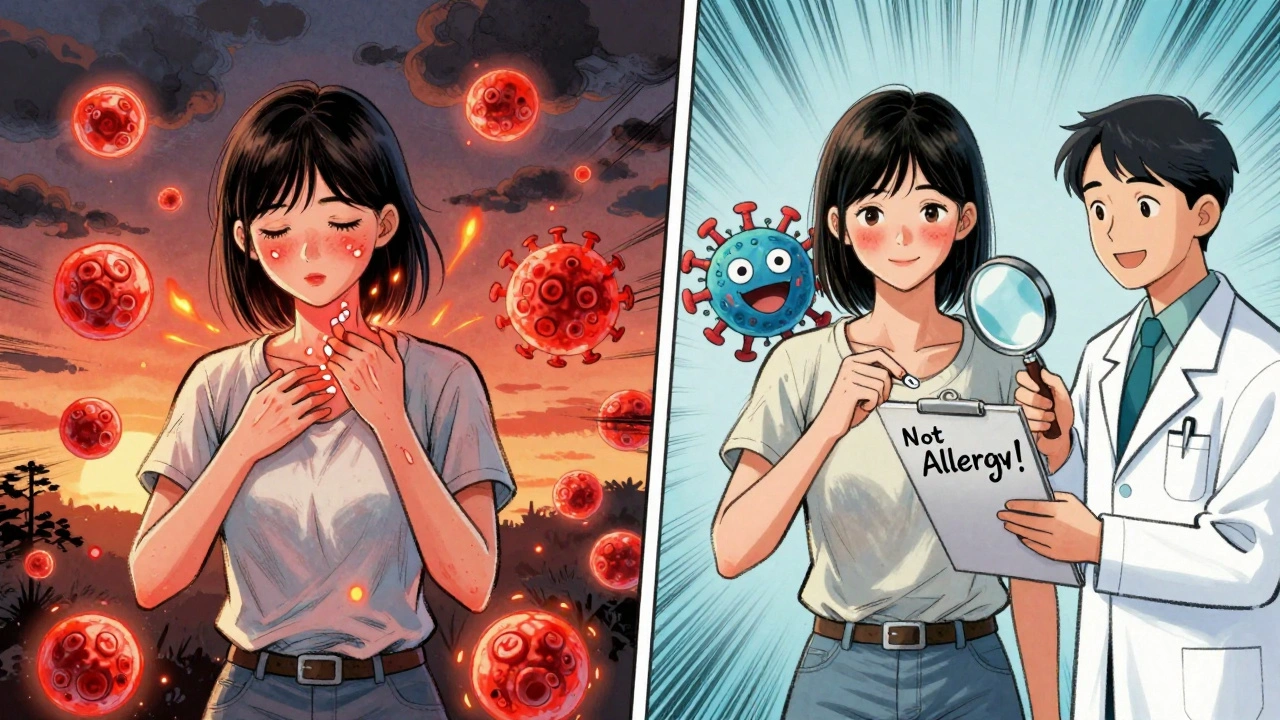
You took a pill, and within hours, your skin broke out in a rash. Your first thought? Drug allergy. But what if it wasn’t? What if it was just a side effect - something common, harmless, and totally expected? Mixing up these two things isn’t just confusing - it can put your health at risk.
What’s Really Happening in Your Body?
A drug allergy means your immune system thinks the medication is an invader. It sounds like a bug, so your body fights back - releasing histamine, triggering swelling, hives, or even anaphylaxis. This isn’t just discomfort. It’s a life-threatening response that demands immediate avoidance of the drug.
On the other hand, a side effect is built into the drug’s chemistry. It’s not your immune system acting up - it’s the drug doing exactly what it’s designed to do, just in a way that affects more than just your target condition. For example, statins lower cholesterol, but they can also cause muscle aches. That’s not an allergy. It’s a known side effect, happening in 5-10% of users.
The difference matters because 90-95% of people who say they have a drug allergy don’t actually have one. That’s not a guess - it’s backed by data from the American Academy of Allergy, Asthma & Immunology. Most of those reactions were side effects, viral rashes, or unrelated symptoms mislabeled as allergies.
Timing Tells the Story
When did the reaction happen? That’s your first clue.
If you took penicillin and broke out in hives within 30 minutes - that’s a classic IgE-mediated allergic reaction. Your body made antibodies on the spot. This kind of reaction can escalate fast. Anaphylaxis can happen in under an hour. These are true allergies.
But if you started amoxicillin for an ear infection and got a rash five days later? That’s often not an allergy. Especially if you had a virus like Epstein-Barr at the same time. Studies show 90% of those rashes in kids are misdiagnosed as penicillin allergies - when they’re actually viral reactions. The drug had nothing to do with it.
Side effects usually show up early, too - but they follow a pattern. Nausea from antibiotics? Comes on within the first 24-72 hours. Diarrhea from metformin? Happens in 20-30% of people, usually in the first week. And guess what? It often gets better if you keep taking it. Allergies don’t do that. If you’re truly allergic, every dose makes it worse.
Common Triggers and Real-World Examples
Penicillin and other beta-lactam antibiotics cause 80% of documented drug allergies. But here’s the twist: up to 95% of people who say they’re allergic to penicillin can safely take it after proper testing. That’s not a myth - it’s what allergists see every day.
Take Sarah, a 34-year-old from Perth. She avoided penicillin for 15 years because she got a rash as a child. She was told it was an allergy. When she needed antibiotics for a severe sinus infection, her doctor had to give her a broad-spectrum drug - vancomycin - because of her "allergy." It cost her $3,200 extra, and she ended up with a C. diff infection - a direct result of using a stronger, less targeted antibiotic.
After a simple skin test, she found out she wasn’t allergic at all. She could’ve taken amoxicillin safely the whole time.
Side effects? They’re everywhere. ACE inhibitors cause dry cough in 5-20% of users because they build up bradykinin. SGLT2 inhibitors for diabetes make you pee more - that’s not an allergy, it’s how they work. Opioids cause itching in 30-50% of people - again, not an allergy. You can treat the itch with antihistamines and keep the pain relief.
Why Mislabeling Costs Lives - and Money
Labeling a side effect as an allergy doesn’t just mess with your treatment. It messes with public health.
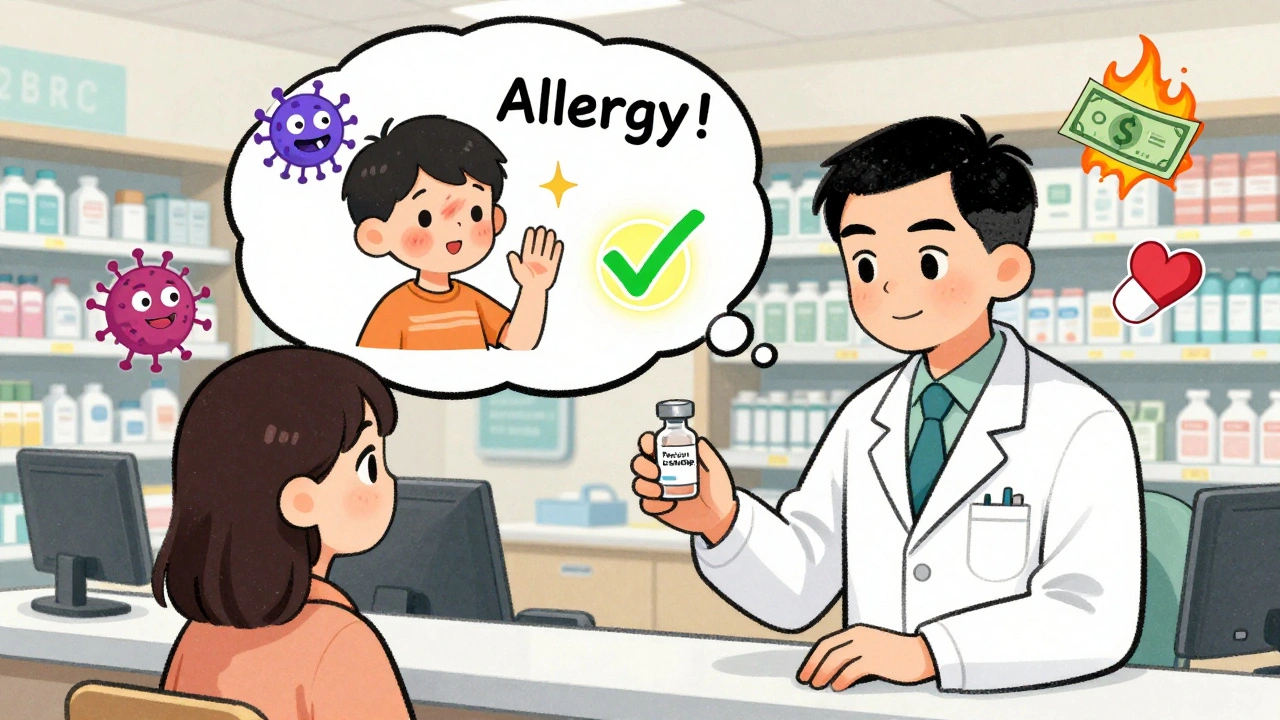
When doctors avoid penicillin because of a mislabeled allergy, they reach for vancomycin or azithromycin instead. Those drugs are broader, stronger, and more likely to kill off good bacteria. That’s how C. diff infections spread. Patients with mislabeled penicillin allergies are 2.5 times more likely to get one.
The cost? More than $1 billion a year in the U.S. alone. In Australia, it’s rising too. A 2023 study showed patients with unverified penicillin allergies had hospital bills $1,025 higher on average. That’s not because the drug was expensive - it’s because the alternatives are, and because complications pile up.
And it’s not just penicillin. Sulfa drugs, NSAIDs, and even chemotherapy agents get mislabeled. One patient in a Reddit thread said she was denied effective UTI treatment for years because of a "sulfa allergy" - later found to be a stomach upset from a single dose 10 years ago.
How to Know for Sure - What to Do Next
If you’ve been told you have a drug allergy, ask yourself:
- What exactly happened? (Rash? Swelling? Trouble breathing? Nausea?)
- When did it happen? (Within an hour? After a week?)
- Did you have a virus or infection at the same time?
- Did the reaction happen every time you took the drug?
If your answer is vague - "I just know I’m allergic" - you’re not alone. Only 38% of people with reported drug allergies can describe their reaction accurately, according to NIH data.
Here’s what to do:
- Don’t assume. Write down exactly what happened - symptoms, timing, treatment.
- Ask your doctor if you should see an allergist. Skin tests for penicillin are 97-99% accurate when done right.
- Consider a supervised drug challenge. For low-risk cases, doctors will give you a tiny dose and watch you for an hour. Over 95% of people pass without issue.
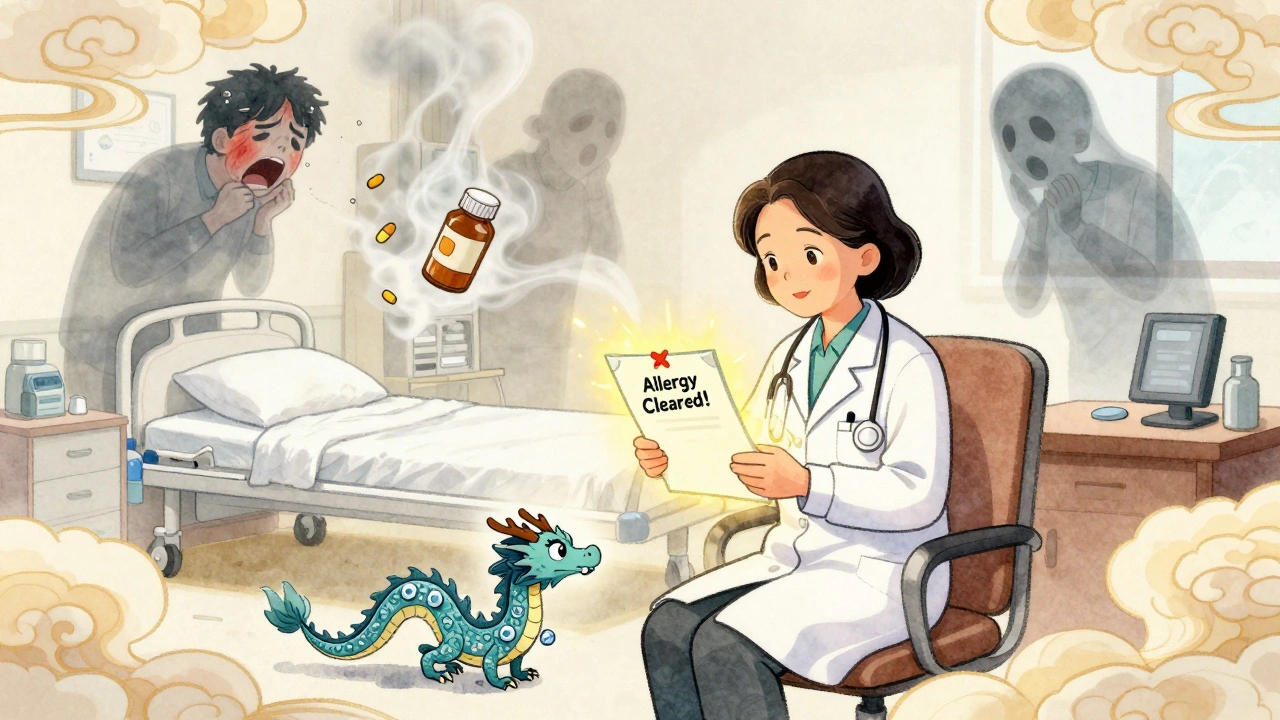
- Update your records. If you’re cleared, make sure your GP, pharmacist, and hospital know. Don’t let an old label haunt you.
Pharmacist-led allergy review programs have cut inappropriate penicillin avoidance by 80% in the U.S. Veterans Health system. Australia is starting to catch up. Some hospitals now use electronic alerts to flag vague allergy entries and prompt clarification.
What You Should Never Do
Never stop a medication because you think you’re allergic - without checking first.
Don’t assume a rash means allergy. Many rashes are viral, especially in kids. Amoxicillin rashes during a cold or mono are almost never allergies.
Don’t let a childhood reaction define your adult treatment. Allergies can fade. What was dangerous at age 6 might be harmless at 30.
And never ignore a real allergic reaction. If you’ve ever had swelling of the lips, tongue, or throat, trouble breathing, or a drop in blood pressure after a drug - that’s an emergency. Don’t test it yourself. See an allergist.
The Bigger Picture
This isn’t just about penicillin. It’s about how we think about medicine. We’re taught to fear side effects. But not all reactions are created equal.
The FDA, WHO, and major medical groups now treat this confusion as a patient safety crisis. That’s why drug labels are changing. New medication guides include simple decision trees: "Was it a rash? Did you have a fever? Did it happen after a virus?"
By 2027, most U.S. hospitals will have automated alerts in their systems that ask: "Is this a true allergy or a side effect?" That’s progress.
But real change starts with you. If you’ve ever said, "I’m allergic to this drug," take a moment to ask: What really happened? You might be saving yourself from unnecessary risk - and maybe even saving your life.
Can you outgrow a drug allergy?
Yes, many people outgrow drug allergies - especially penicillin. Studies show that 80% of people who had a penicillin allergy in childhood lose it within 10 years. The immune system changes over time. That’s why it’s important to get retested if you were labeled allergic as a kid. A simple skin test or oral challenge can confirm whether you’re still allergic.
Is a rash always a sign of drug allergy?
No. Many rashes that appear after taking medication are caused by viruses, not the drug. For example, amoxicillin often causes a rash in kids who have mononucleosis - but that’s not an allergy. The same goes for rashes that show up days after starting a drug. True allergic rashes usually appear within hours. Delayed rashes are often T-cell mediated and need specialist evaluation - but they’re still not always true allergies.
Can side effects be dangerous?
Yes, some side effects can be serious - but they’re not allergies. For example, statins can cause muscle damage, and NSAIDs can trigger kidney problems or stomach bleeding. These are known risks, and doctors monitor for them. The difference is, you can often manage them: lower the dose, switch drugs, or add a protective medication. With allergies, you must avoid the drug entirely.
How accurate are allergy tests for drugs?
For penicillin, skin tests are 97-99% accurate at ruling out allergy - meaning if the test is negative, you’re almost certainly safe. For other drugs, testing is less reliable. There’s no skin test for sulfa or ibuprofen allergies. In those cases, doctors may use a graded oral challenge - giving small, increasing doses under supervision. It’s safe for most people and is the gold standard when testing isn’t available.
What should I do if I think I’m allergic to a drug?
Don’t stop the medication on your own - especially if it’s critical for your health. Write down exactly what happened: symptoms, timing, how long it lasted. Then talk to your doctor or pharmacist. Ask if you should be referred to an allergist. Bring your notes. Most reactions aren’t allergies, and getting it right means you’ll have better treatment options in the future.
Final Thoughts
Medications save lives - but they come with risks. The key isn’t avoiding all reactions. It’s understanding which ones are dangerous and which ones are just noise.
True drug allergies are rare. Side effects are common. Confusing them leads to worse treatments, higher costs, and avoidable complications. You don’t need to be a doctor to make the difference. Just ask the right questions. And if you’ve been carrying a drug allergy label for years - it might be time to check if it still fits.
Ariel Nichole
December 11, 2025 AT 12:12I used to think I was allergic to penicillin because I got a rash as a kid. Turns out I had mono. Took me 12 years and a bad sinus infection to finally get tested. Now I take amoxicillin like it’s candy. So glad I didn’t keep avoiding it.
Thanks for this post - seriously, everyone should read it.
john damon
December 11, 2025 AT 15:58OMG YES 😭 I got labeled allergic to sulfa after one stomach ache in college. Now I can’t get a UTI rx without a 3-week saga. My pharmacist just sighed and said ‘you’re not allergic, you’re just unlucky.’ 🤦♂️
matthew dendle
December 13, 2025 AT 05:1390% of people who say theyre allergic are just bad at describing symptoms lmao
my cousin says she allergic to ibuprofen because her hand tingled once after taking 2 pills while drunk
bro thats not an allergy thats your nerves and cheap booze
stop being dramatic and get tested before you ruin your own healthcare
Lisa Stringfellow
December 13, 2025 AT 14:38I’m just saying… if you’re going to make people feel guilty for protecting themselves, maybe don’t use a tone that sounds like you’re lecturing a child.
Some of us had real reactions. Not everyone’s story fits your neat little chart.
And now you’re telling us to risk our lives because ‘studies say’? Cool.
Kristi Pope
December 15, 2025 AT 03:18This is the kind of post that makes me believe in humanity again 🌱
My grandma was told she was allergic to penicillin at 7 - turned out she had chickenpox. She spent 40 years on stronger antibiotics, got C. diff twice, and never knew she could’ve just taken amoxicillin.
She’s 82 now and finally got tested last year. She cried.
Don’t let your past labels become your prison. Get checked. It’s not just about you - it’s about the next person who needs the right drug.
Thank you for writing this.
Vivian Amadi
December 16, 2025 AT 22:40Stop spreading misinformation. Not all rashes are viral. Some are delayed hypersensitivity reactions and they CAN be dangerous. You’re oversimplifying a complex immunological issue.
And no, not everyone can just ‘get tested’ - insurance won’t cover it, and allergists are booked for months.
So don’t act like it’s that easy.
Jimmy Kärnfeldt
December 18, 2025 AT 07:45It’s wild how we treat medicine like it’s a magic bullet that should never have side effects.
We panic at a rash, but we shrug off nausea, dizziness, fatigue - all the quiet ways drugs mess with us.
Maybe the real issue isn’t mislabeling allergies - it’s that we’ve been taught to fear every weird feeling after taking a pill.
We need to learn the difference between danger and discomfort.
And maybe, just maybe, trust our bodies a little more - and doctors a little less, until they ask the right questions.
Monica Evan
December 20, 2025 AT 07:02My mom took penicillin for 30 years after being told she was allergic as a kid - because she didn’t want to ‘make a fuss’.
Turns out she had a mild rash from a virus at 11. She’s fine now - got tested at 68. But she missed out on so many treatments because she was scared.
Don’t be like my mom. Write it down. Talk to your doctor. Even if you’re nervous.
You deserve better meds than what fear gives you.
Also - if you’re in the US, check if your local pharmacy has a med review program. They’ll do it for free. Seriously.
Taylor Dressler
December 21, 2025 AT 09:07Important clarification: true IgE-mediated penicillin allergies are rare, but non-IgE mediated reactions like DRESS or SJS can be life-threatening and require lifelong avoidance. These are not the same as a rash from a virus or a side effect.
Always consult an allergist before assuming your reaction was benign.
Also - if you’ve ever had swelling, difficulty breathing, or hypotension, do NOT attempt a challenge without medical supervision.
Knowledge is power, but ignorance can kill.
Aidan Stacey
December 23, 2025 AT 07:00My brother was denied pain meds after surgery because he said he was allergic to morphine - turns out he just got itchy from histamine release. They gave him something way less effective, he was in agony for days.
Now he’s an advocate. He tells everyone: ‘If you itch, it doesn’t mean you’re allergic. If you can’t breathe, then panic.’
Simple. Clear. Life-changing.
Thanks for the post. This needs to be on every pharmacy’s wall.
Katherine Liu-Bevan
December 24, 2025 AT 03:48Just got my penicillin skin test results today - negative. I’ve avoided it since I was 8. I’m 31 now. I cried in the waiting room.
My doctor said, ‘You’ve been carrying a ghost this whole time.’
She’s right.
Thank you for reminding us that healing isn’t just about medicine - it’s about unlearning fear.