
How to Involve Grandparents and Caregivers in Pediatric Medication Safety
 Jan, 4 2026
Every year, more than 58,000 children under five end up in the emergency room because they got into medicine they weren’t supposed to. And in nearly four out of ten cases, the medicine came from a grandparent’s purse, nightstand, or kitchen counter. This isn’t about carelessness-it’s about misunderstanding. Most grandparents love their grandchildren deeply and want nothing more than to keep them safe. But they don’t always know how.
Why Grandparents Are at the Center of This Problem
Grandparents are more likely than anyone else to be taking multiple medications every day. On average, they juggle 4.7 prescriptions, compared to just 2.1 for parents in their 30s and 40s. Many of these are blood pressure pills, pain relievers, diabetes meds, or antidepressants-medicines that can be deadly if a child gets into them. And because they’re used to managing their own meds for decades, they often don’t see the risk.One study found that 36% of grandparents believe child-resistant caps are enough to keep kids safe. But here’s the truth: 30% of 4-year-olds can open those caps in under five minutes. That’s not a flaw in the cap-it’s normal child development. Kids are curious, strong for their size, and great at figuring things out. If medicine is within reach, they’ll find it.
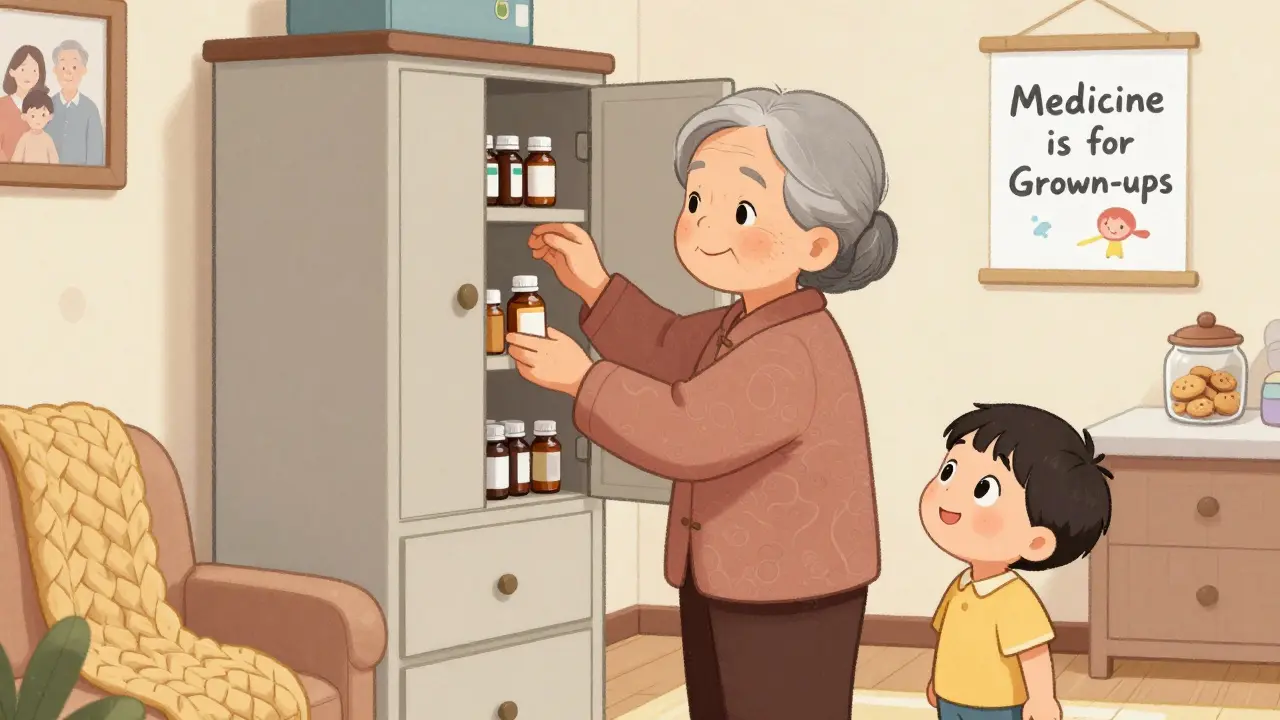
And where do they usually find it? In purses left on the couch. On the nightstand beside the bed. In the bathroom cabinet where shampoo and toothpaste sit side by side. In the kitchen drawer next to the cookies. These aren’t dangerous habits-they’re habits formed out of convenience. Grandparents don’t think of their meds as hazards. They think of them as part of their routine.
What Works: The PROTECT Campaign and Real Results
In 2010, the CDC and the Consumer Healthcare Products Association launched the Up & Away and Out of Sight campaign. It wasn’t about scaring people. It was about giving clear, simple steps that fit into real life.A 2017 study tracked 223 grandparents who got a 15-minute education session based on this campaign. Before the talk, only 39% stored their meds safely. Three months later? That jumped to 78%. The changes were simple:
- Move meds out of the bathroom-humidity ruins pills and kids love the sink.
- Don’t leave them on the nightstand-even if you take them right before bed.
- Keep them off the kitchen counter, even if it’s just for a minute while you make coffee.
- Never put meds in a purse or bag when grandchildren are around.
The biggest win? They didn’t need fancy tech. No apps. No smart locks. Just a locked cabinet-preferably above 4 feet high, where kids can’t reach it. And if the cabinet doesn’t lock? A simple latch that takes 15 pounds of force to open works. That’s more than most toddlers can manage.
Why Grandparents Resist-and How to Get Past It
Some grandparents feel blamed. They hear “You’re putting your grandchild at risk” and shut down. That’s why the best programs avoid language like “you should” or “you’re wrong.” Instead, they say: “Let’s make sure our grandkids stay safe.”One grandmother on Reddit shared how she changed after a close call: her 3-year-old grabbed her blood pressure pills from her purse. She didn’t yell. She didn’t feel guilty. She just got a small lockbox, put it in the closet, and started telling her grandson, “These are Grandma’s special vitamins-only grown-ups touch them.” That’s the tone that works.
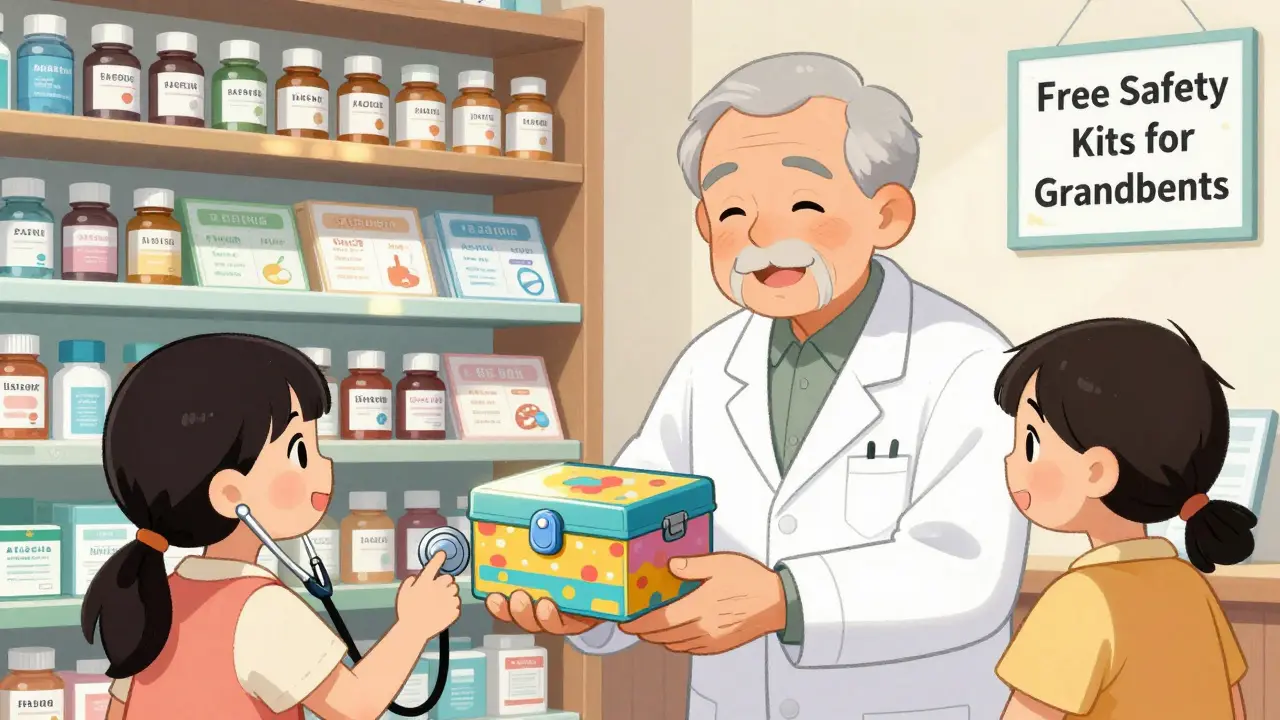
Another common barrier? Arthritis. Many grandparents can’t twist child-resistant caps. That’s why pharmacists now offer easy-open caps as a free service. Ask for them. Some pharmacies even give away free lockboxes to seniors during medication pickups. In fact, 78% of grandparents who got a personalized safety check from a pharmacist changed their habits.
What Grandparents Should Do Right Now
Here’s what you can do today, no matter where you live or how tech-savvy you are:- Find every medicine. Go through your medicine cabinet, purse, nightstand, and drawers. Include vitamins, supplements, and over-the-counter stuff like cough syrup or ibuprofen.
- Put them back in original bottles. Never transfer pills to pill organizers unless you’re using them for yourself. Kids can mistake those for candy.
- Lock them up. Use a cabinet with a latch, a lockbox, or even a high shelf with a childproof door. Don’t overthink it-just make it out of reach.
- Have the talk. When kids visit, say: “Medicine is not candy. Only adults give medicine. If you find medicine, tell an adult right away.” Say it calmly. Repeat it. Kids remember.
- Check expiration dates. Throw out anything old. Expired meds can still be dangerous. Ask your pharmacist how to dispose of them safely.
What Parents Should Do to Help
Parents can’t fix this alone. Grandparents need support, not pressure. Here’s how to help without sounding critical:- Offer to buy a lockbox as a gift. Say, “I got this for Grandma-she’ll love it.”
- Send a printed checklist with pictures. Some grandparents don’t use smartphones.
- Ask your pediatrician to mention medicine safety during checkups. Only 12% of Medicare plans offer this counseling-but doctors can still bring it up.
- Keep a list of your child’s meds and dosing schedule. Give a copy to grandparents so they know what to watch for.
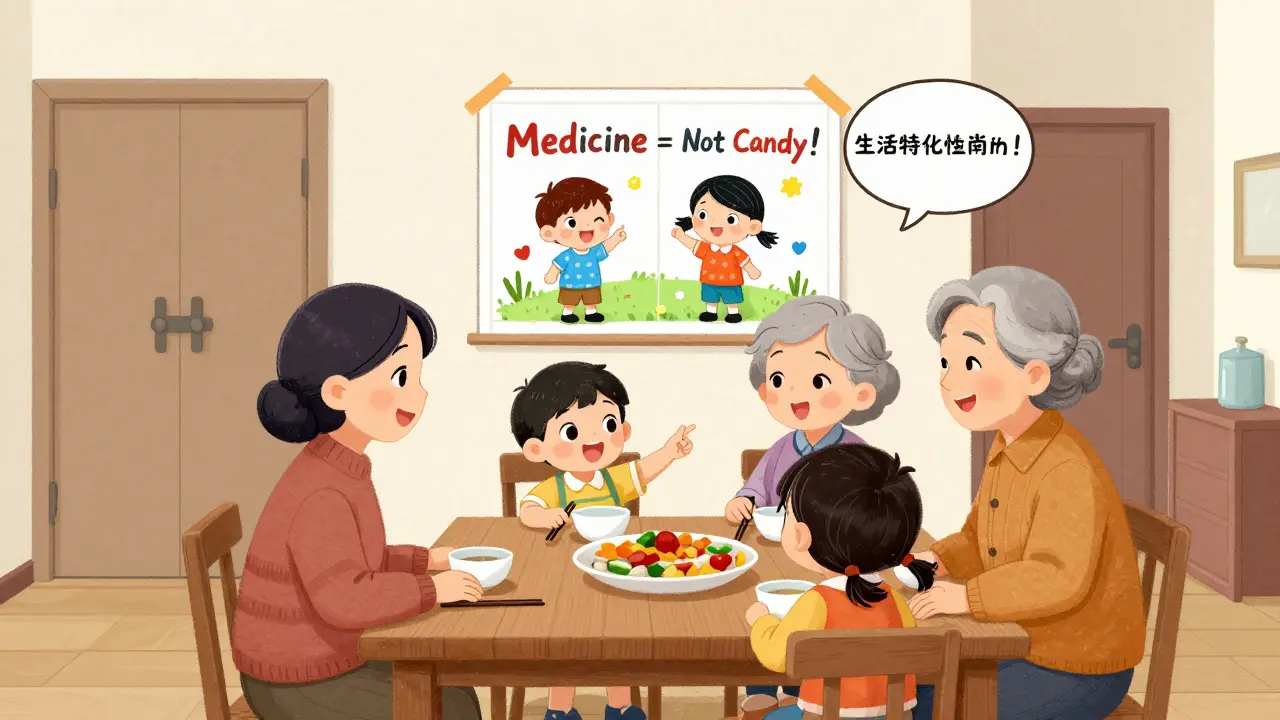
- Make safety a family habit. Let kids draw a poster: “Medicine is for grown-ups.” Hang it on the fridge.
One family did this after their 2-year-old found an asthma inhaler. Now, every time the grandparents come over, the kids help put the lockbox away. It’s not about control. It’s about teamwork.
What’s Changing in 2026
New tools are coming. In January 2024, the CDC launched a free digital toolkit with videos showing exactly how to store medicine safely. The videos are in Spanish, Mandarin, and Arabic-and they’re designed for people who don’t use tech often.There’s also a new NIH trial testing a simple app that sends a reminder to grandparents before holidays or visits: “Your grandkids are coming. Double-check your meds.” Early results show 85% of users follow through.
And in 2023, the American Geriatrics Society added pediatric medicine safety to its official guidelines for older adults. That means doctors will start asking: “Do you care for young children? Are your meds locked away?”
It’s not about fear. It’s about awareness. And it’s working.
Final Thought: This Isn’t a Grandparent Problem. It’s a Family Problem.
Medicine safety isn’t about who’s right or wrong. It’s about making sure no child ever has to go to the ER because they swallowed something they didn’t understand. Grandparents aren’t the enemy. They’re the solution.They’re the ones who bake cookies, read bedtime stories, and hold hands during thunderstorms. They’re also the ones who hold the pills. Let’s help them keep both safe.
Why do grandparents keep medicine on their nightstands?
Many grandparents keep medicine on their nightstands because it’s convenient-they take it right before bed and don’t want to walk to another room. They don’t think about children being around. But even if the child is napping, a toddler can wake up, climb, and reach. It’s not laziness-it’s habit. Moving meds to a locked cabinet above 4 feet high solves this without changing their routine.
Are child-resistant caps really enough?
No. While child-resistant caps are required by law, they’re not child-proof. Testing shows that 30% of 4-year-olds can open them in under five minutes. That’s why the CDC recommends storing medicine in a locked cabinet, not just relying on the cap. Caps are a backup, not the main safety measure.
What should I do if my grandchild swallows medicine?
Call Poison Control immediately at 1-800-222-1222. Don’t wait for symptoms. Don’t try to make them vomit. Have the medicine bottle ready so you can tell them the name, dose, and time it was taken. Keep this number saved in your phone and posted on the fridge. Most poisonings are treated successfully when help is called fast.
Can I use a pill organizer for my meds if my grandkids visit?
Only if you keep it locked away. Pill organizers look like candy to kids. Even if they’re labeled, children don’t read. If you use one for yourself, store it in the same locked cabinet as your original bottles. Never leave it on the counter, in a purse, or on the bedside table.
Do vitamins and supplements count as medicine?
Yes. Many vitamins-especially iron, gummy vitamins, and liquid supplements-can be toxic if a child takes more than one. Gummy vitamins are designed to taste good, which makes them extra dangerous. Treat them the same as prescription pills: lock them up, keep them out of sight, and tell kids they’re not candy.
Is it safe to keep medicine in the bathroom?
No. Bathrooms are humid, which can make pills break down faster. Kids also see the bathroom as a play space-they’re curious about the sink, the cabinet, the towels. The best place is a high cabinet in a bedroom or hallway, away from moisture and out of reach. If you must use the bathroom, lock the cabinet.
How do I talk to my grandchild about medicine without scaring them?
Keep it simple and positive. Say: “Medicine helps grown-ups feel better, but it’s not for kids. Only adults give medicine. If you see something that looks like candy but isn’t, tell me right away.” You can even turn it into a game: “Let’s find all the medicine in the house and put it in the safe box!” Kids respond to routine, not fear.
Can I ask my pharmacist for help?
Absolutely. Pharmacists are trained in medicine safety and often have free lockboxes, easy-open caps, and printed guides for grandparents. Just say: “I care for young grandchildren-can you help me store my meds safely?” Most pharmacies will help, even if you didn’t get the prescription there.
Connor Hale
January 6, 2026 AT 06:47It's not about blame. It's about systems. We expect older people to adapt to modern safety standards without acknowledging how deeply ingrained their routines are. Medicine isn't just a pill-it's a ritual. The real solution isn't lockboxes. It's redesigning the environment to match human behavior, not punish it.
Roshan Aryal
January 7, 2026 AT 23:59Of course Americans are obsessed with locking everything. In India, we trust our kids to learn by doing. If a child swallows medicine, it’s their first lesson in consequence. This over-sanitized parenting culture is why kids grow up fragile. Let them touch the bottle. Let them learn. No one’s dying from a dropped aspirin.
Catherine HARDY
January 9, 2026 AT 20:56Did you know the CDC secretly partners with pharmaceutical companies to push this narrative? Lockboxes cost money. Child-resistant caps are a loophole. They want you dependent on their ‘solutions’ while hiding the real issue: the over-prescription of dangerous meds to seniors. This isn’t safety-it’s corporate control disguised as care.
bob bob
January 11, 2026 AT 01:05I love how this post doesn’t shame anyone. My grandma used to keep her pills on the nightstand-until my niece climbed up and almost ate her diabetes med. We didn’t yell. We just got a $12 lockbox from Target and made it a thing. Now she calls it ‘the magic box.’ Kids love rituals. Make safety one.
Vicki Yuan
January 11, 2026 AT 06:08The data here is compelling: 78% adherence after a 15-minute intervention proves behavioral change is achievable without coercion. The key is framing: ‘Let’s keep our grandkids safe’ instead of ‘You’re dangerous.’ Language shapes perception. Also, pill organizers are a silent hazard-never leave them unattended, even if labeled. Children don’t read. They taste.
en Max
January 12, 2026 AT 03:32It is imperative to acknowledge the multifactorial nature of this public health challenge. The convergence of polypharmacy, cognitive aging, developmental curiosity in pediatric populations, and environmental accessibility creates a non-linear risk profile. Mitigation strategies must be multimodal: environmental restructuring, caregiver education, and pharmacological stewardship. The efficacy of the Up & Away campaign is statistically significant (p < 0.01), yet scalability remains limited by socioeconomic and digital literacy barriers.
Angie Rehe
January 12, 2026 AT 06:09You people are so naive. You think a lockbox fixes everything? What about the 70% of grandparents who don’t have a cabinet? What about the ones who live in apartments with no storage? And don’t get me started on the fact that 40% of these meds are prescribed by doctors who never ask if kids are around. This is a system failure, not a grandparent problem. Fix the system, not the old folks.
Dee Humprey
January 13, 2026 AT 12:55I’m a nurse and I’ve seen too many ER visits from this exact thing. Here’s what works: give grandma a lockbox with a sticker that says ‘Grandma’s Special Vitamins’ and let the grandkid help put it away. Turn it into a game. They’ll feel proud. And if she has arthritis? Ask the pharmacist for easy-open caps-they’re free. No judgment. Just help. 💙
josh plum
January 14, 2026 AT 08:55Let’s be real-this is what happens when you raise kids without discipline. If your grandchild is grabbing pills like candy, maybe they need a good spanking, not a lockbox. People these days treat kids like fragile glass figurines. Let them learn the hard way. One dose of ibuprofen won’t kill them. But it’ll teach them respect.
John Ross
January 15, 2026 AT 13:05In Japan, elders store meds in a designated wooden box called a 'koyō-bako'-a cultural ritual, not a medical necessity. The child learns early: this box is sacred. No one touches it. No explanations needed. We don’t need apps or lockboxes. We need cultural norms. Maybe we’ve lost something by over-engineering safety.
Ashley Viñas
January 17, 2026 AT 05:03How is this even still a problem? It’s 2024. If you can’t manage your own medication without endangering a child, perhaps you shouldn’t be babysitting. This isn’t ‘family teamwork’-it’s negligence dressed up as empathy. Lockboxes are $8. Pharmacy consultations are free. The ball is in their court.
Brendan F. Cochran
January 18, 2026 AT 18:28lol why are we all acting like this is a big deal? My grandma kept her pills in her purse and we all lived. Kids are curious. They lick stuff. That’s how they learn. If you’re worried, just keep your purse on the floor. Problem solved. Stop turning everything into a national crisis.
Stephen Craig
January 19, 2026 AT 03:40Convenience is the enemy of safety. Habit overrides instruction. The solution isn’t education-it’s friction. Make safe storage the default. Lockboxes should be included with every prescription for seniors with grandchildren. No opt-in. No paperwork. Just automatic.
Enrique González
January 19, 2026 AT 08:33My dad took his meds on the nightstand for 20 years. Then my daughter crawled up and grabbed his blood pressure pill. He didn’t panic. He just got a lockbox the next day. Now he says it’s easier-he doesn’t have to remember where he put it. Sometimes the fix is simple. You just have to want it.
Aaron Mercado
January 19, 2026 AT 20:44THIS IS A TRAGEDY THAT COULD BE PREVENTED!!! Why are we still talking about ‘habits’? This isn’t about ‘convenience’-this is about DEAD CHILDREN! I had a cousin who died from a gummy vitamin overdose. GUMMY VITAMINS!! And now we’re debating whether to put them in a cabinet?!!? This is not a suggestion. This is a MANDATE. LOCK THEM UP. NOW. BEFORE IT’S TOO LATE!!!