
Medication Therapy Management: How Pharmacists Optimize Generic Drug Use for Better Outcomes
 Jan, 27 2026
When you pick up a prescription, most people think the pharmacist just fills the bottle. But in reality, their job goes far beyond counting pills. In medication therapy management (MTM), pharmacists act as medication detectives-tracking down problems you didn’t even know you had. And one of their most powerful tools? Generic drugs.
What Medication Therapy Management Really Means
MTM isn’t a fancy term for a quick chat at the counter. It’s a structured, patient-focused service where pharmacists sit down with you-usually for 20 to 40 minutes-and review every single medication you’re taking. Not just the ones they dispensed. All of them. Prescribed by your cardiologist, your rheumatologist, your primary care doctor, even the over-the-counter supplements you’re using.
The goal? Make sure every pill you take is necessary, safe, and actually working. That means catching duplicate prescriptions, spotting dangerous interactions, and fixing doses that are too high or too low. But here’s the part most people don’t realize: a huge part of MTM is about cost. And that’s where generic drugs come in.
Why Generic Drugs Are a Pharmacist’s Secret Weapon
Generic drugs aren’t cheap knockoffs. They’re exact copies of brand-name drugs in terms of active ingredients, dosage, safety, and effectiveness. The FDA requires them to meet the same strict standards. In fact, 90% of prescriptions filled in the U.S. are for generics-and for good reason.
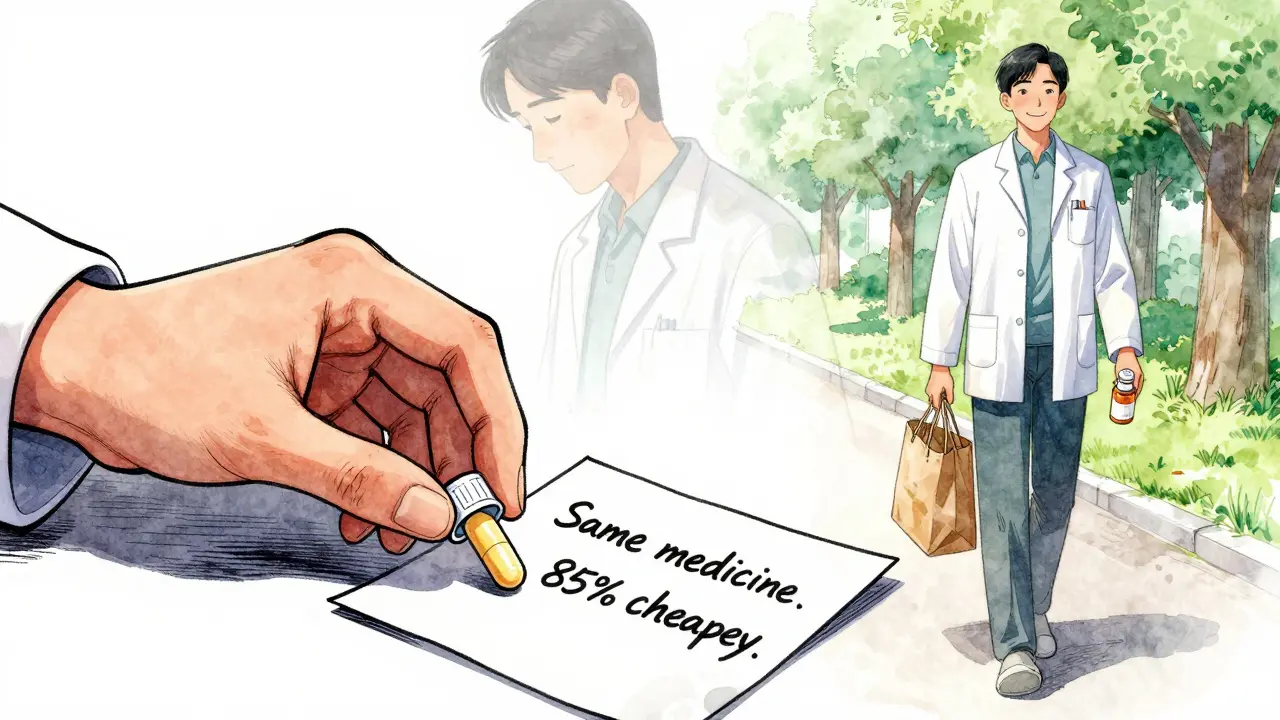
On average, generics cost 80 to 85% less than their brand-name counterparts. That’s not a small saving. For someone taking five medications a day, switching to generics can cut monthly drug costs from $800 to under $150. That’s the difference between being able to afford your insulin or skipping doses to stretch your budget.
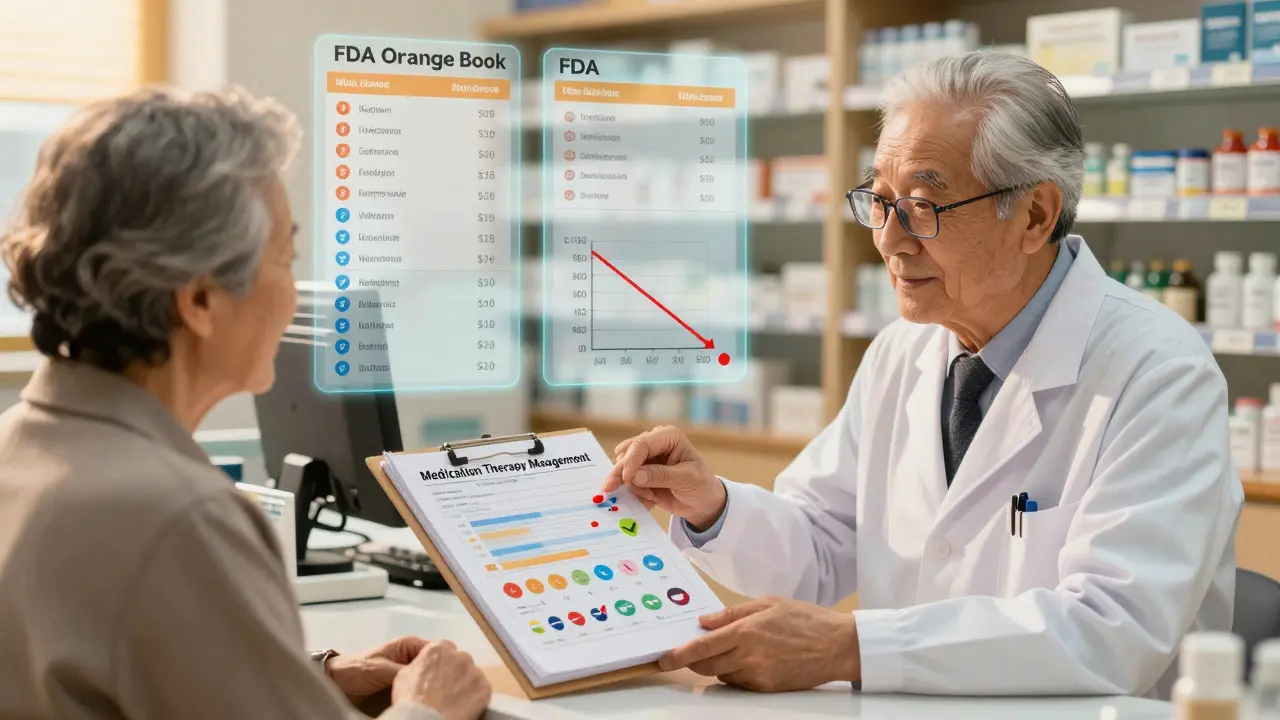
But here’s the catch: not every patient knows this. Many still believe generics are weaker, less reliable, or even fake. That’s where pharmacists in MTM programs step in. They don’t just swap the label. They explain why the generic is just as safe. They show data from the FDA’s Orange Book, which rates drugs for therapeutic equivalence. They answer questions like, “Will this make me feel different?” or “Why did my doctor switch me?”
The Real Impact: Saving Money, Saving Lives
Cost isn’t just a number on a receipt. It’s the reason people stop taking their blood pressure pills. It’s why someone with diabetes skips their metformin because they can’t afford it. And it’s why medication non-adherence kills more people each year than heart disease or stroke.
MTM pharmacists have data to prove their work works. In one study, patients who went through a full MTM session with a pharmacist saw their medication adherence jump by nearly 19 percentage points. That means more people took their meds as prescribed. And that led to fewer ER visits, fewer hospital stays, and lower overall healthcare costs-$1,247 less per person per year.
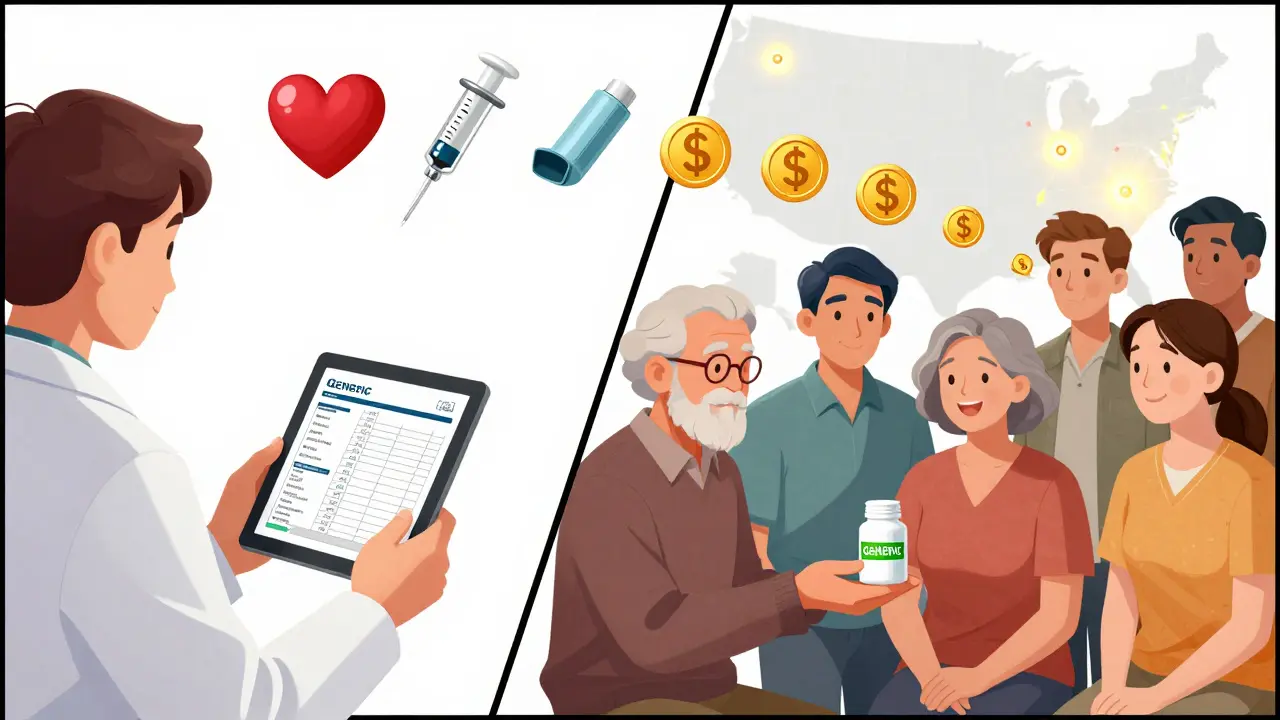
And when pharmacists specifically focused on switching patients to appropriate generics, those cost savings made up 37% of the total reduction. One patient in Minnesota saved $287 a month after her pharmacist found three brand-name drugs that had cheaper, equally effective generics. Another in Texas had her $400 monthly inhaler switched to a $15 generic-saving her from choosing between medicine and groceries.
How Pharmacists Decide When to Switch
It’s not as simple as just swapping any brand for a generic. Pharmacists don’t guess. They use tools like the FDA’s Orange Book to check if a generic is rated “A”-meaning it’s therapeutically equivalent. For drugs with a narrow therapeutic index-like warfarin, levothyroxine, or certain seizure meds-they go even deeper. They look at bioequivalence studies, patient history, and even lab results.
For example, switching a patient from brand-name Synthroid to a generic levothyroxine isn’t just about price. If the patient has been stable on the brand, the pharmacist might recommend staying on it-or at least sticking with the same generic manufacturer to avoid tiny variations that could affect thyroid levels. That’s the kind of detail only a trained pharmacist catches.
They also consider drug delivery systems. A generic inhaler might look the same, but if the propellant or particle size is different, it could affect how well the medicine reaches the lungs. Pharmacists know this. Doctors often don’t.
MTM vs. The Old Way of Pharmacies
Traditional pharmacy work is transactional. You hand over a script. They fill it. You pay. It takes about 1.7 minutes. No questions asked. No follow-up.
MTM is the opposite. It’s proactive. It’s personal. In a single session, a pharmacist might identify 4 or more medication-related problems: duplicates, side effects, missed doses, or unnecessary drugs. They don’t just flag issues-they fix them. They call your doctor to suggest a change. They create a Medication-Related Action Plan (MAP) that you keep with you. They even follow up in a week or two to see how you’re doing.
The difference? One is a checkout line. The other is a health partnership.
Barriers to Getting MTM Services
Even though MTM saves money and lives, most people still don’t know it exists. Only 15 to 25% of Medicare beneficiaries who qualify actually sign up. Why? Many pharmacies don’t promote it. Others say the reimbursement is too low.
Medicare Part D pays $50 to $150 per Comprehensive Medication Review. But private insurers? They often pay only $25 to $75. For a pharmacist who spends 30 minutes with you, documents everything in SOAP format, calls your doctor, and follows up-that’s barely minimum wage. So some pharmacies skip it entirely.
Another problem? Integration. Only 38% of community pharmacies have their systems linked to electronic health records. That means pharmacists have to manually pull together your full medication list-often from multiple sources. It’s time-consuming. It’s frustrating. And it slows down care.
What’s Changing for the Better
Things are shifting. Telehealth has made MTM more accessible. Now, you can have your medication review over Zoom from your living room. That’s huge for older adults or people in rural areas.
Also, pharmacists are starting to use pharmacogenomics-testing how your genes affect how you process drugs. That means a generic might be perfect for you, but not for your neighbor, even if you’re on the same medication. Pharmacists are now trained to read these genetic reports and adjust choices accordingly.
The American Pharmacists Association is pushing for standardized reporting on generic drug savings. That means pharmacies will soon track and share exactly how much money they’ve saved patients through MTM. That transparency will help prove the value of these services to insurers and policymakers.
What You Can Do
If you’re on multiple medications, especially if you’re paying out of pocket, ask your pharmacist if you qualify for MTM. You don’t need a referral. If you’re on Medicare Part D and take four or more chronic medications, you’re likely eligible.
Don’t assume your doctor knows everything you’re taking. Bring your pill bottles-or a list-with you to your pharmacy visit. Ask: “Are there cheaper generics I could use? Are any of these drugs doing the same thing?”
And if your pharmacy doesn’t offer MTM, ask why. If they say it’s because “they don’t do it,” push back. Demand better. Your health-and your wallet-deserve it.
The Bigger Picture
Pharmacists are the most accessible healthcare providers. You don’t need an appointment. You can walk in. They’re trained to understand how drugs interact-not just with each other, but with your lifestyle, your diet, your income.
MTM isn’t just a service. It’s a shift in how we think about care. Instead of waiting for someone to get sick, we’re using pharmacists to keep people healthy. And generic drugs? They’re not just cheaper. They’re smarter. They’re safer. And with the right pharmacist guiding you, they’re life-changing.
What is medication therapy management (MTM)?
Medication Therapy Management (MTM) is a service provided by pharmacists to review all of a patient’s medications-prescription, over-the-counter, and supplements-to ensure they’re safe, effective, and necessary. It includes identifying drug interactions, improving adherence, reducing costs, and creating a personalized action plan. MTM is typically offered in community pharmacies, clinics, or via telehealth.
Can pharmacists switch my brand-name drugs to generics?
Yes, pharmacists can and often do recommend generic substitutions during MTM sessions. They check the FDA’s Orange Book to confirm therapeutic equivalence and assess whether the generic is appropriate for your condition. For drugs with narrow therapeutic windows (like warfarin or thyroid meds), they may consult your doctor before switching. The goal is always to maintain effectiveness while lowering cost.
Are generic drugs really as good as brand-name ones?
Yes. The FDA requires generics to have the same active ingredient, strength, dosage form, and route of administration as the brand-name drug. They must also be bioequivalent, meaning they work the same way in the body. The only differences are in inactive ingredients (like fillers or dyes), which rarely affect performance. Over 90% of prescriptions in the U.S. are for generics because they’re proven safe and effective.
Who qualifies for MTM services?
Medicare Part D beneficiaries who take four or more chronic medications, have at least one chronic condition, and are expected to spend over $5,000 annually on prescriptions typically qualify. Many commercial insurers and employer plans also offer MTM to high-risk or high-cost patients. Even if you’re not on Medicare, ask your pharmacist-you may still be eligible.
How much does MTM cost?
MTM services are usually free for Medicare Part D beneficiaries and many commercial plan members. The pharmacy is paid by the insurer or government program-not the patient. Some private clinics may charge a fee, but most community pharmacies offer it at no extra cost as part of their care model.
How often should I get an MTM review?
Medicare requires at least one Comprehensive Medication Review per year. But if you’ve had a hospital stay, started new medications, or changed dosages, you should request a review sooner. Many pharmacists recommend a check-in every 6 months if you’re on multiple drugs, especially for chronic conditions like diabetes, heart disease, or COPD.
What if my pharmacist suggests a generic but I’m worried it won’t work?
It’s normal to have concerns. Ask your pharmacist to show you the FDA’s therapeutic equivalence rating (usually an “A” rating). They can also explain the bioequivalence studies and share data on how many patients successfully switched. If you’re still unsure, they can work with your doctor to try the generic for a short period and monitor your response before making a final switch.
matthew martin
January 29, 2026 AT 02:52Man, I never realized pharmacists were basically the unsung heroes of my medication stack. I thought they just handed out pills like a vending machine. Turns out they’re the ones catching when my blood pressure med is doubling up with my supplement stash. Wild how much they know that doctors don’t always have time to dig into.
And generics? I used to think they were like knockoff AirPods - same shape, but sound like it’s underwater. Turns out they’re FDA-certified clones. Mind blown.
My grandma switched to generic levothyroxine last year and her TSH stayed perfect. She didn’t even notice the change. Just saved $180 a month. That’s a whole grocery run.
Why isn’t this service advertised everywhere? It’s like the pharmacy’s keeping the good stuff behind the counter.
Chris Urdilas
January 30, 2026 AT 17:39So let me get this straight - pharmacists are now medication detectives, cost-cutting ninjas, and emotional support providers all in one? And we’re still paying them like they’re flipping burgers?
Meanwhile, my doctor spends 8 minutes with me and says ‘take this pill’ without even asking if I can afford it. The system is broken, but at least the pharmacist’s got a shot at fixing it.
Also, ‘therapeutic equivalence’ sounds like a term made up by someone who’s never had to choose between insulin and rent. But hey - at least someone’s trying.
Jeffrey Carroll
February 1, 2026 AT 13:51The clinical evidence supporting Medication Therapy Management is both robust and compelling. The documented reductions in hospitalization rates, coupled with improved adherence metrics, underscore the value proposition of pharmacist-led interventions.
It is imperative that healthcare systems prioritize reimbursement models that reflect the time-intensive nature of comprehensive medication reviews. The current payment structures, particularly under private insurers, are grossly inadequate to sustain this level of patient-centered care.
Furthermore, the integration of pharmacogenomic data into MTM protocols represents a significant advancement toward personalized medicine. This evolution must be supported through standardized training and interoperable electronic health record systems.
Phil Davis
February 3, 2026 AT 11:02Oh, so now pharmacists are doctors? Cool. Next they’ll be reading my MRI results and prescribing chemo.
Jokes aside - yeah, I get it. They’re doing the work no one else has time for. But let’s be real - if your insurance only pays $30 for a 30-minute consult, you’re not going to offer it unless you’re a saint or a martyr.
My local pharmacy doesn’t even mention MTM. I had to Google it. That’s the problem. Not the service. The silence.
Irebami Soyinka
February 5, 2026 AT 03:44USA thinks it’s so smart with its generics, but Nigeria? We know REAL medicine. We’ve been using generics for decades because we had no choice - and guess what? We didn’t die. We survived.
You think your FDA is the only one that matters? We have NAFDAC - and they don’t mess around. Your ‘brand-name’ drugs are just corporate greed wrapped in a white coat.
Stop acting like generics are some new discovery. We’ve been saving lives with them while you were crying over $500 insulin.
😂❤️ #AfricaKnowsBetter
doug b
February 5, 2026 AT 16:48If you’re on 4+ meds, ask your pharmacist. Seriously. Just walk in and say, ‘Hey, can you check if any of these are duplicates or if there’s a cheaper version?’ They’ll do it for free.
I did it last month. Switched two brand-name pills to generics. Saved $210/month. My dog eats better than I used to.
Don’t overthink it. Just ask. They’re trained for this.
Mel MJPS
February 6, 2026 AT 21:32I had no idea MTM was even a thing until my pharmacist sat me down after I complained about feeling ‘off’ on my new meds. Turns out I was taking two different drugs that both lowered my potassium. She caught it. My doctor didn’t.
She also switched me to a generic for my cholesterol med - same results, $12 a month. I cried a little. Not because I was sad - because someone finally cared enough to look.
Thank you, pharmacists. You’re the quiet ones who keep us alive.
Jess Bevis
February 8, 2026 AT 15:41Generics work. Ask anyone who’s been on them for years.
Rose Palmer
February 9, 2026 AT 19:00It is imperative to acknowledge the structural barriers that impede the widespread adoption of Medication Therapy Management services. Reimbursement inadequacies, lack of interoperability with electronic health records, and insufficient public awareness collectively undermine the potential of this critical intervention.
Furthermore, while pharmacogenomics presents a promising frontier, its implementation must be guided by rigorous clinical validation and equitable access protocols to prevent exacerbating existing disparities in healthcare delivery.
Policy reform and institutional investment are not optional - they are prerequisites for sustainable, patient-centered pharmaceutical care.
Mindee Coulter
February 11, 2026 AT 18:05My pharmacist switched my asthma inhaler to a generic and I was scared AF but it worked just as good and I saved $300 a month. I told my mom and now she’s asking her pharmacist too. Why isn’t everyone doing this?
Also I love my pharmacist she remembers my dog’s name and asks how he’s doing. She’s basically my therapist with a pharmacy degree.
Brittany Fiddes
February 12, 2026 AT 00:46Oh, so now Americans are impressed by generics? How quaint. In the UK, we’ve been using them for decades - and we don’t need a whole 40-minute session to understand that a pill is a pill.
Also, your ‘pharmacist detectives’ are just doing what pharmacists in every civilized country have done since the 1980s. You’re 30 years behind. And still, you act like it’s some revolutionary breakthrough.
At least you’re not as bad as Canada. Still, I’m surprised you didn’t turn this into a TED Talk.