
Narcolepsy: Understanding Daytime Sleepiness and Stimulant Treatment Options
 Dec, 22 2025
When you’re exhausted all day-even after a full night’s sleep-it’s not just laziness. For about 1 in 2,000 people, this constant, overwhelming need to sleep is a neurological disorder called narcolepsy. It’s not about being tired. It’s about the brain losing control of when to be awake and when to sleep. The result? Sudden sleep attacks during work, driving, or even talking. And while there’s no cure yet, stimulant medications have become the most common way to manage the core symptom: excessive daytime sleepiness.
What Narcolepsy Really Feels Like
Narcolepsy isn’t just feeling sleepy. It’s a constant battle against your own brain. People with narcolepsy experience irresistible sleep urges multiple times a day-often 4 to 6 sleep attacks lasting 15 to 30 minutes. After each one, they wake up feeling refreshed… only to feel the pull of sleep again an hour later. This cycle repeats daily for months, sometimes years, before a diagnosis is made.Many also face other symptoms that make daily life harder. About 70% of cases include cataplexy-a sudden loss of muscle control triggered by strong emotions like laughter or surprise. Imagine your knees giving out mid-laugh, or your head dropping while talking. It’s terrifying and embarrassing, and it only happens in Type 1 narcolepsy.
Then there’s sleep paralysis-waking up unable to move, fully aware but trapped in your body. Or vivid hallucinations as you’re falling asleep or waking up: seeing shadowy figures, hearing voices, feeling like someone’s in the room. These aren’t dreams. They’re real-seeming sensory experiences that happen while you’re technically awake.
Nighttime sleep isn’t restful either. People with narcolepsy spend 8 or more hours in bed but only get 6.5 hours of actual sleep, broken into 4 to 6 chunks. They wake up frequently, sometimes multiple times an hour. So even if they sleep long, they don’t sleep well.
How Narcolepsy Is Diagnosed
There’s no single blood test for narcolepsy. Diagnosis requires two key steps. First, a nighttime sleep study (polysomnography) rules out other sleep disorders like sleep apnea. Then comes the Multiple Sleep Latency Test (MSLT)-a daytime test where you’re given five 20-minute nap opportunities, two hours apart.If you fall asleep in under 8 minutes on average, and enter REM sleep during two or more naps (called SOREMPs), that’s diagnostic. In some cases, doctors test spinal fluid for hypocretin-1 levels. If it’s 110 pg/mL or lower, it confirms Type 1 narcolepsy. This protein, made in the hypothalamus, helps keep you awake. In Type 1 narcolepsy, the immune system attacks the cells that make it.
Most people are diagnosed between ages 10 and 30, but 1 in 4 cases show up after 40. That’s why many go years undiagnosed-doctors assume they’re just stressed, depressed, or not sleeping enough.
Why Stimulants Are the First-Line Treatment
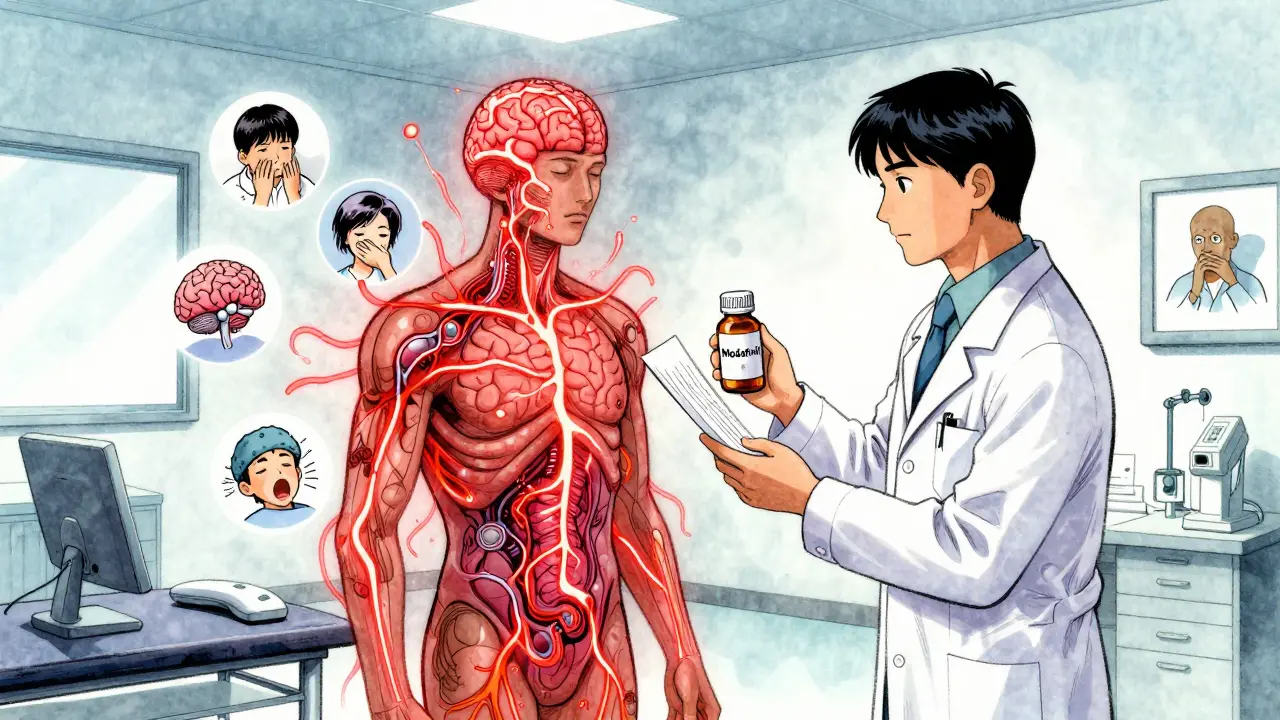
Because narcolepsy is caused by a lack of wakefulness signals in the brain, stimulants are used to boost those signals. They don’t fix the root problem-the loss of hypocretin-but they help the brain stay alert. The goal isn’t to make you hyper. It’s to make you able to function.Three main types of stimulants are used today. The most common are modafinil and armodafinil. These are not amphetamines. They work by increasing dopamine in the brain and helping the remaining hypocretin cells work better. Modafinil is usually started at 200 mg in the morning. If it doesn’t help enough after two weeks, the dose goes up to 400 mg. About 70% of users see a noticeable drop in sleepiness, measured by the Epworth Sleepiness Scale.
Armodafinil is the longer-lasting version of modafinil. It lasts about 15 hours, so it can be taken once daily. In clinical trials, 65% of people on armodafinil had Epworth scores below 10-the threshold for normal daytime sleepiness. That’s a big deal for someone who used to fall asleep at their desk or while driving.
Traditional Stimulants: More Powerful, More Risky
For people with severe sleepiness-Epworth scores above 16-modafinil often isn’t enough. That’s where traditional stimulants like methylphenidate (Ritalin) and mixed amphetamine salts (Adderall) come in. These are more potent. About 80% of users report strong improvement in alertness.But they come with trade-offs. These drugs increase heart rate and blood pressure. Studies show an average rise of 2-3 mmHg in blood pressure and 5-8 beats per minute in heart rate. For someone with existing heart issues, that’s dangerous. That’s why doctors now require an ECG before starting these drugs and check blood pressure every three months.
Side effects are common. Appetite loss, anxiety, irritability, and trouble sleeping at night happen in nearly half of users. About 45% stop taking them within a year because of side effects. And because they’re controlled substances (Schedule II in the U.S.), prescriptions are harder to refill and harder to get approved by insurance.
Newer Options: Better Safety, Higher Cost
In the last five years, two newer drugs have entered the market. Pitolisant (Wakix) works by boosting histamine, a natural wakefulness chemical. It’s as effective as modafinil but has almost no cardiovascular risk. The catch? It costs $850 a month-more than double the price of generic modafinil.Solriamfetol (Sunosi) blocks dopamine and norepinephrine reuptake, similar to Adderall but without the same abuse potential. It reduces sleepiness by 7.5 to 9.8 points on the Epworth scale, depending on the dose. But it carries a warning: 7% of users develop high blood pressure. Still, it’s a good option for people who can’t take amphetamines.
For those with cataplexy, sodium oxybate (Xyrem) is the gold standard. It’s not a stimulant-it’s a sedative taken at night. It reduces cataplexy by 85% and improves daytime sleepiness too. But it’s tightly controlled. You have to get it from a special pharmacy, take it twice at night, and follow strict rules to avoid misuse. A new version, JZP-258, with less sodium, is expected to be approved by the end of 2024, which could help patients who can’t tolerate the salt load.

What Patients Really Say
Real-world experiences tell a different story than clinical trials. On patient forums like MyNarcolepsyTeam, 68% of modafinil users rate it highly, praising the “clean energy” without jitters. But 412 out of 632 users say the effect fades after 18 months. They need higher doses, or they switch.Amphetamine users are more satisfied with their alertness-78% rate it 4.5 out of 5-but 65% complain about losing their appetite. Many say they feel emotionally flat, like they’ve lost their ability to laugh or cry normally. And almost everyone mentions “rebound fatigue”-a crash in the late afternoon or evening that leaves them more tired than before.
One teacher, Sarah Johnson, went from an Epworth score of 18 (severe) to 6 on armodafinil. She’s now able to teach full-time. But she still naps after school. She still takes breaks. She still plans her day around her energy levels. Medication helps-but it doesn’t make narcolepsy disappear.
Challenges in Getting Treatment
Getting the right medication isn’t easy. Insurance often denies coverage unless you’ve tried cheaper options first. The average wait for prior authorization is 14 days. That means people go weeks without treatment.Doctors sometimes don’t escalate doses fast enough. A 2022 study found that 42% of patients stay on suboptimal doses for over six months. That’s because doctors fear side effects-or don’t know the guidelines well enough.
And there’s still a stigma. Many people think narcolepsy is just “being lazy.” But it’s a neurological condition with real biological markers. Workplaces are slowly catching up. Sixty-eight percent of Fortune 500 companies now have policies to support employees with narcolepsy, allowing naps, flexible hours, or remote work.
The Future: Beyond Stimulants
Right now, all treatments are symptomatic. They help you stay awake, but they don’t stop the immune system from destroying hypocretin cells. That’s why researchers are working on disease-modifying therapies.One promising drug, TAK-994, mimics hypocretin by activating its receptor. In trials, it cut sleepiness by nearly 8 points with few side effects. But development was paused in 2023 due to liver concerns in a small number of patients.
Long-term, scientists are exploring cell replacement-growing new hypocretin-producing neurons in the lab-and immunotherapy to stop the autoimmune attack. These are still years away. But for the first time, there’s real hope that one day, narcolepsy won’t need daily pills to manage.
For now, stimulants remain the most reliable tool. The key is matching the right drug to the person-considering severity, side effects, cost, and lifestyle. Modafinil for mild cases. Amphetamines for severe ones. Newer drugs when safety is a priority. And always, always, combining medication with good sleep habits, scheduled naps, and workplace support.
Narcolepsy doesn’t go away. But with the right treatment, it doesn’t have to control your life either.
Can narcolepsy be cured?
No, there is no cure for narcolepsy yet. It’s a lifelong neurological condition caused by the loss of hypocretin-producing brain cells. Current treatments focus on managing symptoms like daytime sleepiness and cataplexy, not fixing the underlying cause. Research into immune therapies and hypocretin replacement is ongoing, but these are still experimental.
Is modafinil addictive?
Modafinil is not considered addictive in the same way as amphetamines. It has a low potential for abuse and is not a controlled substance in most countries. Unlike stimulants like Adderall, it doesn’t cause euphoria or intense cravings. However, some people develop tolerance over time and need higher doses for the same effect, which is different from addiction.
Why do some people feel worse after taking stimulants?
Some people experience rebound fatigue, where the medication wears off and sleepiness returns even stronger. Others have side effects like headaches, anxiety, or high blood pressure that make them feel worse. In rare cases, stimulants can trigger psychosis, especially at high doses. If you feel worse, talk to your doctor-your dose may need adjusting, or you may need a different medication.
Can I drive with narcolepsy?
Many people with narcolepsy can drive safely if their symptoms are well-controlled with medication and they take precautions-like scheduling naps before long drives, avoiding driving during peak sleepiness hours, and never driving without their medication. But if you have frequent sleep attacks or uncontrolled cataplexy, driving can be dangerous. Always follow your doctor’s advice and check your state’s regulations, as some require medical clearance.
How long does it take for stimulants to work?
Modafinil and armodafinil usually start working within 1 to 2 hours after taking them, with full effects seen by 3 to 4 hours. Traditional stimulants like Adderall can work faster-in 30 to 60 minutes. But it can take several weeks to find the right dose. Most doctors wait 2 to 4 weeks before adjusting, because side effects often fade as your body adjusts.
Do I need to take stimulants forever?
Yes, for most people, stimulants are needed long-term. Since narcolepsy is caused by permanent loss of hypocretin cells, stopping medication usually brings symptoms back within days. Some people try to taper off, but relapse is common. The goal isn’t to stop treatment-it’s to find the lowest effective dose that lets you live normally.
Raja P
December 23, 2025 AT 21:56Man, I never realized how much goes into this until I read this. My cousin was diagnosed last year and I thought it was just him being lazy. Turns out he’s fighting a war inside his brain every single day. Thanks for laying it out so clearly.
Joseph Manuel
December 25, 2025 AT 11:57The clinical data presented is methodologically sound, though the anecdotal extrapolations from MyNarcolepsyTeam lack statistical rigor. The reliance on self-reported Epworth Scale scores introduces significant confirmation bias, particularly given the absence of longitudinal controls. A more robust conclusion would require double-blind, placebo-controlled trials with polysomnographic validation.
Harsh Khandelwal
December 26, 2025 AT 04:56Let’s be real - modafinil’s just Big Pharma’s way of keeping us docile while they poison our water with fluoride and 5G brain chips. They don’t want you sleeping too much because then you’d notice the lizard people running the DMV. And don’t get me started on how they’re secretly replacing hypocretin cells with microchips disguised as neurons. I’ve seen the videos. They’re hiding the cure because it’s cheaper to sell pills.
Andy Grace
December 26, 2025 AT 09:18I’ve known someone with narcolepsy for years. It’s not just about sleep - it’s about the isolation. The way people look at you like you’re lazy, or drunk, or just not trying hard enough. I never knew how much courage it takes to get up and face that every day. Just… thank you for writing this.
Delilah Rose
December 27, 2025 AT 00:13It’s fascinating how much the medical community has evolved in understanding this - from dismissing it as depression to finally recognizing it as a neurochemical imbalance with clear biomarkers like hypocretin deficiency. I think what’s really underdiscussed is the emotional toll of being misdiagnosed for years - the shame, the guilt, the internalized stigma - and how even when you get the right diagnosis, the system still makes it so hard to access care because of insurance hoops and doctor ignorance. It’s not just a medical issue, it’s a societal one. We need more education in med schools, more empathy in workplaces, and more funding for research that doesn’t just treat symptoms but actually tries to fix the root cause. And honestly, if we can develop a way to regenerate hypocretin neurons, we might not just help narcoleptics - we might unlock new insights into how sleep and wakefulness work in every human brain.
Spencer Garcia
December 28, 2025 AT 01:59Modafinil first, then escalate if needed. Always combine with naps and schedule. No magic pills, just smart management.
Abby Polhill
December 29, 2025 AT 14:10So we’ve got SOREMPs, hypocretin-1 hypofunction, and now we’re talking about histamine agonists and dopamine reuptake inhibitors. Honestly, it’s like watching a neuropharmacology symposium unfold in real time. The fact that sodium oxybate’s being re-engineered to reduce sodium load? That’s next-gen precision medicine right there. We’re moving from brute-force stimulants to targeted neuromodulation - and honestly, that’s the future.
Bret Freeman
December 29, 2025 AT 20:16They’re lying. They’ve had a cure for this since the 90s. They just don’t want you to sleep more than 4 hours a night because then you’d stop buying stuff, stop working 80-hour weeks, and start questioning the system. That’s why they keep pushing stimulants - it keeps you docile, productive, and dependent. Wake up. This isn’t medicine - it’s control. And they’re making billions off your exhaustion.
Lindsey Kidd
December 31, 2025 AT 11:51Thank you for sharing this 💙 I’ve been on armodafinil for 3 years and I still cry when I think about the first day I drove to work without falling asleep at the light. You’re not alone. And yes, the fatigue still comes back - but now I know it’s not my fault. 🙏
Austin LeBlanc
December 31, 2025 AT 13:03So you’re telling me people with narcolepsy are just too weak to push through? Why don’t they just drink more coffee? Or get up earlier? Or stop being so dramatic? This isn’t a disability - it’s a choice. And now we’re giving them $850/month drugs because they can’t handle life? Wake up, society. This is just another excuse for laziness dressed up in medical jargon.
niharika hardikar
January 1, 2026 AT 17:57The diagnostic criteria for narcolepsy, particularly the MSLT protocol, remain inconsistent across institutions due to inter-rater variability in SOREMP identification. Furthermore, the reliance on Epworth Sleepiness Scale as a primary outcome metric is problematic given its subjective nature and lack of ecological validity. A paradigm shift toward objective neurophysiological biomarkers is imperative to standardize clinical evaluation and ensure equitable access to treatment.
Rachel Cericola
January 2, 2026 AT 06:08I want to say this to every doctor reading this: Don’t wait six months to increase the dose. Don’t make people beg for Adderall because your insurance form says ‘try modafinil first.’ I’ve seen patients cry because they missed their kid’s school play because they crashed at 2 p.m. Narcolepsy isn’t a ‘mild case’ or a ‘moderate case’ - it’s a life sentence of exhaustion, and we owe it to these people to treat them like humans, not insurance claims. If you’re not pushing for faster access, you’re part of the problem. We need policy change, not just pill prescriptions.
Blow Job
January 4, 2026 AT 00:29My brother’s been on modafinil for 8 years. He doesn’t feel ‘high’ - he just feels like himself again. Before, he’d fall asleep mid-sentence. Now he coaches soccer, reads to his kids, and doesn’t panic when the phone rings. This isn’t about drugs. It’s about dignity.