
Penicillin Desensitization: Safe Protocols for Allergic Patients Who Need Beta-Lactams
 Dec, 5 2025
Penicillin Allergy Eligibility Checker
Eligibility Assessment
This tool helps determine if you or your patient is eligible for penicillin desensitization based on allergy history and medical condition. It's based on CDC, AAAAI, and IDSA guidelines.
More than 10% of people in the U.S. say they’re allergic to penicillin. But here’s the catch: 90% of them aren’t. Many were misdiagnosed as kids after a rash or stomach upset, and that label stuck-blocking access to the safest, most effective antibiotics for life-threatening infections. When someone truly needs penicillin-say, for neurosyphilis, endocarditis, or group B strep in pregnancy-there’s a way forward: penicillin desensitization.
What Penicillin Desensitization Actually Does
Penicillin desensitization isn’t a cure for allergy. It doesn’t change your immune system permanently. Instead, it’s a controlled, temporary trick: by slowly introducing tiny, increasing doses of penicillin over a few hours, you teach your body to tolerate it-just long enough to finish the treatment. Once you stop the drug, the tolerance fades, usually within 3 to 4 weeks. But during that window, you can safely receive the full therapeutic dose.This matters because alternatives to penicillin are often worse. Broad-spectrum antibiotics like vancomycin, clindamycin, or fluoroquinolones are more expensive, less effective for certain infections, and fuel antimicrobial resistance. A 2017 study in the Journal of Allergy and Clinical Immunology found that patients wrongly labeled as penicillin-allergic cost hospitals $3,000 to $5,000 more per admission due to longer stays and costlier drugs.
Who Gets Desensitized-and Who Doesn’t
Desensitization isn’t for everyone. It’s reserved for patients with a confirmed or strongly suspected IgE-mediated allergy (like hives, swelling, or anaphylaxis) who have no safe alternative. Common scenarios include:- Pregnant women with syphilis-penicillin is the only drug that crosses the placenta to kill the bacteria safely
- Patients with bacterial endocarditis where penicillin-based regimens are the gold standard
- Severe community-acquired pneumonia in patients with no other viable options
But it’s absolutely off-limits for people who’ve had:
- Stevens-Johnson Syndrome (SJS)
- Toxic Epidermal Necrolysis (TEN)
- Drug Reaction with Eosinophilia and Systemic Symptoms (DRESS)
These are T-cell-mediated reactions, not IgE-driven. Desensitization won’t prevent them-and could make things worse. The CDC, AAAAI, and IDSA all agree: if you’ve had one of these severe skin reactions, avoid penicillin entirely.
How It’s Done: IV vs. Oral Protocols
There are two main routes: intravenous (IV) and oral. Both follow the same principle-start tiny, go slow, watch closely-but differ in setup and risk.IV Desensitization is the most common in hospitals. It starts with a 100 units/mL solution, giving just 0.2 mL (20 units) as the first dose. Each next dose doubles the amount, every 15 to 20 minutes. By the end of about 4 hours, the patient receives the full therapeutic dose. This method gives doctors tight control over dosing and allows immediate response if a reaction occurs. Brigham and Women’s Hospital has successfully completed over 176 IV desensitizations using their standardized protocol.
Oral Desensitization is often called “easier and likely safer.” It uses the same incremental approach but with pills or liquid. Doses are given every 45 to 60 minutes instead of every 15 to 20. Studies show about one-third of patients get mild reactions-itching, rash, or hives-but those usually respond to antihistamines and don’t require stopping the process. The UNC policy document notes oral protocols are simpler to manage and less resource-intensive.
Neither route is proven superior in large studies. But oral is preferred when possible, especially for pregnant women or patients who can tolerate pills. The CDC recommends IV only when the infection requires immediate, high-dose delivery or when oral absorption is unreliable.
Preparation and Safety: What Happens Before and During
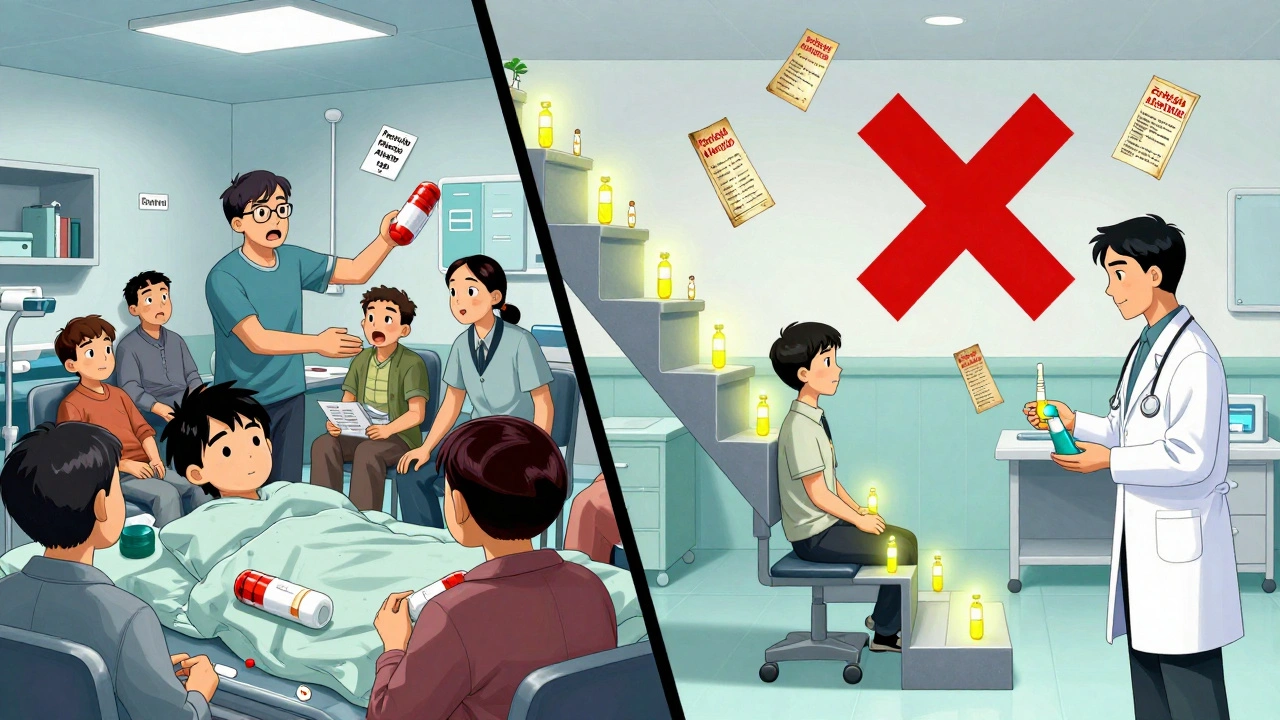
Desensitization isn’t something you do in a doctor’s office. It requires a monitored hospital setting-usually inpatient. Here’s what’s required:- Premedication: Patients get antihistamines (like diphenhydramine or cetirizine), H2 blockers (ranitidine), and sometimes montelukast one hour before starting. These don’t prevent reactions-they reduce their severity.
- Monitoring: Vital signs are checked every 15 minutes. Nurses watch for drops in blood pressure, wheezing, swelling, or new rashes. If any of these happen, the protocol stops immediately.
- Emergency readiness: Epinephrine, oxygen, and airway equipment must be at the bedside. Staff must be trained to treat anaphylaxis on the spot.
- Pharmacy prep: Each dose is precisely diluted and labeled. Prisma Health’s 2024 protocol requires 19 separate labels and a 48-hour stop order to prevent accidental repeat dosing.
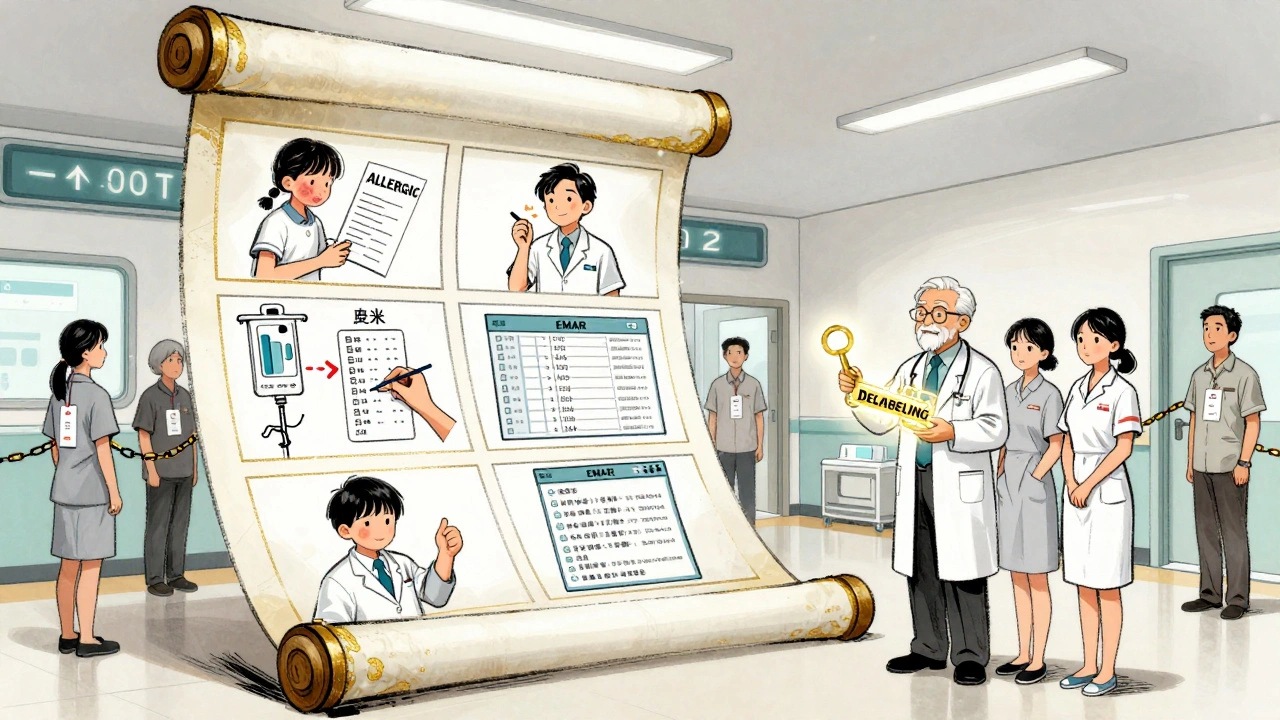
Documentation is critical. Nurses sign off on every dose in the electronic medical record (EMAR). If the patient has a reaction, the protocol is paused, antihistamines are given, and dosing resumes slower-sometimes extending the total time to 6 or 8 hours.
Why This Isn’t Done More Often
Despite its life-saving potential, penicillin desensitization remains rare outside academic hospitals. Only 17% of community hospitals have formal protocols, compared to 89% of academic centers. Why?- It’s complex. Staff need training. You can’t just hand a nurse a protocol and expect safe results.
- It’s time-consuming. A full IV desensitization takes 4+ hours. That’s one bed tied up, one nurse focused, one pharmacy team working.
- It’s misunderstood. Many providers confuse it with a “graded challenge”-a much simpler test for low-risk patients. A graded challenge skips the incremental build-up and gives a small therapeutic dose. It’s fine for low-risk cases, but dangerous if used for true IgE-mediated allergy.
Dr. David Khan, an allergist, points out that improper use has led to preventable anaphylactic events in 2-3% of cases. That’s why the AAAAI requires providers to complete at least five supervised desensitizations before doing one alone.
The Bigger Picture: Fighting Antibiotic Resistance
This isn’t just about one drug. It’s about saving antibiotics for when they matter most. The CDC reports that carbapenem-resistant Enterobacteriaceae infections jumped 71% between 2017 and 2021. These are superbugs that survive even our strongest drugs. When we avoid penicillin because of a mislabeled allergy, we reach for carbapenems or other last-resort antibiotics-accelerating resistance.The National Action Plan for Health Care-Associated Infections (2020) made penicillin allergy delabeling a top priority. In 2023, $15 million in grants went to hospitals to build allergy clarification programs. The IDSA’s 2022 roadmap predicts that by 2027, half of U.S. hospitals will have formal desensitization and testing programs-up from just 22% today.
What Comes Next
The future of penicillin desensitization is moving fast. New guidelines from Prisma Health (2024) now require full EMAR integration and digital documentation. The CDC is updating its STI treatment guidelines to allow desensitization in resource-limited settings where alternatives are scarce. Researchers are exploring whether molecular mechanisms can extend the tolerance window beyond the current 3-4 weeks. Some are even testing desensitization for non-antibiotic drugs like taxanes used in cancer treatment.But the biggest hurdle isn’t science-it’s access. Until every hospital has trained staff, clear protocols, and the will to prioritize safety over convenience, patients will keep being denied the best treatment because of a label that might not even be true.
If you’ve been told you’re allergic to penicillin, ask: Was this confirmed with skin testing or a blood test? If not, you may be one of the 9 in 10 who can safely take it. And if you need penicillin now, desensitization is a proven, safe path forward-when done right.
Can you outgrow a penicillin allergy?
Yes, many people do. Studies show that up to 80% of people who had a penicillin allergy as children lose it within 10 years, even without testing. But without formal evaluation-like skin testing or a supervised challenge-you shouldn’t assume you’re no longer allergic. Labels stick, and misusing penicillin after a past reaction can be dangerous.
Is penicillin desensitization safe during pregnancy?
Yes, and it’s often necessary. For syphilis in pregnancy, penicillin is the only treatment that reliably prevents transmission to the baby. Desensitization is routinely performed in Labor and Delivery units under close monitoring. The risk of untreated syphilis far outweighs the small chance of an allergic reaction during the procedure.
What if I have a reaction during desensitization?
Mild reactions like itching or a rash are common-about one in three patients. The protocol is paused, antihistamines are given, and dosing resumes at a slower rate. If you develop swelling, trouble breathing, or low blood pressure, the infusion is stopped immediately, and emergency treatment begins. Serious reactions are rare when protocols are followed correctly.
Do I need to keep taking penicillin after desensitization?
Yes. The tolerance only lasts as long as you keep receiving penicillin. If you stop for more than 48 hours, your body forgets the tolerance. If you need penicillin again later, you’ll have to go through the full desensitization process again. That’s why it’s only used when you’re sure you’ll need the full course.
Can I get tested before desensitization?
Absolutely. Skin testing with penicillin G and its major determinant (PPL) is the gold standard for confirming IgE-mediated allergy. If the test is negative, you can usually take penicillin safely without desensitization. If it’s positive, then desensitization is the next step. Testing reduces unnecessary procedures and ensures only those who truly need it go through the process.
Is desensitization the same as a graded challenge?
No. A graded challenge gives a small therapeutic dose (like 1/10th of a full dose) and waits to see if a reaction occurs. It’s used for low-risk patients-those with a vague history, like a childhood rash that wasn’t hives or swelling. Desensitization is for confirmed IgE-mediated allergy. It uses tiny, incremental doses over hours to build tolerance. Mixing them up can lead to anaphylaxis.
Can I do penicillin desensitization at home?
No. It requires continuous monitoring, emergency equipment, and trained staff. Even mild reactions can escalate quickly. All major guidelines-from the CDC to AAAAI-require it to be done in a hospital setting with immediate access to life-saving interventions.
Arjun Deva
December 7, 2025 AT 06:46So let me get this right… you’re telling me the entire medical establishment has been lying to us for decades about penicillin allergies?? And now they want us to trust them again?? With incremental doses?? Please. I’ve seen what happens when they “adjust” protocols-remember the Vioxx scandal? The flu vaccine fiasco? They’ll say it’s “safe” until someone dies… then it’s “rare” and “unforeseen.” I’m not signing up for their lab experiment.
Inna Borovik
December 8, 2025 AT 07:16Let’s be real-this whole desensitization framework is a Band-Aid on a hemorrhage. The real problem is the systemic failure to properly diagnose penicillin allergies in the first place. Skin testing is underutilized, allergists are scarce, and primary care docs just slap on the label like it’s a vaccine exemption. The $3k–$5k cost differential? That’s not just a stat-it’s a moral indictment. We’re spending more on antibiotics we don’t need because we’re too lazy to test properly. And now we’re turning hospitals into desensitization clinics? That’s not innovation-that’s triage.
Jackie Petersen
December 8, 2025 AT 08:00America’s healthcare system is broken, but this? This is pure genius. We’re finally doing something right. Penicillin is cheap, effective, and has been saving lives since WWII. Why are we letting fear and bad paperwork dictate treatment? I’ve seen patients die because they were labeled allergic and given vancomycin instead. This isn’t just medicine-it’s justice. If you’re afraid of this, you’re afraid of progress. And that’s not brave. It’s cowardly.
Annie Gardiner
December 9, 2025 AT 18:19Isn’t it funny how we’re willing to chemically retrain our immune systems to tolerate a drug… but we won’t retrain our minds to question why we were told we were allergic in the first place? Maybe the real allergy isn’t to penicillin… it’s to responsibility. To asking the right questions. To admitting we were misinformed as kids and now we’re too proud to admit it. We’ve turned a medical label into an identity. And that’s the real crisis.
Rashmi Gupta
December 11, 2025 AT 06:36India has been doing this for years-quietly, efficiently, without the fanfare. We don’t have fancy EMAR systems or 19-label protocols. We use oral desensitization with plain penicillin V tablets, spaced out, under supervision. No drama. No panic. Just care. Why does America need so much paperwork to do what’s simple? Maybe it’s not the medicine… it’s the bureaucracy.
Andrew Frazier
December 12, 2025 AT 18:55Look, I’ve been in the trenches. I’ve seen patients get anaphylaxis from penicillin. I’ve also seen nurses give the wrong dose because they were tired. This protocol sounds great on paper, but in real life? It’s a nightmare waiting to happen. And don’t even get me started on the pharmacy delays. I’ve seen meds held up for 48 hours because someone forgot to sign off on a label. We’re not saving lives here-we’re playing Russian roulette with paperwork.
Kumar Shubhranshu
December 13, 2025 AT 13:28Oral desensitization works. Simple. Proven. Safe. No need for IVs. No need for alarms. Just pills. Slow. Patient. Done. Stop overcomplicating it.
Mayur Panchamia
December 14, 2025 AT 08:58Oh, so now we’re supposed to believe that 90% of people are lying about their penicillin allergy? That’s the most ridiculous thing I’ve heard since the ‘5G causes COVID’ crowd. People don’t just make up rashes and swelling-those are REAL reactions. And now you want to shove penicillin down their throats because it’s cheaper? What’s next? Forcing flu shots on people who got hives from a mosquito bite? This isn’t science-it’s corporate greed wrapped in a white coat. The FDA’s asleep at the wheel, and you’re cheering it on. Shameful.