
Why Generic Drugs Look Different from Brand-Name Medicines
 Dec, 15 2025
Have you ever picked up your prescription and thought, "This isn't the same pill I got last month"? Maybe it’s a different color, shape, or size. You’re not alone. Millions of people in the U.S. experience this every year - and most of them panic, wondering if something’s wrong. The truth? Nothing’s wrong. Your medicine still works exactly the same. The difference is legal, not medical.
It’s the Law, Not the Science
Generic drugs look different from brand-name medicines because U.S. trademark law says they have to. The FDA doesn’t make this rule because it thinks variety is fun. It’s because of something called the Hatch-Waxman Act of 1984. This law let generic drug companies sell cheaper versions of brand-name drugs - but only if they didn’t copy the exact look. Why? To protect the brand-name company’s intellectual property. A pill’s color, shape, and markings are considered part of its brand identity. So even if two pills contain the exact same active ingredient, same strength, same dosage form, and work the same way in your body, the generic version can’t look identical to the original.This isn’t about safety or effectiveness. It’s about trademarks. Think of it like soda: you can buy a cola that tastes exactly like Coca-Cola, but you can’t make it look like the red can with the white script. Same idea here.
Same Medicine, Different Look
The active ingredient - the part that actually treats your condition - is identical in both brand and generic versions. If your brand-name pill has 10 mg of lisinopril, so does the generic. Same for atorvastatin, metformin, fluoxetine, or any other common drug. The FDA requires generic manufacturers to prove their version works the same way in your body. That means it gets absorbed at the same rate and to the same extent. The FDA’s acceptable range? Between 80% and 125% of the brand-name drug’s absorption. Most generics fall within 95-105%. That’s tighter than the variability allowed in brand-name pills themselves.So what changes? The inactive ingredients. These are the fillers, dyes, binders, and coatings that give the pill its shape, color, and texture. A brand-name drug might use a blue dye to stand out on the shelf. A generic version might use a white tablet with a yellow stripe. One manufacturer might use lactose as a binder; another might use cellulose. None of these affect how the medicine works. They just change how it looks and sometimes how it feels in your mouth.
Real-World Examples
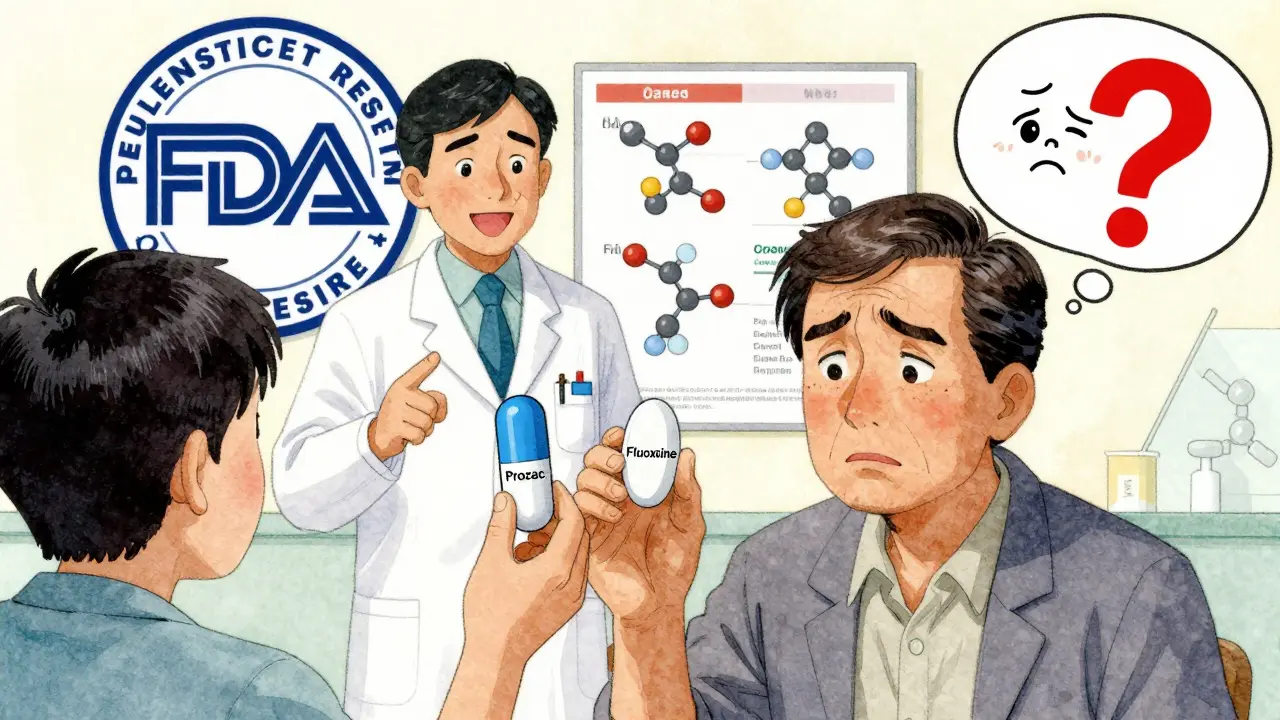
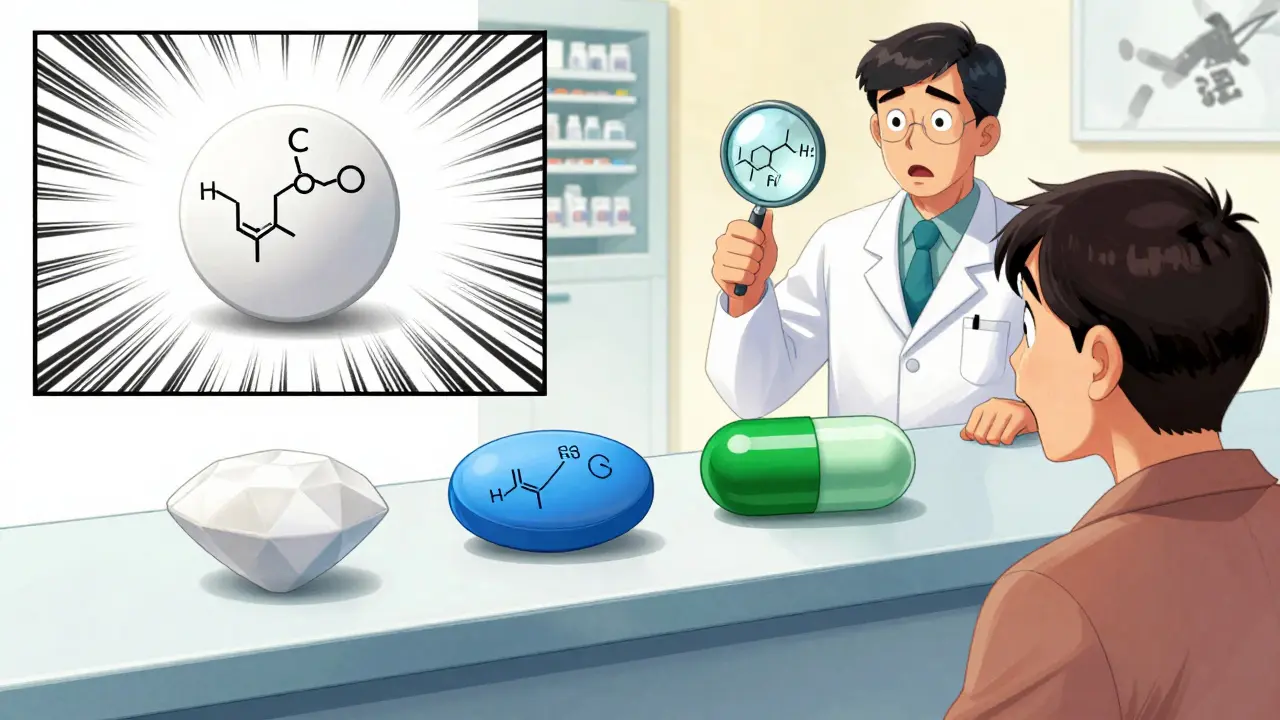
Take Prozac (fluoxetine). The brand-name version is a blue capsule. But if you get the generic, you might get a white, oval tablet. Or a pink one. Or a yellow capsule. It depends on who made it - Teva, Mylan, Sandoz, or another company. All contain 20 mg of fluoxetine. All work the same. But they look nothing alike.Same with Lipitor (atorvastatin). The brand is a white, diamond-shaped tablet. Generics? You might get a white oval, a blue oval, or even a green capsule. Again - same cholesterol-lowering effect. Different appearance.
And here’s the kicker: if you switch between different generic manufacturers - say, from Teva to Mylan - your pill might change color again, even if you didn’t switch from generic to brand. That’s because each company has its own design. There’s no standard for what a generic “should” look like. Only one rule: don’t copy the brand.
Why This Causes Problems
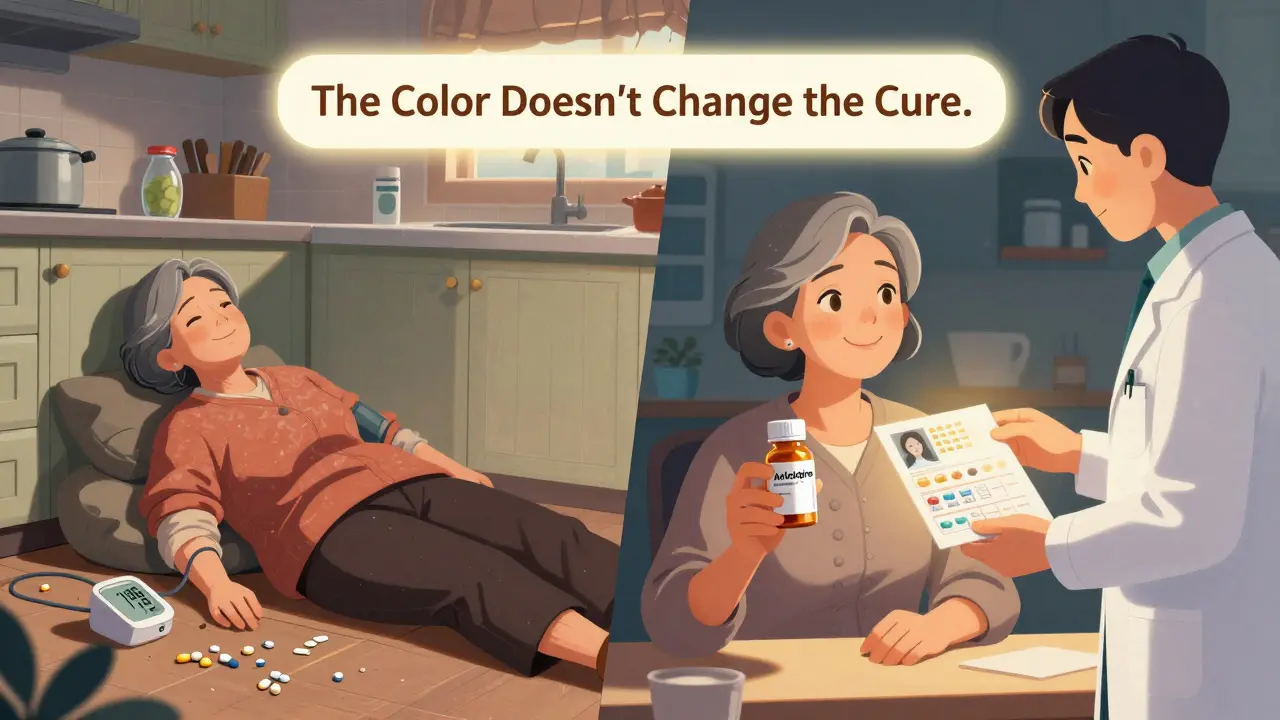
People don’t trust what they don’t understand. When your pill looks different, your brain says: "This isn’t right." That’s natural. But in medicine, that suspicion can be dangerous.A 2021 study in JAMA Internal Medicine found that 14.2% of patients stop taking their medication after switching to a generic - mostly because they think it’s weaker, fake, or broken. One case from Brown University Health tells the whole story: a 72-year-old woman with high blood pressure stopped taking her amlodipine after her pill turned from white to blue. She didn’t realize it was the same drug. Eleven days later, her blood pressure spiked to 198/112. She ended up in the ER.
Pharmacies see this all the time. According to UMass Memorial Health, appearance changes are the third most common cause of medication errors - right after similar-sounding drug names and messy handwriting. That’s not because generics are unsafe. It’s because patients don’t know they’re safe.
What Pharmacies Are Doing About It
Pharmacists know this is a real problem. So many have started doing more than just handing out pills.Chain pharmacies like CVS and Walgreens now have systems that flag when a patient gets a generic with a different appearance. When that happens, the pharmacist is prompted to talk to the patient. They’ll say: "This is the same medicine, just made by a different company. It’s not a different drug. It’s not weaker. It’s exactly the same active ingredient."
Some pharmacies now include a photo of the pill on the label. Others give out printed sheets showing what the generic version looks like before you pick it up. Humana’s patient education campaign found that when people see a picture and read a simple explanation, they’re 22% less likely to quit taking their meds.
Even better? Some generic manufacturers - like Teva and Mylan - now voluntarily keep the same shape and color for the same drug across their product lines. So if you’ve been on Teva’s generic atorvastatin, you’ll keep getting the same white oval tablet, even if you refill at different pharmacies. That’s not required by law - it’s just good practice.
Cost Savings Are Huge
You might be wondering: why does any of this matter? Because it saves billions.In 2022 alone, generic drugs saved the U.S. healthcare system $313 billion. Over the last decade, that’s $2.2 trillion. That’s money that didn’t go to drug companies. It went to patients’ pockets, to lower insurance premiums, to hospitals that could treat more people.
Generic drugs cost 80-85% less than brand-name versions. A 30-day supply of brand-name Zoloft might be $200. The generic? $10. That’s not a typo. And the FDA approves every single one of them.
But if people stop taking their meds because they don’t recognize the pill, those savings vanish. Emergency visits, hospitalizations, worsening conditions - they all cost more than the drug ever did.
What You Can Do
If your pill looks different:- Don’t panic. It’s probably still the same medicine.
- Ask your pharmacist. They can tell you if it’s the same active ingredient. They can show you a picture.
- Check the label. Look for the drug name and strength. If it says “fluoxetine 20 mg,” it’s the same as the blue capsule.
- Don’t skip doses. If you’re unsure, call your doctor or pharmacist before stopping.
- Ask for consistency. If you’ve had a good experience with one generic manufacturer, ask your pharmacy to stick with that one.
And if you’re worried about narrow therapeutic index drugs - like warfarin, levothyroxine, or phenytoin - talk to your doctor. These require tighter control, and your provider might prefer you stay on one brand or generic version. But even then, the active ingredient is still the same. The difference is still just appearance.
The Future Is Changing
The FDA is starting to notice this problem. In September 2023, they released draft guidance suggesting generic manufacturers should try to match the brand’s appearance when possible - not because of trademark law, but because it helps patients stick to their meds.A new federal law, the Elijah E. Cummings Lower Drug Costs Now Act, requires the Department of Health and Human Services to create standards to reduce appearance-related errors by June 2025. That could mean standardized colors or shapes for common drugs. It could mean mandatory labeling with images. It’s not law yet - but it’s coming.
For now, the rule remains: generics must look different. But the message is clear: the color doesn’t change the cure.
Why do generic drugs look different if they’re the same medicine?
Generic drugs look different because U.S. trademark laws prevent them from copying the exact color, shape, or markings of brand-name pills. This protects the original manufacturer’s intellectual property. But the active ingredient, strength, dosage, and effectiveness are identical. The differences are only in inactive ingredients like dyes and coatings - which don’t affect how the drug works.
Are generic drugs less effective than brand-name drugs?
No. The FDA requires generics to prove they work the same way in the body as the brand-name version. They must deliver the same amount of active ingredient at the same rate. Studies show the difference in absorption is typically less than 5%, well within the FDA’s 80-125% acceptable range. For most people, there’s no difference in effectiveness.
Can switching between different generic brands cause problems?
For most medications, switching between generic manufacturers causes no issues. But for drugs with a narrow therapeutic index - like warfarin, levothyroxine, or phenytoin - even small changes can matter. If you take one of these, talk to your doctor about staying on the same generic version. Otherwise, switching between generics is safe and common.
Why do I sometimes get a different generic even if I didn’t change pharmacies?
Pharmacies often switch between generic manufacturers based on cost, availability, or contracts with insurers. One month you might get Teva’s version; next month, it could be Mylan’s. Both are FDA-approved and equally effective. The change is not because your prescription changed - it’s because the pharmacy’s supplier did.
What should I do if I’m worried about my new pill?
Don’t stop taking it. Call your pharmacist and ask: "Is this the same medicine?" They can show you the active ingredient and compare it to your old pill. Many pharmacies now include photos on labels or offer printed guides. If you’re still unsure, contact your doctor. Never stop a medication without talking to a professional.
Rich Robertson
December 16, 2025 AT 20:48Been there. Got my blood pressure med switched from white oval to blue rectangle last month. Thought I got scammed. Called my pharmacist - turned out it was the same damn thing. Saved me $180 a month. Why do we treat medicine like it’s a sneaker drop?
Rulich Pretorius
December 17, 2025 AT 23:15The real tragedy isn’t the pill color - it’s that we’ve normalized distrust in science because corporations turned medicine into branding. The FDA’s rules make sense legally, but ethically? We’re punishing patients for intellectual property laws designed to protect profit, not people. The system is broken, not the pill.
Thomas Anderson
December 19, 2025 AT 18:34My grandma used to freak out every time her generic Xanax changed shape. I printed out a little cheat sheet with pics of each version and taped it to her pillbox. She stopped panicking. Simple fix. Pharmacies should do this by default.
Edward Stevens
December 21, 2025 AT 11:54So let me get this straight - we let companies trademark the color of a pill, but we don’t let patients know it’s the same drug? Genius. Next they’ll trademark the smell of insulin. At least my coffee doesn’t change flavor every time I buy it.
Daniel Wevik
December 23, 2025 AT 05:42From a pharmacokinetic standpoint, the 80–125% bioequivalence window is statistically robust - but for patients with narrow therapeutic index drugs like warfarin, even 5% variability can trigger INR spikes. The real issue isn’t appearance - it’s lack of standardized labeling and patient education infrastructure. We’re treating a systemic failure like a UX problem.
jeremy carroll
December 24, 2025 AT 10:25lol i just thought my generic zoloft was weak cause it was pink n not blue… turned out i was just stressed out. also i miss the old blue ones. they looked more ‘professional’ lmao. pharmacy should send a text when it changes. like ‘hey ur pill is now a yellow oval. its still the same. chill.’
Sinéad Griffin
December 26, 2025 AT 02:46AMERICA IS THE ONLY COUNTRY THAT LETS PHARMA COMPANIES OWN THE COLOR OF MEDICINE. WE PAY MORE FOR BRAND NAMES, THEN GET SCAMMED BY DIFFERENT-SHAPED GENERIC PILLS? NOPE. WE NEED A LAW. NOW. 🇺🇸✊ #MedicineIsNotAMarketingBrand
Alexis Wright
December 27, 2025 AT 06:12Let’s be honest - this isn’t about trademarks. It’s about corporate control. The brand-name companies paid lobbyists to write the Hatch-Waxman Act so generics couldn’t compete on appearance - which is the *only* way patients recognize their meds. It’s not a loophole. It’s a racket. And now we’re all just supposed to swallow it? Literally.
Natalie Koeber
December 29, 2025 AT 02:21have u ever wondered why ALL the generics look different? what if they’re not even the same drug? what if the FDA is in on it? i read a guy on a forum who said the blue pill has 10% less active ingredient than the white one - they just say it’s ‘within range’… but what if the range is rigged? i’m not taking my meds until i get the original. i don’t trust the system.
Wade Mercer
December 30, 2025 AT 16:55People who stop taking their meds because the pill looks different are irresponsible. You’re not just risking your health - you’re making everyone else’s insurance more expensive. If you can’t follow basic instructions, maybe you shouldn’t be in charge of your own treatment.
Dwayne hiers
January 1, 2026 AT 09:58For drugs with narrow therapeutic indices - warfarin, levothyroxine, phenytoin, cyclosporine - therapeutic drug monitoring (TDM) is critical when switching generics. While bioequivalence is statistically sound, inter-individual variability in absorption can be clinically significant in sensitive populations. Pharmacist-led interventions with pill imagery and patient counseling reduce non-adherence by up to 22%, per Humana’s 2022 cohort analysis. Standardization is not just prudent - it’s a clinical imperative.
Jonny Moran
January 2, 2026 AT 17:48Hey - if you’re worried about your pill changing, you’re not crazy. It’s weird to get a different color every month. But here’s the good news: your pharmacist is your secret weapon. Ask them to show you the pill image. Ask them to stick with the same maker if you’re stable. You’ve got more control than you think. You’re not just a patient - you’re your own best advocate.