
DMARDs and Biologic Medications: What You Need to Know About Immunosuppressive Therapy
 Feb, 24 2026
When your immune system turns on your own body, things get complicated. In autoimmune diseases like rheumatoid arthritis, psoriatic arthritis, or ankylosing spondylitis, your immune system doesn’t just fight off germs-it attacks your joints, skin, and even organs. That’s where DMARDs come in. These aren’t painkillers. They don’t just numb the ache. They go deeper. They change how your immune system works. And for millions of people, they’re the difference between living with constant pain and living with control.
What Exactly Are DMARDs?
DMARD stands for disease-modifying antirheumatic drug. The name says it all: they modify the disease. Unlike NSAIDs or corticosteroids that only mask symptoms, DMARDs work to slow or stop the damage caused by your immune system. They’ve been around since the 1980s, but their use has evolved dramatically. Today, there are three main types: conventional synthetic DMARDs, biologic DMARDs, and targeted synthetic DMARDs (like JAK inhibitors).Conventional DMARDs are the oldest and most common. Think of them as broad-spectrum tools. They don’t pick and choose which part of the immune system to calm down-they hit a wide range of cells. The most well-known is methotrexate. It’s taken once a week as a pill or injection, costs as little as $4 a month in the U.S., and has been the go-to first-line treatment for decades. Others include leflunomide, hydroxychloroquine, and sulfasalazine. These are usually tried first because they’re affordable, well-studied, and work for many people.
But for about one in three people with rheumatoid arthritis, methotrexate just doesn’t cut it. That’s where biologics come in.
Biologic DMARDs: Precision Tools for a Complex System
Biologic DMARDs, or just “biologics,” are made from living cells. That’s why they’re so specific. Instead of flooding your whole immune system with suppression, they zero in on one exact target-like a sniper instead of a shotgun.Some block TNF-alpha, a key inflammation protein. Drugs like adalimumab (Humira), infliximab (Remicade), and etanercept (Enbrel) do this. Others target different pathways: rituximab wipes out B cells that produce inflammatory signals, tocilizumab blocks IL-6 receptors, and abatacept interrupts the signal between T cells and other immune cells.
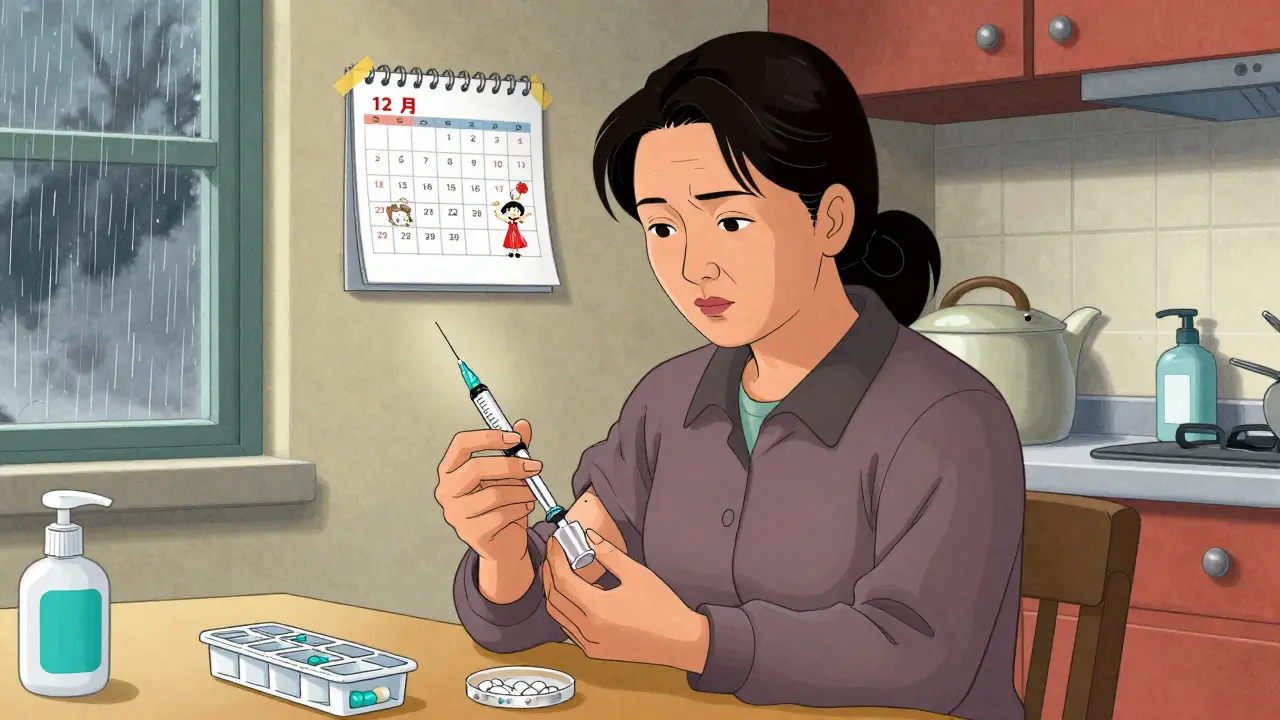
These drugs are given either as an IV infusion (in a clinic) or as a weekly self-injection. Most patients learn how to give themselves the shot at home after a few training sessions. It sounds intimidating, but many say it becomes routine-like brushing your teeth.
Biologics often work faster than conventional DMARDs. While methotrexate might take 3-6 months to show full effect, some biologics start making a difference in 2-4 weeks. For people with severe joint damage or rapidly progressing disease, that speed matters.
Cost, Access, and the Real-World Hurdles
Here’s the tough part: biologics are expensive. Without insurance, a single month’s supply can cost $1,000 to $5,000. Even with coverage, out-of-pocket costs can still hit $500 a month. That’s why many patients wait months just to get insurance approval. Some clinics report delays of 2-6 weeks just to start treatment.But there’s hope. Since 2016, biosimilars have entered the market. These are nearly identical copies of brand-name biologics, and they’re 15-30% cheaper. For example, biosimilars of adalimumab and etanercept are now widely available. They work just as well, and many insurers now require patients to try them first.
Meanwhile, conventional DMARDs remain the backbone of treatment. Methotrexate still costs less than a cup of coffee a day. It’s not glamorous, but it’s effective-and it’s what most patients start with.

Side Effects: What to Watch For
No medication is without risk. Conventional DMARDs can cause nausea, fatigue, liver stress, or low blood counts. That’s why regular blood tests every 4-8 weeks are standard. You’ll need them to catch problems early.Biologics bring different risks. Because they’re so powerful, they lower your body’s ability to fight infections. A simple cold can turn into pneumonia. A small cut might get infected. That’s why doctors always check for TB before starting biologics-you can’t have latent TB when your immune system is suppressed.
Signs to watch for: fever, night sweats, cough lasting more than a week, or unusual fatigue. If you feel off, don’t wait. Call your doctor. In studies, 5-10% of biologic users experience serious infections that require hospitalization.
Some patients also develop antibodies against the drug itself. This can make it less effective over time. If you notice your pain creeping back after months of relief, it might be time to switch.
What About JAK Inhibitors?
JAK inhibitors like tofacitinib and upadacitinib are the newest class. They’re pills-no injections needed. They work inside immune cells to block signals that cause inflammation. They’re often used when biologics fail or aren’t tolerated.But they come with their own warnings. The FDA has placed black box warnings on JAK inhibitors for increased risk of heart attack, stroke, cancer, and blood clots, especially in people over 50 with heart disease risk factors. That means they’re not for everyone. Your doctor will weigh your personal risks before prescribing one.
How Therapy Actually Works in Real Life
Most patients don’t jump straight to biologics. The standard path looks like this:- Start with methotrexate (or another conventional DMARD).
- Wait 3-6 months to see if symptoms improve.
- If not, add a second DMARD (like sulfasalazine or hydroxychloroquine).
- If still no improvement after 6-12 months, move to a biologic or JAK inhibitor.
This step-by-step approach isn’t about dragging things out-it’s about balancing effectiveness with safety and cost. Studies show that 70% of patients who stick with methotrexate for a full year see meaningful improvement. Only about 20-30% ever need biologics.
One patient I spoke with in Perth shared her story: after 14 months of methotrexate with little relief, she switched to adalimumab. Within six weeks, she could hold her granddaughter’s hand without pain. Six months later, her DAS28 score-a measure of arthritis activity-dropped by 70%. But she also had two bouts of pneumonia. "It’s worth it," she said. "But I’m not careless anymore. I wash my hands. I skip crowded places in winter. I carry hand sanitizer everywhere."

The Future Is Targeted-and More Personal
Research is moving fast. New biologics are in Phase III trials, targeting even more specific immune pathways. Some aim to reduce infection risk while keeping effectiveness. Others are being tested for conditions beyond arthritis-like lupus, psoriasis, and even Crohn’s disease.One big shift? Personalized dosing. Instead of one-size-fits-all, doctors are starting to adjust doses based on blood markers, weight, and how fast the drug clears from your system. It’s not routine yet, but it’s coming.
And cost? Biosimilars will keep driving prices down. By 2030, experts predict biologic use will grow 5-7% a year-not because more people are getting sick, but because access is improving.
What You Can Do Right Now
If you’re on DMARD therapy:- Take your meds exactly as prescribed-even if you feel fine.
- Don’t skip blood tests. They’re not busywork; they’re lifesavers.
- Keep a symptom journal. Note pain levels, fatigue, and any new symptoms.
- Ask about biosimilars. They’re just as safe, and much cheaper.
- Get your flu shot. And your pneumonia shot. And your shingles shot (if eligible). Your immune system needs all the help it can get.
If you’re considering starting treatment: talk to your rheumatologist about your goals. Do you want to stop joint damage? Regain mobility? Reduce pain enough to play with your kids? Your answer will shape your plan.
Are DMARDs the same as steroids?
No. Steroids like prednisone reduce inflammation quickly but don’t change the disease course. They’re used short-term to control flares while DMARDs take effect. Long-term steroid use causes bone loss, weight gain, and diabetes. DMARDs are designed for ongoing use to prevent damage.
Can I stop taking DMARDs if I feel better?
Not without your doctor’s approval. Even if you feel fine, your immune system may still be attacking your joints. Stopping too soon can lead to a flare-and sometimes, irreversible joint damage. Some patients can reduce dosage under supervision, but complete stoppage is rare and risky.
Do biologics cure autoimmune diseases?
No. They don’t cure. But they can put disease into remission-meaning little to no active inflammation. Many people live symptom-free for years. That’s not a cure, but it’s as close as we’ve gotten so far.
Why do I need blood tests if I feel fine?
DMARDs can affect your liver, kidneys, or bone marrow without you noticing. A drop in white blood cells or rising liver enzymes might not cause symptoms-but it can lead to serious infection or organ damage if left unchecked. Monthly or quarterly blood work catches these issues early.
Is it safe to get vaccinated while on biologics?
Yes-but timing matters. Live vaccines (like MMR or shingles) should be given before starting biologics. Inactivated vaccines (flu, pneumonia, COVID, tetanus) are safe during treatment. Always check with your rheumatologist before getting any shot. Some biologics reduce vaccine effectiveness, so your doctor might adjust timing.
Khaya Street
February 25, 2026 AT 23:18DMARDs are the unsung heroes of autoimmune care. Methotrexate? Cheap, effective, and decades-proven. Biologics? Fancy, but not always necessary. I’ve seen patients go from wheelchairs to walking dogs because they stuck with the basics. No magic bullet, just smart, slow, steady medicine.
Christina VanOsdol
February 27, 2026 AT 08:42Okay but let’s be real 🤡 I’ve been on Humira for 5 years and yes I’ve had 3 ER trips from pneumonia… BUT I can hug my kids again so 🤷♀️✨ #worthit #biologiclife #immunecollapsingbuthappy
Brooke Exley
February 28, 2026 AT 06:03You’re not alone. Seriously. The journey with DMARDs is wild - it’s like training for a marathon where the finish line keeps moving. But every blood test, every injection, every awkward pharmacy visit? It’s building a life you can actually live. You’re not just managing disease - you’re reclaiming joy. Keep going. Your future self is already thanking you 💪❤️
Alfred Noble
March 1, 2026 AT 19:18Been on methotrexate since 2020. Still get tired sometimes. Still do the bloodwork. Still hate the needles. But I can play guitar again. That’s huge. Biosimilars are legit - my doc switched me and I saved $300/mo. No difference in how I feel. Also… yeah, hand sanitizer is now my best friend. 🤭
Matthew Brooker
March 3, 2026 AT 11:22One thing no one talks about enough - the emotional toll of being a chronic patient. It’s not just the pain or the meds. It’s the guilt of saying no to parties. The fear of getting sick. The loneliness of being ‘that person’ who can’t just ‘push through.’ But you’re not broken. You’re adapting. And that’s strength.
Emily Wolff
March 3, 2026 AT 11:38It’s ironic. People treat biologics like miracles, but they’re just expensive Band-Aids. Real progress? Lifestyle. Diet. Sleep. Not another $5,000 injection. You’re not a patient. You’re a vending machine for Big Pharma.
Joseph Cantu
March 5, 2026 AT 01:52They don’t tell you this but every biologic is a Trojan horse. The government knows. The drug companies know. They’re slowly sterilizing the population under the guise of ‘treatment.’ You think your blood tests are for safety? They’re tracking your immune response. Mark my words - next year they’ll mandate biologics for ‘public health.’ You’re being manipulated.
Jacob Carthy
March 5, 2026 AT 19:17Why are we paying for these fancy drugs when we’ve got good ol’ methotrexate? This whole system is rigged. Insurance companies love biologics. They cost more. We pay more. Doctors get paid more. Meanwhile, real Americans are stuck choosing between rent and their meds. We need real reform not more pills.
William James
March 5, 2026 AT 21:01It’s funny how we call these drugs ‘disease-modifying’ like they’re some kind of alchemy. But really, they’re just buying time. Time to hold your grandkid. Time to walk without wincing. Time to sleep through the night. The science is complex. But the purpose? Simple. To give you back the quiet, ordinary moments you didn’t even realize you were losing. That’s worth every pill. Every needle. Every boring blood test.
David McKie
March 7, 2026 AT 11:33They call methotrexate the backbone. But it’s more like the rusted chain holding together a sinking ship. Biologics? A life raft made of gold. Expensive? Yes. Necessary? Absolutely. I’ve seen patients go from wheelchair to hiking trail. That’s not luck. That’s medicine. Stop romanticizing suffering. This isn’t a moral test - it’s a medical breakthrough.